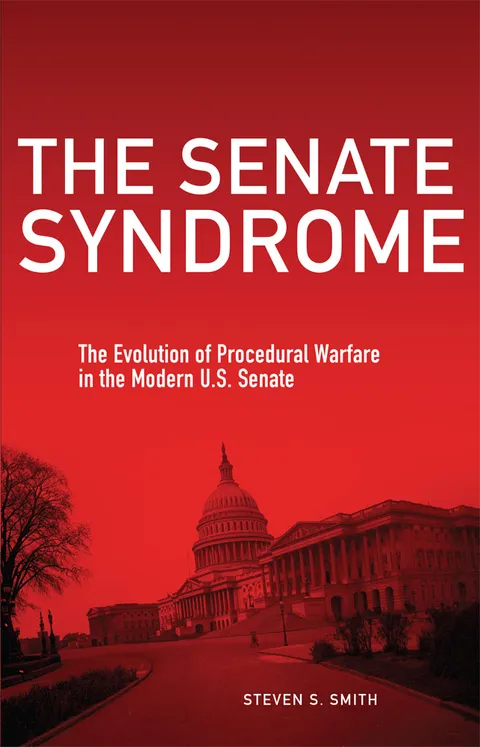
The Senate Syndrome
The Evolution of Procedural Warfare in the Modern U.S. Senate Volume 12
Report an issue
Tell us what's wrong and we'll take a look.
Thanks – we got it. We'll review and follow up if needed.
Like the Senate itself, Smith's account is grounded in history. Countering a cacophony of inexpert opinion and a widespread misunderstanding of political and legislative history, the book fills in a world of missing information--about debates among senators concerning fundamental democratic processes and the workings of institutional rules, procedures, and norms. And Smith does so in a clear and engaging manner. He puts the present problems of the Senate--the "Senate syndrome," as he calls them--into historical context by explaining how particular ideas and procedures were first framed and how they transformed with the times. Along the way he debunks a number of myths about the Senate, many perpetuated by senators themselves, and makes some pointed observations about the media's coverage of Congress.
The Senate Syndrome goes beyond explaining such seeming technicalities as the difference between regular filibusters and post-cloture filibusters, the importance of chair rulings, the changing role of the parliamentarian, and the debate over whether appeals of points of order should be subject to cloture margins, to show why understanding them matters. At stake is resolution of the Senate syndrome, and the critical underlying struggle between majority rule and minority rights in American policy making.
Steven S. Smith
Steven S. Smith is professor in the School of Politics and Global Studies at Arizona State University. He also is the Kate M. Gregg Emeritus Professor of Social Sciences and former Director of the Weidenbaum Center at Washington University. In addition to Wash U, he has been on the faculties of the University of Minnesota, George Washington University, and Northwestern University, and was a senior fellow at the Brookings Institution. He is the author or coauthor of Politics Over Process: Partisan Conflict and Post-Passage Processes in the U.S. Congress (2017), The American Congress (10 editions, 1995-2019), The Senate Syndrome: The Evolution of Parliamentary Warfare in the Modern U.S. Senate (2014), Party Influence in Congress (2007), The Politics of Institutional Choice: The Formation of the Russian State Duma (2001), Politics or Principle: Filibustering in the United States Senate (1997), Call to Order: Floor Politics in the House and Senate (1989), Managing Uncertainty in the House of Representatives: Adaptation and Innovation in Special Rules (1988), Committees in Congress (1984, 1990, 1997).
More by Steven S. Smith


Why Readwise Books?
Readwise Books is an ebook & audiobook platform that automatically logs how much you and your friends read, making it fun and easy to read more. Learn more →