Report an issue
Tell us what's wrong and we'll take a look.
Thanks – we got it. We'll review and follow up if needed.
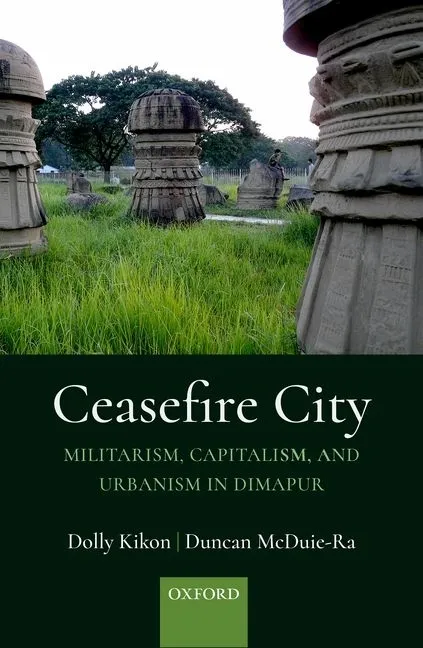
For a city in India's northeast that has been embroiled in the everyday militarization and violence of Asia's longest-running separatist conflict, Dimapur remains 'off the map'. With no 'glorious' past or arenas where events of consequence to mainstream India have taken place, Dimapur's essence is experienced in oral histories of events, visual archives of the everyday life, lived reality of military occupation, and anxieties produced in making urban space out of tribal space.
Ceasefire City captures the dynamics of Dimapur. It brings together the fragmented sensibilities granted and contested in particular spaces and illustrates the embodied experiences of the city. The first part explores military presence, capitalist growth, and urban expansion in Dimapur. The second part presents an ethnographic account of lived realities and the meanings that are forged in a frontier city.
Dolly Kikon
Dolly Kikon is lecturer in anthropology and development studies at the University of Melbourne. She received her PhD in anthropology from Stanford University in 2013. She is the author of Life and Dignity: Women's Testimonies of Sexual Violence in Dimapur (Nagaland) (North Eastern Social Research Centre, 2015) and Experiences of Naga Women in Armed Conflict Situation: Narratives from a Militarized Society (WISCOMP [Women in Security, Conflict Management, and Peace], 2004).
More by Dolly Kikon
Duncan McDuie-Ra
Duncan McDuie-Ra is professor of Urban Sociology at University of Newcastle, Australia. His most recent sole-authored books are Borderland City in New India (2016), Debating Race in Contemporary India (2015), and Northeast Migrants in Delhi: Race, Refuge and Retail (2012).
More by Duncan McDuie-Ra

















Why Readwise Books?
Readwise Books is an ebook & audiobook platform that automatically logs how much you and your friends read, making it fun and easy to read more. Learn more →