Report an issue
Tell us what's wrong and we'll take a look.
Thanks – we got it. We'll review and follow up if needed.
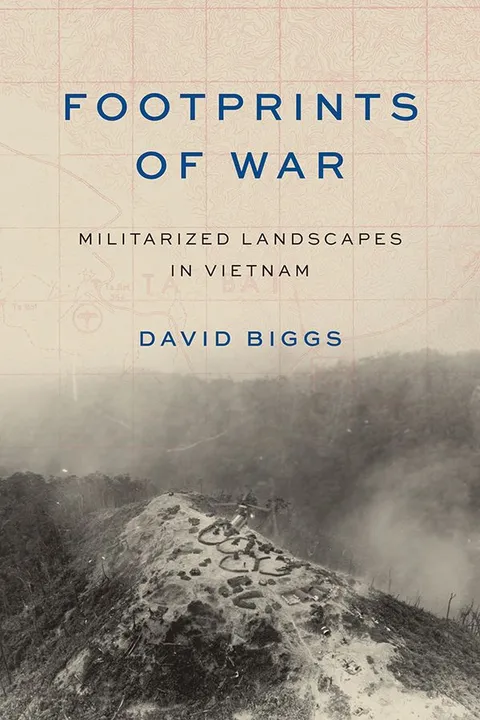
Traces the multilayered political, social, and ecological consequences of military conflict
When American forces arrived in Vietnam, they found themselves embedded in historical village and frontier spaces already shaped by past conflicts. American bases and bombing targets followed spatial and political logics influenced by the footprints of previous wars in central Vietnam, and these militarized landscapes continue to shape postwar land-use politics.
Footprints of War traces the long history of conflict-produced spaces in Vietnam, beginning with early modern wars and the French colonial invasion in 1885 and continuing through the collapse of the Saigon government in 1975. Drawing on extensive archival research and years of interviews and fieldwork in the hills and villages around the city of Huế, David Biggs integrates historical geographic information system (GIS) data and uses aerial, high-altitude, and satellite imagery to render otherwise inscrutable sites as living, multidimensional spaces. This personal and multilayered approach yields an innovative history of the lasting traces of war in Vietnam and a model for understanding other militarized landscapes.
David Andrew Biggs
David Biggs is an associate professor of history at the University of California, Riverside, specializing in Southeast Asia, Vietnam, environmental history, and historical geography. His first book, Quagmire: Nation-Building and Nature in the Mekong Delta (University of Washington Press, 2011), won the George Perkins Marsh Award in 2012 for the best book in environmental history.
More by David Andrew Biggs


Why Readwise Books?
Readwise Books is an ebook & audiobook platform that automatically logs how much you and your friends read, making it fun and easy to read more. Learn more →