Report an issue
Tell us what's wrong and we'll take a look.
Thanks – we got it. We'll review and follow up if needed.
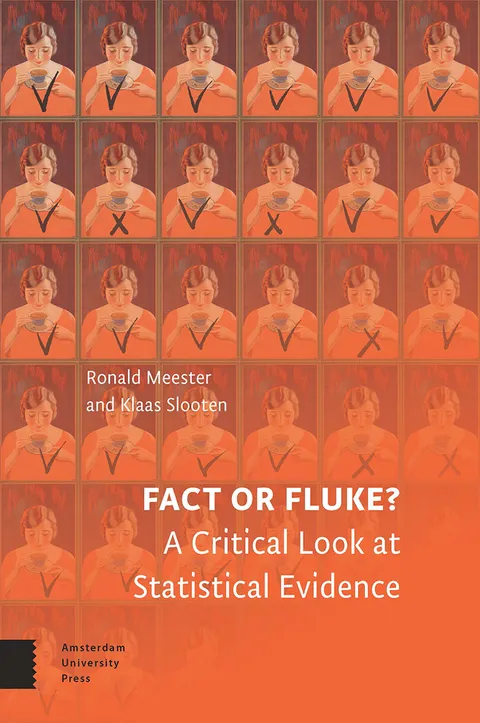
Statistics is more topical than ever. Numerous decisions depend on statistical considerations: just think of the Corona crisis or decisions about approving new drugs or other products. If researchers announce they have proved some fact using statistical tests, can we then always be sure that their claim is correct? How, and more importantly why, does statistics work? What can we expect from statistics and what not? 'Fact or Fluke?' is not a textbook that explains statistical tests to the reader; instead, it discusses what comes before those tests: the philosophy behind the statistics. Should one carry out tests, or are there other ways to look at statistics?
Ronald Meester and Klaas Slooten use a variety of examples - from court cases to theoretical physics - to present different views on statistics and provide arguments for what they think is the best point of view. This book is meant for anyone who is in some way concerned with, or interested in, statistical evidence: scientific researchers, students, teachers, mathematicians, philosophers, lawyers, managers, and no doubt many others.
Ronald Meester
Ronald Meester is Professor in probability theory at Vrije Universiteit Amsterdam. He is co-author of the books Continuum Percolation (1996), Random Networks for Communication (2008), and Wiskunde in je vingers (in Dutch, 2015) and has written around 120 research papers on topics including percolation theory, ergodic theory, philosophy of science, and forensic probability.
More by Ronald Meester
Klaas Slooten
Klaas Slooten works as Statistician at the Netherlands Forensic Institute and at Vrije Universiteit Amsterdam where he is Professor by special appointment. He has published around 30 articles on forensic probability and statistics. He is interested in the mathematical, legal, and philosophical approaches to the evaluation of evidence.
More by Klaas Slooten


Why Readwise Books?
Readwise Books is an ebook & audiobook platform that automatically logs how much you and your friends read, making it fun and easy to read more. Learn more →