Report an issue
Tell us what's wrong and we'll take a look.
Thanks – we got it. We'll review and follow up if needed.
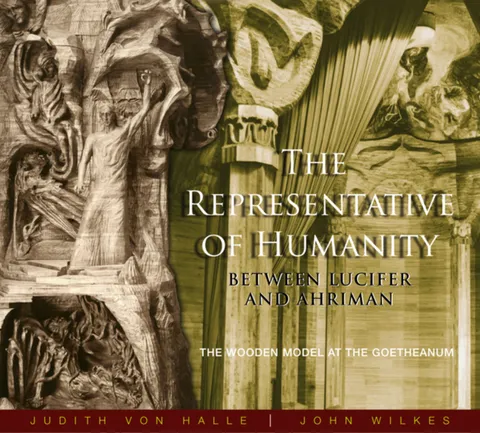
In conceiving his architectural masterpiece--the Goetheanum in Dornach, Switzerland--Rudolf Steiner designed a large wooden model, featuring three main figures, to be placed in a central position in the building. Known as The Representative of Humanity, the sculpture shows Christ in the center, standing and holding a balance between the beings of Lucifer and Ahriman, who represent polar tendencies of expansion and contraction. On New Year's Eve 1922, the Goetheanum was destroyed by fire, but the model--still in the process of being sculpted and housed in an external studio--escaped the flames. It remains intact in the second Goetheanum, where the public may view it.
With numerous full-color photos and illustrations, this book offers a vivid introduction to this monumental, historic artwork. We follow the evolution of the statue through the photographic documentation of many models created during its development, from six smaller versions to a full-size model, which is also still on display. The authors offer impressive insights into the artists' detailed intentions, which were repeatedly revised by Rudolf Steiner. The book demonstrates the continual spiritual movement evident in the whole series of small models, and the metamorphic processes that developed over an eight-year period.
The Representative of Humanity offers indications about the realm and content from which the statue arose, the environment in which it is situated, and the artists who created it--Rudolf Steiner and the sculptor Edith Maryon. They also examine the intentions behind this work of art, which addresses the destiny of humankind.


John Wilkes
John Wilkes, who died in 2011, studied sculpture at the Royal College of Art. While in London he met George Adam and Theodor Schwenk, a pioneer in water research and author of Sensitive Chaos. Wilkes joined the Institute for Flow Sciences in Herrischried, Germany and began his investigations into the flow and rhythm of water which would eventually result in the Flowform. During this period, he also worked at the Goetheanum in Switzerland where he researched and restored Rudolf Steiner's sculptural and architectural models. In 1971 he joined Emerson College in Forest Row, Sussex, and is now Director of the Virbela Rhythm Research Institute.
More by John Wilkes



Why Readwise Books?
Readwise Books is an ebook & audiobook platform that automatically logs how much you and your friends read, making it fun and easy to read more. Learn more →