Report an issue
Tell us what's wrong and we'll take a look.
Thanks – we got it. We'll review and follow up if needed.
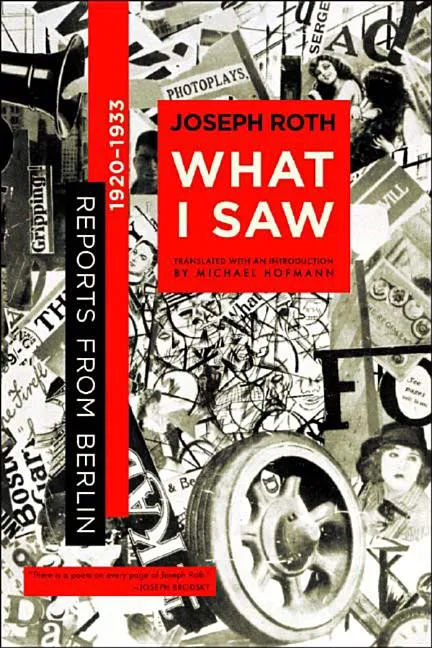
"[Joseph Roth] is now recognized as one of the twentieth century's great writers."—Anthony Heilbut, Los Angeles Times Book Review
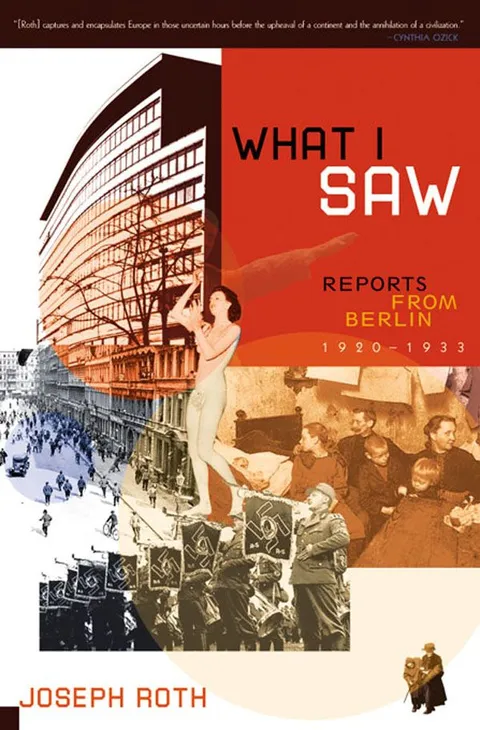
The Joseph Roth revival has finally gone mainstream with the thunderous reception for What I Saw, a book that has become a classic with five hardcover printings. Glowingly reviewed, What I Saw introduces a new generation to the genius of this tortured author with its "nonstop brilliance, irresistible charm and continuing relevance" (Jeffrey Eugenides, New York Times Book Review). As if anticipating Christopher Isherwood, the book re-creates the tragicomic world of 1920s Berlin as seen by its greatest journalistic eyewitness. In 1920, Joseph Roth, the most renowned German correspondent of his age, arrived in Berlin, the capital of the Weimar Republic. He produced a series of impressionistic and political essays that influenced an entire generation of writers, including Thomas Mann and the young Christopher Isherwood. Translated and collected here for the first time, these pieces record the violent social and political paroxysms that constantly threatened to undo the fragile democracy that was the Weimar Republic. Roth, like no other German writer of his time, ventured beyond Berlin's official veneer to the heart of the city, chronicling the lives of its forgotten inhabitants: the war cripples, the Jewish immigrants from the Pale, the criminals, the bathhouse denizens, and the nameless dead who filled the morgues. Warning early on of the dangers posed by the Nazis, Roth evoked a landscape of moral bankruptcy and debauched beauty—a memorable portrait of a city and a time of commingled hope and chaos. What I Saw, like no other existing work, records the violent social and political paroxysms that compromised and ultimately destroyed the precarious democracy that was the Weimar Republic.Joseph Roth
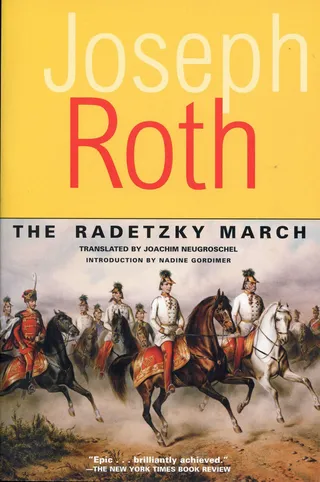
Joseph Roth was a Austro-Hungarian journalist and novelist, best known for his family saga The Radetzky March (1932), about the decline and fall of the Austro-Hungarian Empire. Roth grew up with his mother and her relatives; he never saw his father, who had disappeared before he was born. After secondary school, Roth moved to Lemberg to begin his university studies in 1913, before transferring to the University of Vienna in 1914 to study philosophy and German literature.
More by Joseph Roth





Michael Hofmann
Translated by
The award-winning translator Michael Hofmann has also translated works by Jenny Erpenbeck, Gert Hofmann, Franz Kafka, Heinrich von Kleist, and Joseph Roth for New Directions. His translation of Kairos by Jenny Erpenbeck was awarded the International Booker Prize in 2024.


Why Readwise Books?
Readwise Books is an ebook & audiobook platform that automatically logs how much you and your friends read, making it fun and easy to read more. Learn more →