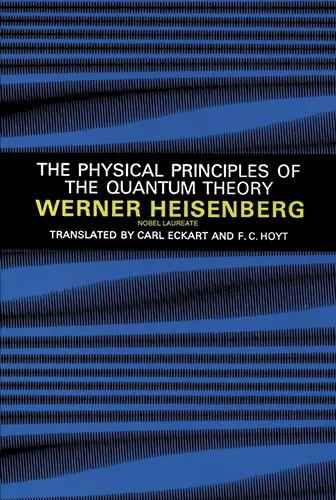
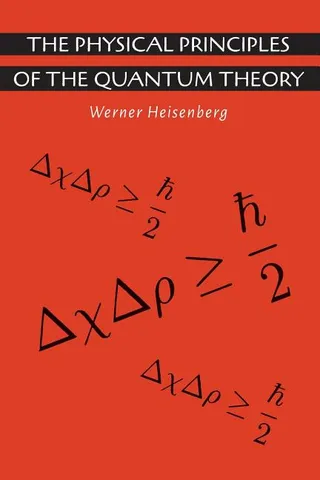
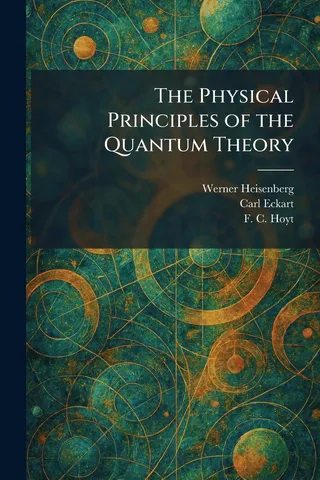
The Physical Principles of the Quantum Theory
Report an issue
Tell us what's wrong and we'll take a look.
Thanks – we got it. We'll review and follow up if needed.
The contributions of few contemporary scientists have been as far reaching in their effects as those of Nobel Laureate Werner Heisenberg. His matrix theory is one of the bases of modern quantum mechanics, while his "uncertainty principle" has altered our whole philosophy of science.
In this classic, based on lectures delivered at the University of Chicago, Heisenberg presents a complete physical picture of quantum theory. He covers not only his own contributions, but also those of Bohr, Dirac, Bose, de Broglie, Fermi, Einstein, Pauli, Schrodinger, Somerfield, Rupp, ·Wilson, Germer, and others in a text written for the physical scientist who is not a specialist in quantum theory or in modern mathematics.
Partial contents: introduction (theory and experiment, fundamental concepts); critique of physical concepts of the corpuscular theory (uncertainty relations and their illustration); critique of the physical concepts of the wave theory (uncertainty relations for waves, discussion of an actual measurement of the electromagnetic field); statistical interpretation of quantum theory (mathematical considerations, interference of probabilities, Bohr's complementarity); discussion of important experiments (C. T. R. Wilson, diffraction , Einstein-Rupp, emission, absorption and dispersion of radiation, interference and conservation laws, Compton effect, radiation fluctuation phenomena, relativistic formulation of the quantum theory).
An 80-page appendix on the mathematical apparatus of the quantum theory is provided for the specialist.
Werner Heisenberg
A controversial WWII figure, Werner Heisenberg was a German physicist. Born in 1901 to an academic family, Heisenberg was interested in scientific and philosophical pursuits from a young age. After graduating from the University of Munich, where he studied under physicist Arthur Sommerfield, Heisenberg went on to establish a career in the study of atomic and particle theory. He won the Nobel Prize in 1932 for his Uncertainty Principle. Heisenberg was one of the top German scientists during World War II, and he worked as the director of the German Uranium Project developing an atomic bomb for Germany. He did not succeed in this effort, however, before the end of the war. He was incarcerated from 1945–46 for his role in the Nazi regime, but in the ’50s and ’60s, Heisenberg continued to contribute his research to the field of nuclear physics. He retired in 1970 and resided in Munich until his death in 1973.
More by Werner Heisenberg


Why Readwise Books?
Readwise Books is an ebook & audiobook platform that automatically logs how much you and your friends read, making it fun and easy to read more. Learn more →