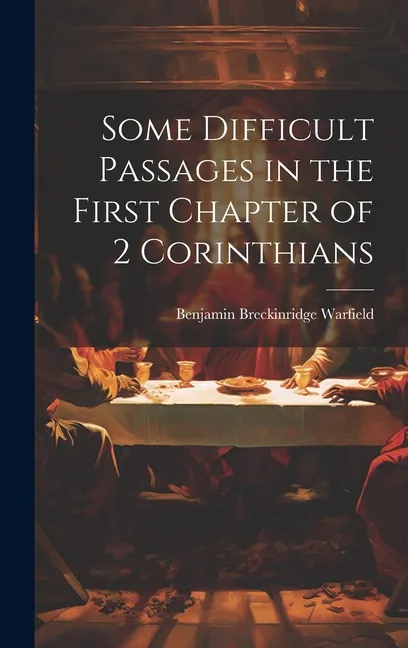
Some Difficult Passages in the First Chapter of 2 Corinthians
Report an issue
Tell us what's wrong and we'll take a look.
Thanks – we got it. We'll review and follow up if needed.
Warfield's scholarly analysis of this challenging section of Paul's writings provides readers with a deep understanding of the theological issues at stake. Drawing on his expertise in Greek and biblical studies, he offers fresh insights into this important but often misunderstood text.
This work has been selected by scholars as being culturally important, and is part of the knowledge base of civilization as we know it.
This work is in the "public domain in the United States of America, and possibly other nations. Within the United States, you may freely copy and distribute this work, as no entity (individual or corporate) has a copyright on the body of the work.
Scholars believe, and we concur, that this work is important enough to be preserved, reproduced, and made generally available to the public. We appreciate your support of the preservation process, and thank you for being an important part of keeping this knowledge alive and relevant.
Benjamin Breckinridge Warfield
Benjamin B. Warfield (1851-1921) received the degree of Doctor of Divinity in 1880 and that of Doctor of Laws in 1892 from the College of New Jersey; that of Doctor of Laws from Davidson College in 1892; that of Doctor of Letters from Lafayette College in 1911; and that of Sacrae Theologiae Doctor from the University of Utrecht in 1913.
Warfield was a voluminous writer. During his lifetime he published the following volumes: Introduction to the Textual Criticism of the New Testament (1886); The Gospel of the Incarnation (1893); Two Studies in the History of Doctrine (1893); The Right of Systematic Theology (1897); The Significance of the Westminster Standards (1898); Acts and the Pastoral Epistles (1902); The Power of God Unto Salvation (1903); The Lord of Glory (1907); Calvin as a Theologian and Calvinism Today (1909); Hymns and Religious Verse (1910); The Saviour of the World (1915); The Plan of Salvation (1915); Faith and Life (1916); and Counterfeit Miracles (1918). The bulk of his writings, however, made their first appearance in Bible dictionaries, encyclopedias and theological magazines, especially the Presbyterian and Reformed Review and its successor the Princeton Theological Review. Following his death, sufficient of this material to make ten large volumes was selected by his literary executors, Ethelbert D. Warfield, William Park Armstrong and Caspar Wistar Hodge, and published by the Oxford University Press.
More by Benjamin Breckinridge Warfield



Why Readwise Books?
Readwise Books is an ebook & audiobook platform that automatically logs how much you and your friends read, making it fun and easy to read more. Learn more →