Report an issue
Tell us what's wrong and we'll take a look.
Thanks – we got it. We'll review and follow up if needed.
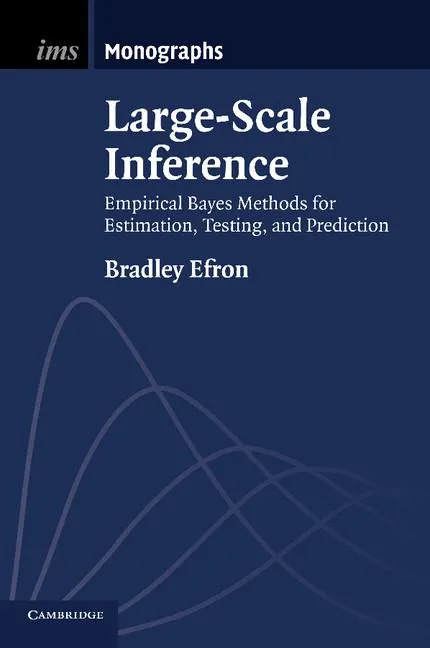
We live in a new age for statistical inference, where modern scientific technology such as microarrays and fMRI machines routinely produce thousands and sometimes millions of parallel data sets, each with its own estimation or testing problem. Doing thousands of problems at once is more than repeated application of classical methods. Taking an empirical Bayes approach, Bradley Efron, inventor of the bootstrap, shows how information accrues across problems in a way that combines Bayesian and frequentist ideas. Estimation, testing, and prediction blend in this framework, producing opportunities for new methodologies of increased power. New difficulties also arise, easily leading to flawed inferences. This book takes a careful look at both the promise and pitfalls of large-scale statistical inference, with particular attention to false discovery rates, the most successful of the new statistical techniques. Emphasis is on the inferential ideas underlying technical developments, illustrated using a large number of real examples.
Bradley Efron
Bradley Efron is Max H. Stein Professor, Professor of Statistics, and Professor of Biomedical Data Science at Stanford University, California. He has held visiting faculty appointments at Harvard University, Massachusetts, the University of California, Berkeley, and Imperial College of Science, Technology and Medicine, London. Efron has worked extensively on theories of statistical inference, and is the inventor of the bootstrap sampling technique. He received the National Medal of Science in 2005 and the Guy Medal in Gold of the Royal Statistical Society in 2014.
More by Bradley Efron


Why Readwise Books?
Readwise Books is an ebook & audiobook platform that automatically logs how much you and your friends read, making it fun and easy to read more. Learn more →