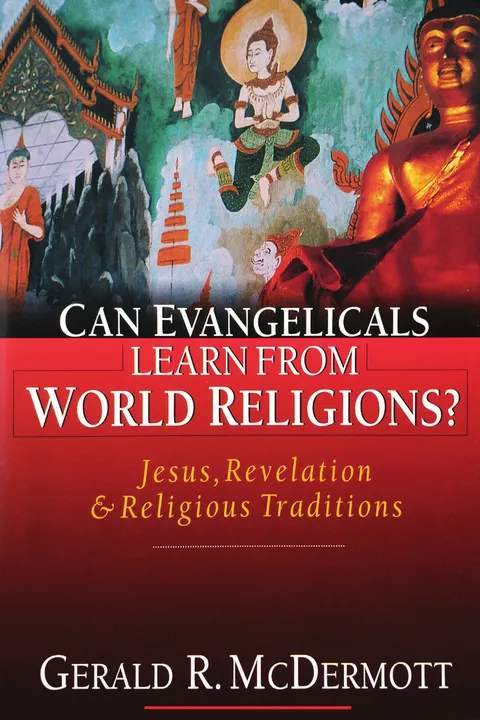
Can Evangelicals Learn from World Religions?
Jesus, Revelation Religious Traditions
Report an issue
Tell us what's wrong and we'll take a look.
Thanks – we got it. We'll review and follow up if needed.
Christianity Today Award of Merit
"Arguably, the church's greatest challenge in the next century will be the problem of the scandal of particularity. More than ever before, Christians will need to explain why they follow Jesus and not the Buddha or Confucius or Krishna or Muhammed. But if, while relating their faith to the faiths, Christians treat non-Christian religions as netherworlds of unmixed darkness, the church's message will be a scandal not of particularity but of arrogant obscurantism.
"Recent evangelical introductions to the problem of other religions have built commendably on foundations laid by J. N. D. Anderson and Stephen Neill. Anderson and Neill opened up the "heathen" worlds to the evangelical West, showing that many non-Christians also seek salvation and have personal relationships with their gods. In the last decade Clark Pinnock and John Sanders have argued for an inclusivist understanding of salvation, and Harold Netland has shed new light on the question of truth in the religions. Yet no evangelicals have focused--as nonevangelicals Keith Ward, Diana Eck and Paul Knitter have done--on the revelatory value of truth in non-Christian religions.Anderson and Neill showed that there are limited convergences between Christian and non-Christian traditions, and Pinnock has argued that there might be truths Christians can learn from religious others. But as far as I know, no evangelicals have yet examined the religions in any sort of substantive way for what Christians can learn without sacrificing, as Knitter and John Hick do, the finality of Christ.
"This book is the beginning of an evangelical theology of the religions that addresses not the question of salvation but the problem of truth and revelation, and takes seriously the normative claims of other traditions. It explores the biblical propositions that Jesus is the light that enlightens every person (Jn 1:9) and that God has not left Himself without a witness among non-Christian traditions (Acts 14:17). It argues that if Saint Augustine learned from Neo-Platonism to better understand the gospel, if Thomas Aquinas learned from Aristotle to better understand the Scriptures, and if John Calvin learned from Renaissance humanism, perhaps evangelicals may be able to learn from the Buddha--and other great religious thinkers and traditions--things that can help them more clearly understand God's revelation in Christ. It is an introductory word in a conversation that I hope will go much further among evangelicals." --Gerald McDermott, from the introduction to Can Evangelicals Learn from World Religions?
Gerald R McDermott
Gerald R. McDermott (PhD, University of Iowa) is the Anglican professor of divinity at Beeson Divinity School. McDermott has been the author, co-author, or editor of more than twenty books. An Anglican priest, he is teaching pastor at Christ the King Anglican Church, and is married to Jean. Together they have three sons and twelve grandchildren.
More by Gerald R McDermott




Why Readwise Books?
Readwise Books is an ebook & audiobook platform that automatically logs how much you and your friends read, making it fun and easy to read more. Learn more →