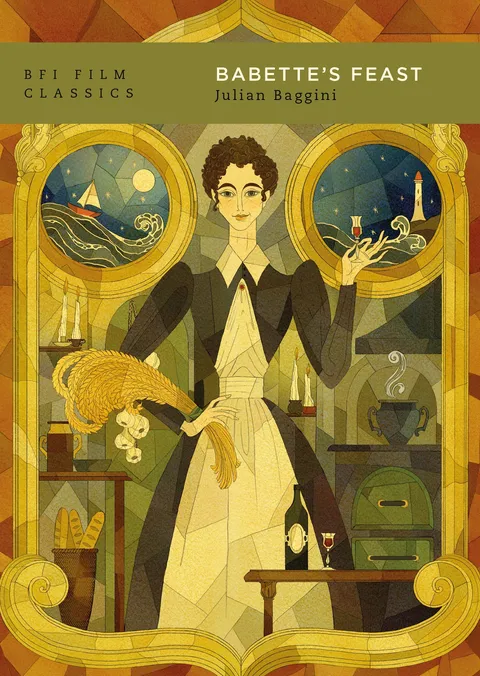
Babette's Feast
Report an issue
Tell us what's wrong and we'll take a look.
Thanks – we got it. We'll review and follow up if needed.
On the face of it, Gabriel Axel's Babette's Feast (1989) is a film in which the eyes – and mouths – of religious zealots are opened to the glories of the sensual world. It is a critique of what Nietzsche called life-denying religion in favour of life-affirming sensuality. But to view the film in that way is to get it profoundly wrong. In his study of the film, Julian Baggini argues that Babette's Feast is not about the battle between religiosity and secularity but a deep examination of how the two can come together. Baggini's analysis focuses on themes of love, pleasure, artisty and grace, to provide a rich philosophical reading of this most sensual of films.
Julian Baggini
Dr Julian Baggini is a philosopher, writer and journalist who has written over 20 books on a wide variety of topics, which have sold over half a million copies in the UK alone. He has served as Academic Director of the Royal Institute of Philosophy and was also the co-founder and editor of The Philosophers' Magazine. Julian's books have seen great international success; his titles have sold in 24 territories (excluding the UK and North America) and have been translated into 23 languages. His bestselling titles include How The World Thinks and The Pig That Wants To Be Eaten, the latter of which was recently released with a new edition by Granta. His most recent work, How The World Eats, was published in 2024.
More by Julian Baggini


Why Readwise Books?
Readwise Books is an ebook & audiobook platform that automatically logs how much you and your friends read, making it fun and easy to read more. Learn more →