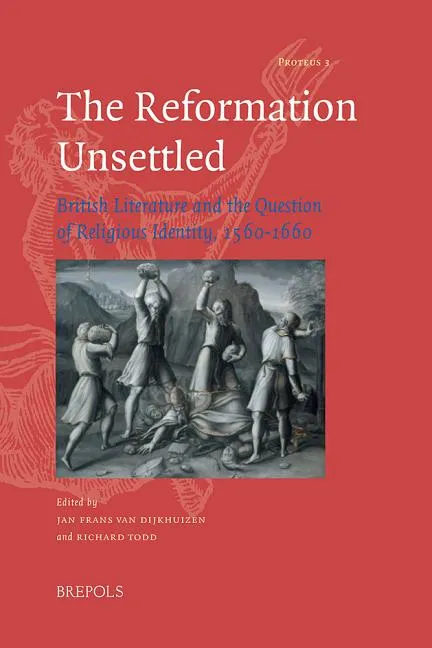
The Reformation Unsettled
British Literature and the Question of Religious Identity, 1560-1660
Report an issue
Tell us what's wrong and we'll take a look.
Thanks – we got it. We'll review and follow up if needed.
Recent historical studies have emphasized that the English Reformation can no longer be seen as an inevitable response to abuses within the late-medieval Western ('Catholic') Church. Contrary to Protestant stereotypes, the late-medieval Church catered to the spiritual needs of its members. In addition, the English Reformation was an incomplete process and, even after the Elizabethan Settlement of 1559, English religious culture was full of continuities with the past, with pre-Reformation religious culture only partially displaced. This essay collection investigates how the literature of the first century after the Elizabethan Settlement dealt with this cultural ambivalence. Focusing on a mixture of canonical texts and less well-known ones, the contributors show that the religious hybridity of early-modern England is found in a concentrated form in the literary texts of the period. In contrast to theologians, literary writers were not obliged to choose sides. Literary discourse could confront incompatible doctrinal perspectives within a single text, or forge a hybrid spiritual sensibility out of the competing religious traditions. Literature, sometimes in spite of writers' avowed denominational allegiances, embraced, explored and deepened the ambivalence of early modern English religious culture in a manner unavailable in other kinds of texts.
Richard Todd
Richard Todd was educated at Amherst and Stanford. He has spent many years as a magazine and book editor, and has written articles on a wide range of cultural themes for Harper's, the Atlantic Monthly, the New York Times Magazine, Conde Nast Traveler, and the Columbia Journalism Review, among others. He is the author of a previous book, The Thing Itself, and he teaches in the MFA program at Goucher College.


Why Readwise Books?
Readwise Books is an ebook & audiobook platform that automatically logs how much you and your friends read, making it fun and easy to read more. Learn more →