The Fruit Jar Unearths a Lost Chapter of Galveston’s Queer History
Length: • 4 mins
Annotated by Brittanie
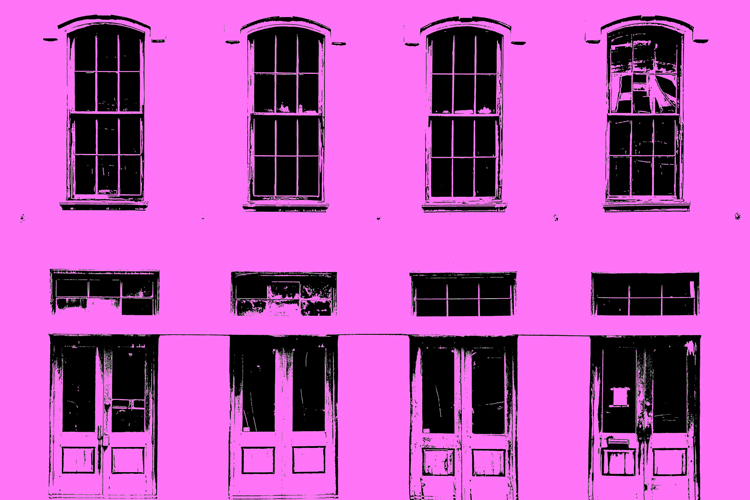
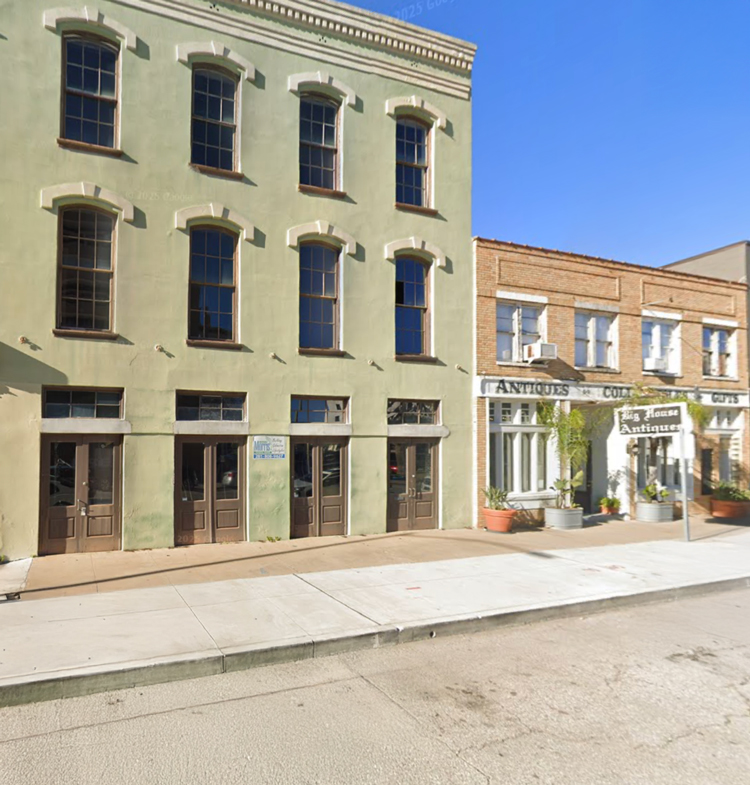
“It is important to memorialize the small spaces ... that aren’t inscribed in all of the local history, but are absolutely inscribed in somebody’s history.” — Jake Margolin
One of Galveston’s least-known gay bars, the Fruit Jar, once operated in the historic 1873 John Sealy Building located at 2214 Mechanic Street. Popular in the mid-1970s, the club has all but vanished from local LGBTQ history.
Houston-based queer collaborative interdisciplinary artists Nick Vaughan and Jake Margolin became interested in the Fruit Jar after discovering it in the 1978 Damron Guide, a pocket-sized directory that helped LGBTQ travelers navigate the United States safely. The men are husbands and fathers and their work involves extensive original archival research and deep collaborations with local LGBTQIA+ communities.
The two are known for their intricate installations that illuminate lesser-known but compelling chapters of LGBTQ history. Since 2025, they have worked on an ambitious project inspired by Town Meeting I, the landmark 1978 gathering of 4,000 queer community members at the AstroArena.
“We are making a map of what the gay landscape was like when Town Meeting I happened. And the Fruit Jar was something that just jumped out to us when we stood in front of its former facade. It spoke to us,” Margolin says.
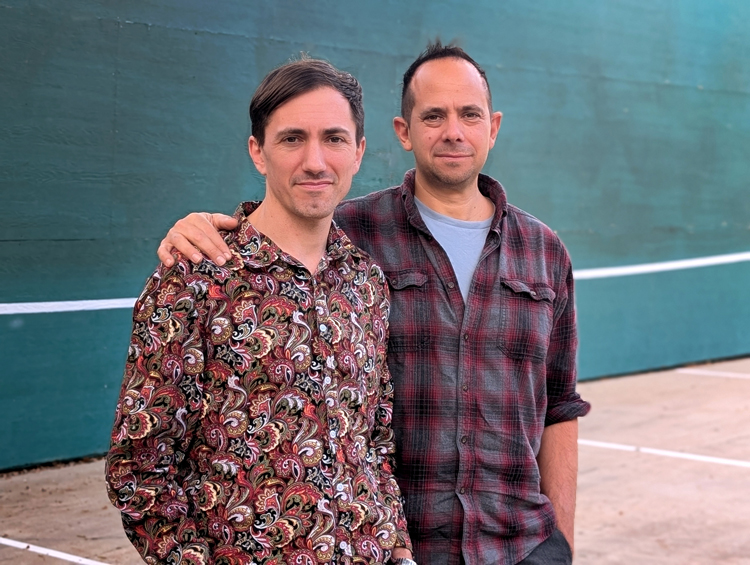
“These were spaces where our community could meet. We love to memorialize them as being as important as other places that are already memorialized,” Margolin explains. “It is important to memorialize the small spaces, the spaces that didn’t last for decades, that aren’t inscribed in all of the local history, but are absolutely inscribed in somebody’s history.”
As a result, the men’s newest immersive installation, The Fruit Jar, will be on view at the Galveston Arts Center from October 10, 2026, through January 3, 2027.
The exhibition is the third installment in their ongoing series of installations and symposiums inspired by Town Meeting I. Additional events are planned for 2027, culminating in a 2028 celebration of the gathering’s 50th anniversary.
“Right now, we know very little about the Fruit Jar. But I’ve got a feeling that by the end of December, Nick and I are going to know a lot more about it,” Vaughan predicts. “And we may in the process find something that opens up a whole other avenue of inquiry for us, a whole new way of understanding some facet of the rich diversity of queer experiences. It’s that mystery and not knowing that drew us to making this piece.”
Traces of the Fruit Jar are hard to come by. Its name first appears in the business listing at the back of This Week in Texas (TWT) in January 1976. By June 1979, the same magazine shows a club with a different name at that address. It appears that the Fruit Jar did not advertise in either of the era’s local gay publications, Nuntius or TWT.
“The Fruit Jar was presumably an incredibly vibrant place with a lot of very important experiences for people, and now it is largely forgotten,” Margolin emphasizes. “There’s very little written about it. So, in some ways, choosing the Fruit Jar is a permission for people’s stories to be not the big story, but to be whatever story it is that pops up for them. I bet it was a different thing for every person who went in there. Those small lenses in some ways actually open up to much more broad understandings of the community and the climate and what was going on. These spaces provided community, provided a place for our people to be our people.”
Margolin describes the new installation: “When you walk into the gallery, the first thing you’ll see is the facade of the building that in 1978 was the Fruit Jar. We constructed it with stencils and it is rather delicate with bridging and scaffolding behind it to hold all of the floating pieces in place. As you walk around it, it’ll feel a bit like you’re entering the building.”
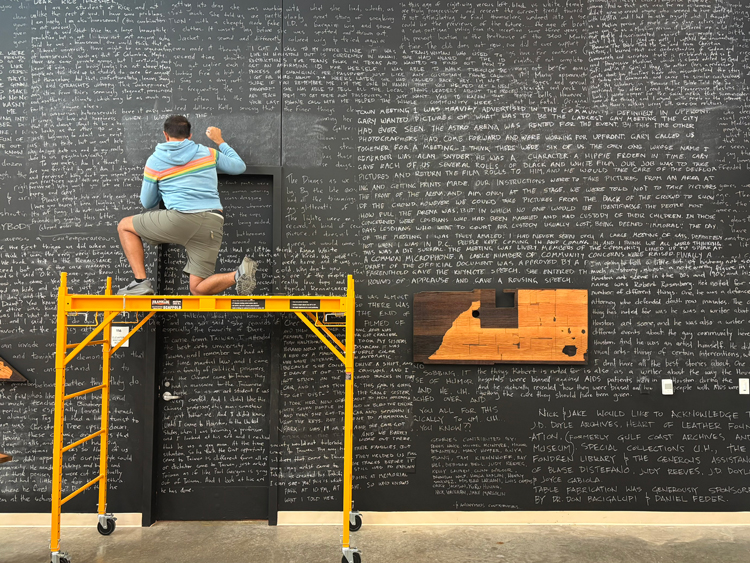
Visitors will next encounter a monumental 12-by-56-foot chalkboard where the artists collect oral histories from community members. “The stories layer over one another as they accumulate,” Margolin explains. “We erase the stories that are up there and add new ones. But as chalk does, it doesn’t ever disappear. It turns into a cloud of stories.”
“So, you have this accumulating cloud of stories that start to feel like they’re as complex and as diverse and as murky as our community actually is, and like what a real community history is,” Vaughan continues.
The exhibition will also include a video installation featuring views of the undersides of the original bar tops from Mary’s, complete with wads of gum left by patrons. Even the simplest of objects can become deeply human traces of history.
A pay phone will complete the installation, paying homage to the storied phone at Mary’s, most certainly where calls important to Houston’s LGBTQ history were made. “That phone will be functional so that people can actually call into a toll-free number and leave stories to be added to the wall,” Vaughan points out.
The exhibition will also anchor Town Meeting 2026: Galveston Arts Center, a symposium on October 24. Artists, organizers, and scholars will examine the history and possibilities of queer artistic participation, connecting queer artists with broader LGBTQ political and social initiatives, and envisioning the future of organizing. The symposium is free, but registration is required. Register: rendezvouscenterforart.org
WHAT: The Fruit Jar
WHEN: October 10, 2026–January 3, 2027
WHERE: Galveston Arts Center, 2127 The Strand
INFO: galvestonartscenter.org/nickandjake