Steal Ka'Chava's referral email.
Length: • 5 mins
Annotated by karik
Plus the fix they missed, a 52% open rate that sells next to nothing, and 3 alt text rewrites.
I'm breaking down the exact workflow I use to go from blank screen to finished email in under 10 minutes at GURU Conference 2026.
Hey, it's Chase.
Read time: 4 min 25 sec, plus a paste-ready referral email.
This week: the referral email worth stealing, the line in it worth fixing, the industry that opens at 52% and converts at 0.04%, where to put your referral link, the survey question that beats your attribution software, and 3 alt text rewrites.
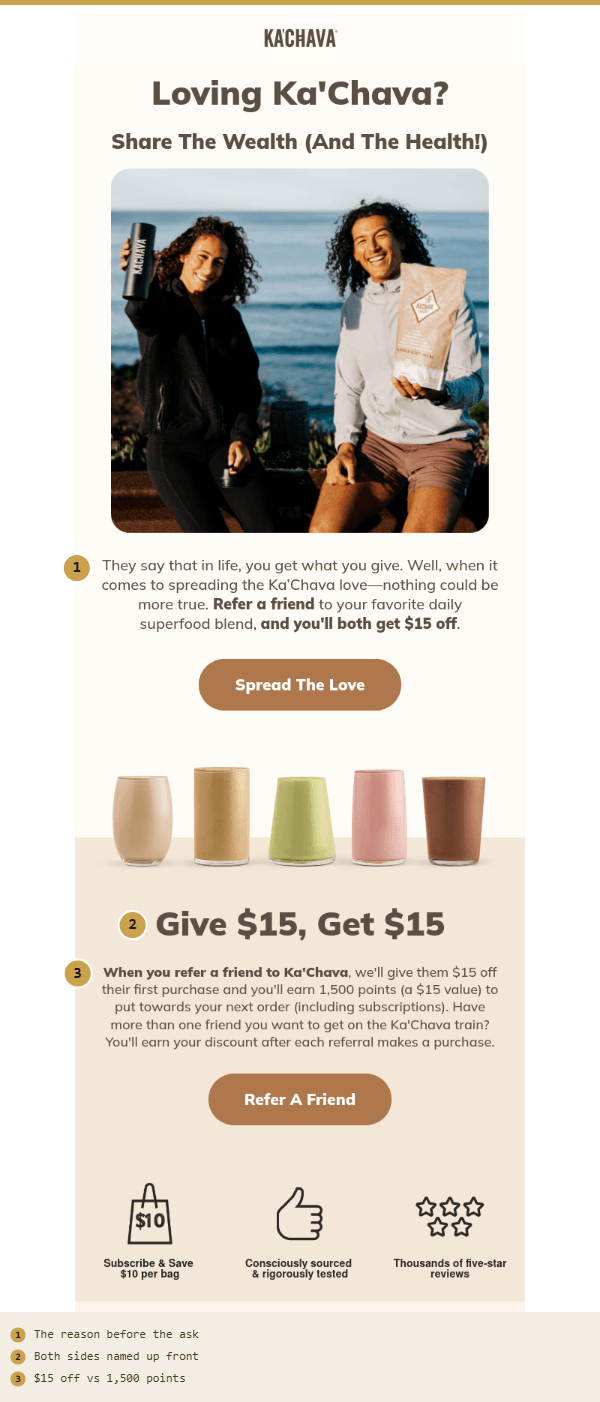
Ka'Chava asks you to bring a friend, then pays the two of you in different currencies.
The subject is "Give $15, get $15 when you refer a friend."
The preview text reads "It's a win-win."
Inside: "Loving Ka'Chava?", two people on a beach holding the product, and the promise: "Refer a friend to your favorite daily superfood blend, and you'll both get $15 off."
Then you scroll, and the terms show up: "we'll give them $15 off their first purchase and you'll earn 1,500 points (a $15 value) to put towards your next order."
Read those next to each other. Your friend gets $15 off, and you get points toward something you haven't bought yet.
Three things this email does well:
1. The two-sided headline. "Give $15, get $15" names both people in four words. Most referral emails brag about what you get and leave your friend guessing.
2. The reason before the ask. "They say that in life, you get what you give" comes first, the offer second. That order matters more here than anywhere else, because you're asking a customer to spend their own credibility.
3. The objection strip. Badges under the button: "Consciously sourced & rigorously tested," "Thousands of five-star reviews." A referral puts your customer's name on your product in front of a friend. Those badges tell your customer it's safe to put their name on you.
Steal this for your own referral email: copy the structure, then fix what they missed. The headline promises a mirror. The terms deliver a trade: your friend gets money off, you get store credit you have to spend more money to use, and you only get it once your friend buys.
None of that's hidden. It's all in there if you read to the bottom. But a customer who catches the gap once reads your next offer slower.
One fix. Pay both sides in the same currency. Here it is, ready to paste:
THE REFERRAL EMAIL
"Subject: Give [$X], get [$X]
You already like this enough to be on this list. Here's the version where telling a friend pays you both.
Send a friend [your link]. They get [$X off their first order]. You get [$X off yours], the moment their order ships.
That's the whole offer. Nothing to convert, nothing to redeem later.
[ Send my link ]"
No products to refer? Same email for a service waitlist, a course, or a newsletter. Make the reward something that costs you nothing to give twice.
Ask a customer to vouch for you, then pay them in something they can spend.
Most brands don't switch ESPs because they don't want to switch ESPs.
They just don't want to spend 6 weeks rebuilding every flow, every segment, every form.
I've watched migrations get put off for 18 months for that exact reason.
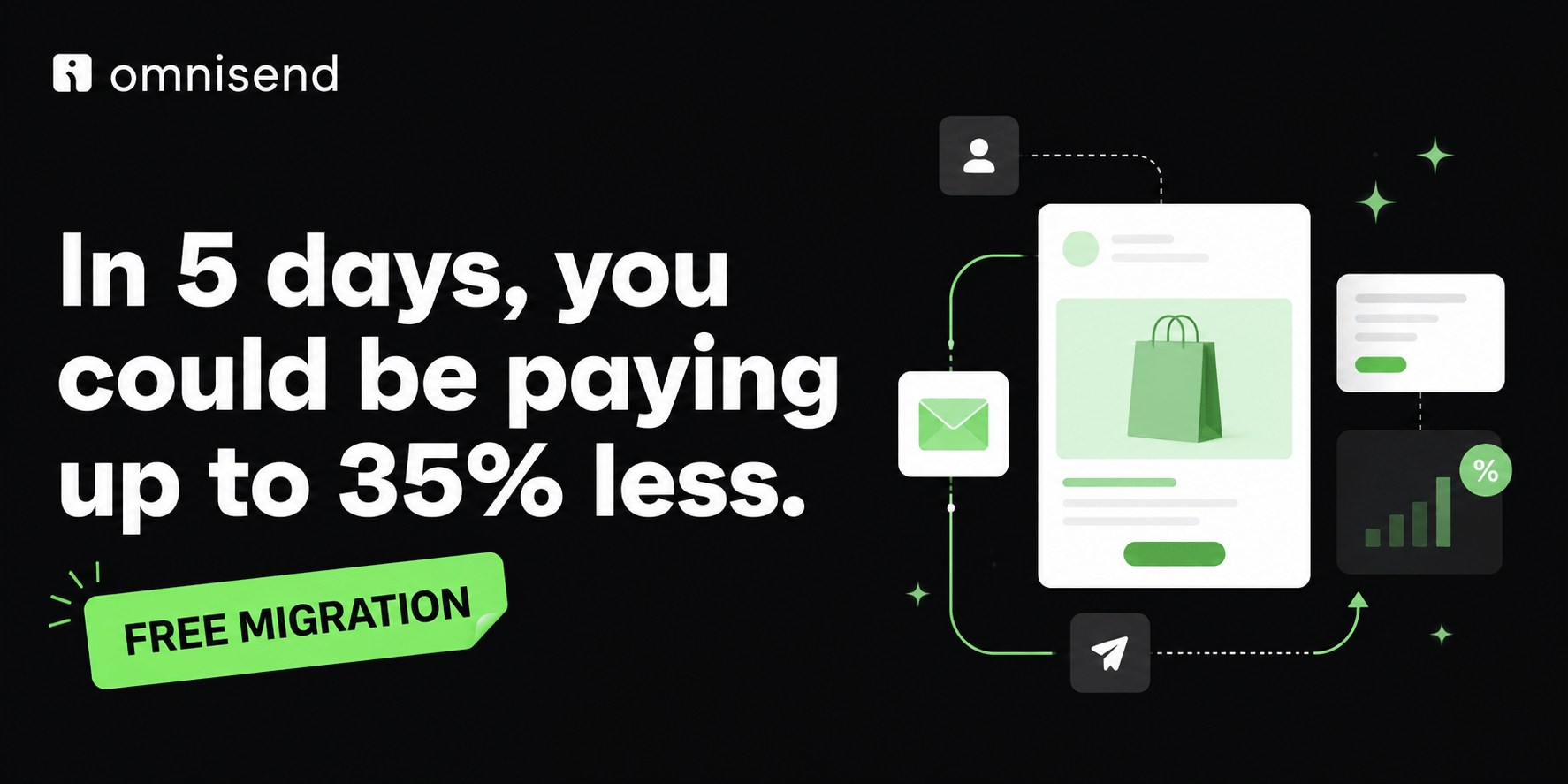
Omnisend just took that off the table:
→ Their team rebuilds your automations, segments, forms, and templates by hand
→ 5 business days, start to finish
→ Free for anyone with 500+ contacts
→ Hands off from your side just verify one email, approve access, done
If you've been eyeing a different ESP but couldn't stomach the switch, the switch is the part they took care of.
sponsored
THE RECEIPTS
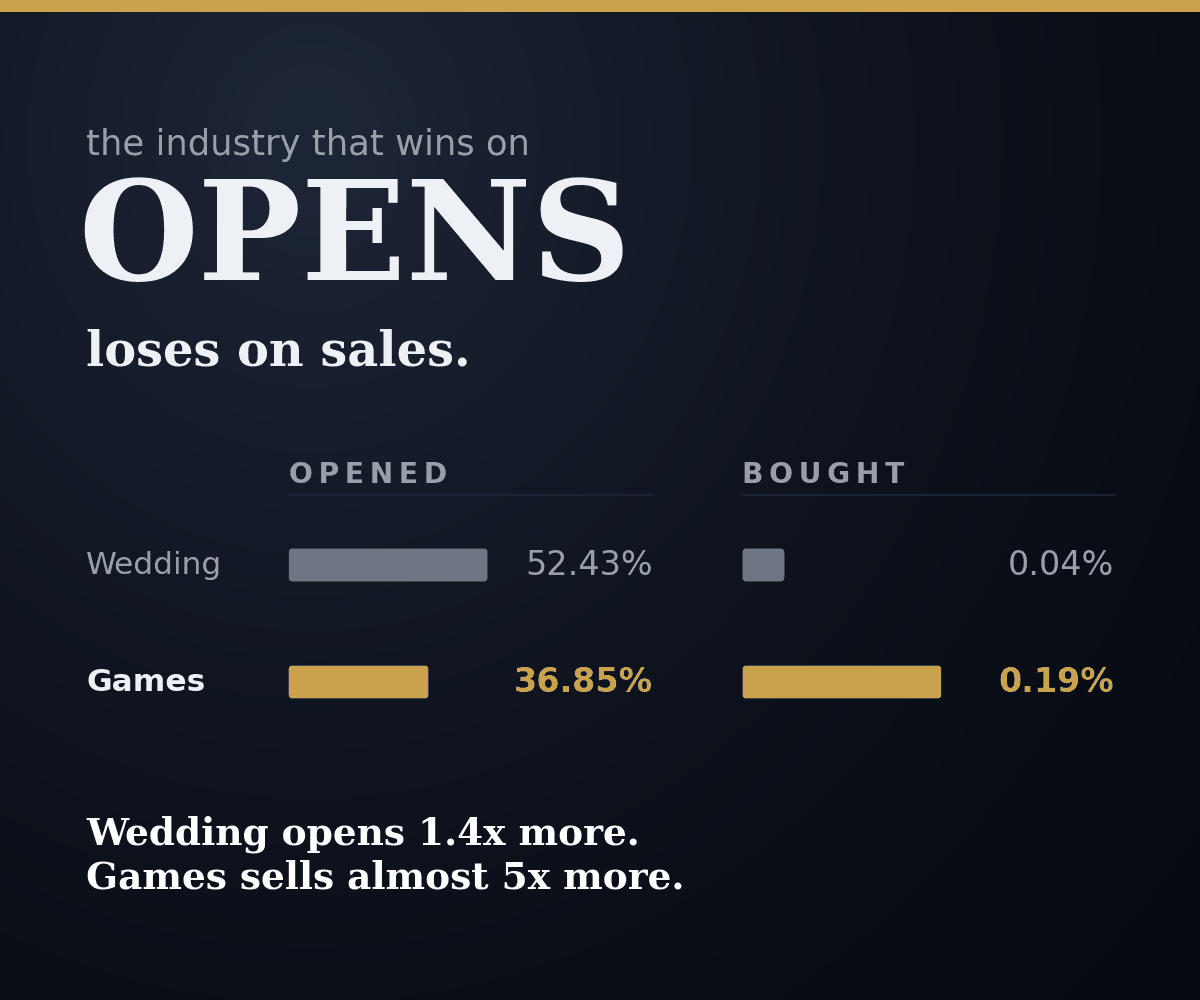
The industry with the best open rate in ecommerce converts the worst.
Wedding brands open at 52.43%, the highest of any industry in Omnisend's 2026 dataset. They convert at 0.04%. Games brands open at 36.85%, about 16 points lower, and convert at 0.19%, close to five times higher.
An open means your subject line worked and your email arrived. It doesn't mean anybody wanted what was inside.
If you report one number to a client this month, report the one that ends in a sale.
THE INBOX MECHANIC
Put your referral link in your shipping confirmation.
Shipping confirmations open at 62.67% in that same dataset, the highest of any email type, with a 16.01% click rate. Your customer is already opening it, and they're in a good mood because the thing they bought is on its way.
Most brands blast the referral ask to the whole list, so it reaches people who never bought anything. Move it to the one email that only goes out after somebody paid you.
One line under the tracking button. No redesign.
THE MONEY MOVE
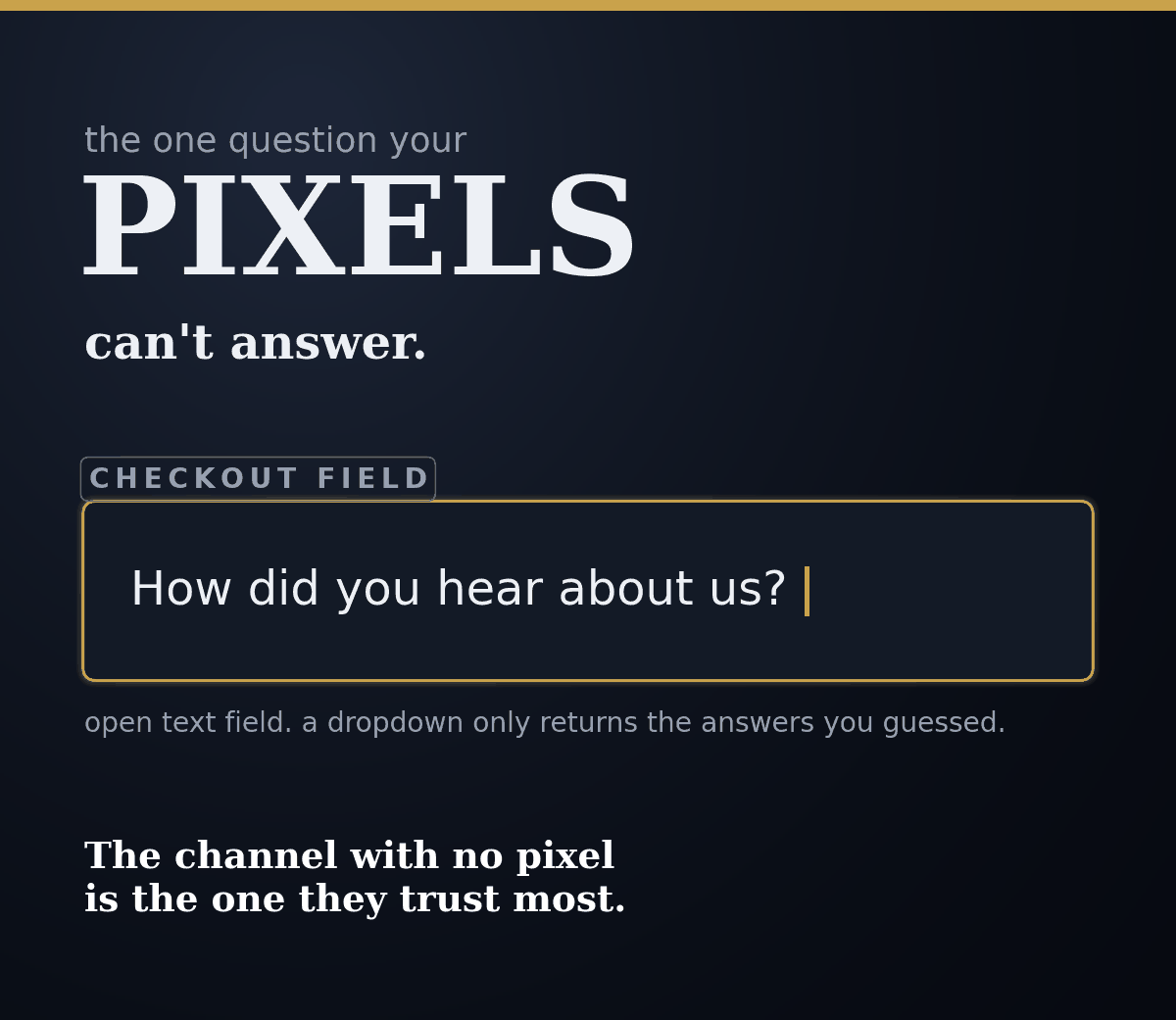
Add one question to your checkout: "How did you hear about us?"
Make it an open text field. Dropdowns hand you back the answers you already guessed.
Your attribution can see the click that closed the sale. It can't see the friend who mentioned you at dinner, or the group chat, or the coworker who won't shut up about you. Those are the channels referral programs live in, and no pixel is going to find them.
Read fifty answers by hand and you'll learn what people call you when they're describing you to someone else. That phrase belongs in your copy.
Today's hero has the same blind spot from the other side. Ka'Chava can count referral links. It can't count the conversations.
THE QUESTION I KEEP GETTING
"Should I pay people to refer their friends?"
Yes, and less than you think. Nobody recommends a product for fifteen dollars. They recommend it because they like it, and the fifteen dollars is you saying it's fine to mention it out loud.
The money buys timing. It moves a recommendation from eventually to today.
So pay on the friend's first order, not on clicks or signups. And keep it to one tier, because a program with levels is a program somebody has to read.
Today's hero gets the ask right and fumbles the payout. Warm invitation, homework reward.
THE REWRITE
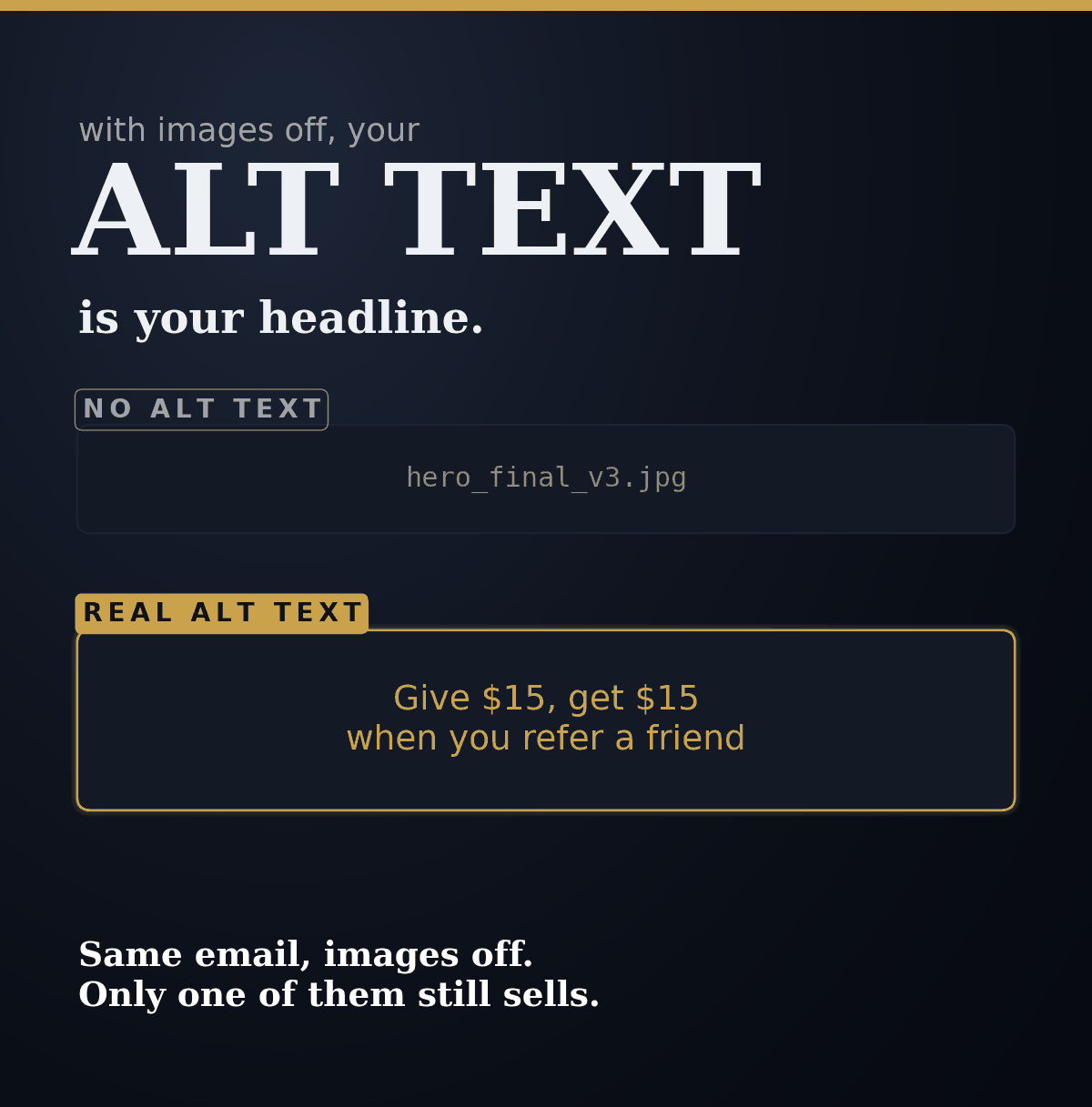
Alt text is what people read when your images don't load.
Every email you send has a second version, the one with images off, and in it your alt text is your headline. Most brands leave it sitting at the filename level.
Here's the difference, written for today's hero:
Before: hero_final_v3.jpg
After: Give $15, get $15 when you refer a friend
Before: button.png
After: Send my referral link
Before: (empty alt on the offer graphic, so the offer disappears)
After: Your friend gets $15 off. You get $15 off.
Open your last campaign, turn images off, and read what's left. If the offer isn't in there, it isn't in the email.
If one person in your contacts would use the alt text fix, send them this email. Forwarding it takes about nine seconds.
Was this one useful? Hit reply with one word: Great, Good, or Meh. Replies help these keep landing in your inbox.
Have a great week and make sure to send some emails.
Chase
P.S. For just $1 for your first 7 days, you can get access to the AI we spent the last few months training on all my email marketing content. Take a look: chasedimond.ai
No longer want to receive these emails? Unsubscribe
Dimond LLC, 13171 Sussex Pl, Santa Ana, California, 92705