Are We Destined to be Dopamine Junkies?
Length: • 16 mins
Annotated by Ronnie
The Complex Drivers of Media Choices, Our Current Media Diet, and How GenAI Will Affect It
A lot of people are worried about the modern media diet. Consider these widely-shared articles [1] :
- Two years ago, Ted Gioia wrote The State of Culture, 2024. It bemoaned the rise of “dopamine culture,” namely that entertainment has been replaced by compulsive, dopamine-seeking activity—short videos, sports gambling, clickbait headlines, music snippets, etc.
- A few months ago, James Marriott published The dawn of the post-literate society, about the decline of literacy, critical thought, and liberal democracy.
- More recently, Derek Thompson wrote The Monks in the Casino, which begins by highlighting two young men, one addicted to porn and the other sports gambling.
These articles, and others like them, all pivot around a similar point: Modern digital life is hijacking our neurochemical reward system. It draws us into activities that feel good in the moment, but hurt us individually and collectively. All also paint a somewhat depressing picture of our media culture and where we’re headed.
The social implications of how people use their leisure time are unquestionably important. (This is something I explored in Chapter 13 of my book, Infinite Content.) But, for media companies, it is also a critically and uniquely important business question. Because most media businesses monetize partly or entirely through advertising, their value is structurally dependent on the duration of time spent by consumers. That isn’t true of Tide detergent, Taco Bell chalupas, or Audi Q3s. Plus, competition for time is inherently zero-sum. So, media companies need to understand how we spend our leisure time and how that’s likely to change.
Is the subtext of these articles correct, that we are inexorably migrating away from more challenging, enriching, and (probably) culturally redeeming content and to content “junk food”—frivolous, mindless, and culturally bankrupt stuff?
In this post, I explore the complex drivers of our media choices, what the data says about how our media diet is (actually) changing, and how this is likely to change as GenAI becomes more prevalent over the next decade.
Tl;dr:
- Our media choices are influenced by base biological needs: cognitive efficiency, dopamine seeking, social bonding, and identity reinforcement. These needs are often in conflict.
- Dopamine-spiking content has big structural advantages. It triggers an older, faster part of the brain, requires active effort to resist, and, when habitual, circumvents thinking altogether.
- I show an analysis that attempts to capture shifts in consumption between high cognitive load, high agency (active) content and low cognitive load, low agency (passive) stuff. It suggests that the changes in our media diet are not as apocalyptic as you might think. Consumption of passive, dopamine-optimizing content has increased substantially over the past decade, but this has mostly expanded total media time, not cannibalized higher cognitive load, higher agency content.
- Will GenAI increase consumption of low agency “junk food” or high agency “quality”? Probably both. As content becomes infinite, fluid, personalized, and synthetic (IFPS), algorithms will get even better at delivering perfectly optimized dopamine hits, which will get even harder to resist. But AI will also probably solve our current discovery problem and reduce friction to making intentional, enriching media choices, too.
- As a result, GenAI will likely make current power law popularity distributions in media even more extreme and barbelled. The middle—casual browsing, serendipitous discovery, and “good enough” content—will get even more squeezed.
The Neurophysiology of Media Choices
The depressing message of some of the articles referenced above is that culture is only headed in one direction: toward more frivolous, mindless, culturally bankrupt content. The reality is more complex.
With our air conditioning, iPhones, and DoorDash, we like to think of ourselves as sophisticated and superior beings. But we are ultimately animals. Maybe the only animals that create knowledge, but still animals. Like other animals, we have base biological needs that drive our behavior, including our media choices. All have evolved over hundreds of thousands or even millions of years, even predating the emergence of homo sapiens as a species ~300,000 years ago. I discuss these in more detail in Infinite Content, Chapter 13, but here is the abridged version:
- Cognitive efficiency. Like all animals, humans evolved to avoid thinking when possible, because thinking is metabolically expensive. The human brain is commonly believed to take up 2% of body weight but consume 20% of calories. The area of the brain most closely associated with reasoning—the prefrontal cortex (PFC)—has an even higher metabolic rate. As a result, our default mode is not deep reasoning, it is cognitive efficiency. How it influences media choices: Preference for passive, easily processed content.
Our default mode is not deep reasoning.
- Dopamine. We also evolved to seek neurochemical rewards for obvious evolutionary reasons: to propagate our genes, we needed motivation to eat, procreate, and avoid threats. The most relevant neuromodulator is dopamine, often called the “reward” neuromodulator, which is linked to the anticipation and novelty of a reward. This helps explain a lot about how social media already functions and why personalized feeds are so effective. A system that learns your triggers (for both attention and emotion) and gives you more (albeit in an unpredictable way) is not just convenient, it’s chemically compelling or even addictive.How it influences media choices: Preference for short duration, variable rewards, novelty, surprise, and emotionally charged content.
- Social bonding and acceptance. At the same time, we also evolved as highly social animals. For most of human history, social exclusion was not just emotionally painful, but probably fatal. If you were rejected by the tribe, you lost protection and food-sharing and were less likely to pass on your genes. This is partly why we care about what other people think and why we conform. It is also why we seek to join communities and tribes. Media plays a critical role in this tribalism. It creates a filtering system, a common vernacular, and even a common set of beliefs or values. How it influences media choices: Preference for shared experiences and content with social currency.
- Identity reinforcement and self-expression. Lastly, we have a strong sense of self, which also has clear evolutionary roots: viewing yourself as a distinct being with a distinct identity and agency makes it more likely that you’ll protect yourself from threats. This is one of the root causes of our drives toward self-improvement, self-expression, and identity reinforcement.How it influences media choices: Preference for content that is enriching, challenging, and consistent with our perceived identity, as well as self-expression and creation.
When you consider how these evolutionary imperatives influence content choices, you quickly realize that many are in conflict. Short, novel, emotionally charged content that optimizes dopamine spikes is very different from shared experiences or content that is enriching or challenging. Scrolling Reels is very different than watching an HBO documentary.
These biological needs create conflicting content choices.
Context Matters, But Dopamine Has a Head Start
Which takes precedence at any point in time depends on an individual’s personality, context, and need state. Did your boss yell at you or did you have a tough commute? Have you been thinking all day about another way to solve that puzzle in the RPG you’re playing or kill that final boss? Are you looking for something to watch with friends and family on a Sunday night? Is it January and one of your resolutions is to stay off Instagram? Did the new J. Cole album drop and you need to be among the first to hear it so you can post? Is it important to your identity as “a well-informed person” to keep up with your favorite political podcast? Do you only have a few minutes before that next meeting?
Different need states influence content choices differently, but short, novel, passive, dopamine-spiking content has a structural advantage.
While different need states influence content choices differently, short, novel, passive, dopamine-spiking content has a big structural advantage:
The Speed Problem: Dopamine Preempts the PFC
The dopamine pathways are evolutionarily older and faster than the reasoning center of the brain, the PFC. When you see that TikTok notification, your dopamine system fires before your PFC can evaluate whether you really should be watching TikTok right now. The PFC can override this impulse, but it requires active effort.
The Depletion Problem: Decision Fatigue Makes Reasoning Harder
A related psychological concept is called ego depletion: self-control is a finite resource that gets depleted through use. Experimental support for ego depletion has faced replication challenges in recent years, so let’s just call it decision fatigue. When you’re tired, stressed, or have been making decisions all day, your PFC is exhausted and your capacity for intentional choice diminishes.
As I mentioned, your PFC can override the impulse to seek dopamine, but that takes effort. That effort is harder to muster if you’re tired or stressed out.
The Automation Problem: Habituation Circumvents Thinking Altogether
Probably the most insidious dynamic is habituation. When you repeat a behavior, your brain physically rewires to make it faster and more automatic. That’s how you can drive home, wash dishes, or shoot a basketball on mental autopilot. Glial cells wrap neural pathways in myelin sheaths, insulating them like electrical wires. The more you repeat the behavior, the thicker the insulation, the faster the signal transmission.
With dopamine preemption and decision fatigue, you’re at least aware you’re making a choice and intervention is theoretically possible. With habituation, the behavior may end-run around conscious decision-making altogether.
These habits generally have a trigger. After many repetitions, when you encounter the trigger, habituation takes over. Just like that desire for a smoke break with your morning coffee, the path from “I’m bored” to “open Instagram” becomes so automatic that it bypasses conscious thought entirely.
So, we have fundamental, biologically-driven needs that are often in conflict. Sometimes we want cognitive ease or a dopamine hit; sometimes we want to watch, play, or listen to something to connect or keep up with friends and family; sometimes we want to actively challenge, educate, or deeply immerse ourselves.
But passive, dopamine-optimizing content has a big head start. That raises an important point that is sometimes overlooked. TikTok, Candy Crush, or ReelShort don’t make people crave dopamine, they just capitalize on our hard-wired desire by making it easy to get. If you give people easy access to dopamine, they’ll take it.
TikTok, Candy Crush, or ReelShort don’t make people crave dopamine, they just capitalize on our hard-wired desire by making it easy to get.
Our Changing Media Diet
It feels intuitively plausible that media consumption is all shifting to frivolous, thoughtless, dopamine-spiking stuff. But is it? Let’s find out. (Hat tip to Michael Gross for inspiring some of this thinking, which you can read here.)
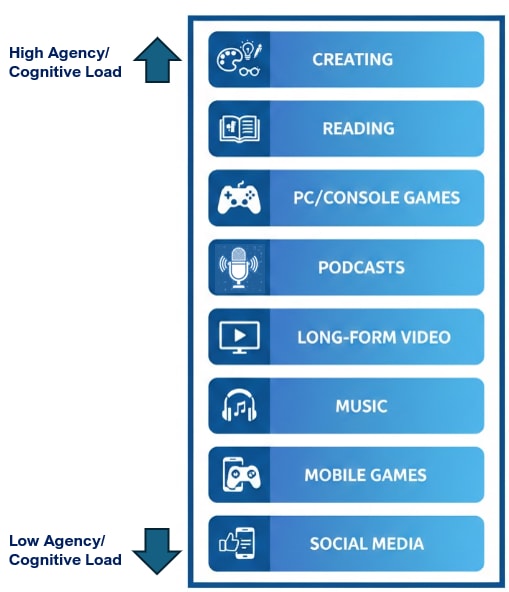
To start, we can rank order different forms of media according to how much effort they require from us to select and use, or as I phrase it in Figure 1, their cognitive load and agency. By agency, I mean whether it is active and intentional (high agency) or passive and reflexive (low agency).
Figure 1. A Subjective Ranking of Media Choices
Source: The Mediator.
To be clear, this is painting with a very broad brush and not entirely fair. Watching a Khan Academy video about differential equations on YouTube on your phone would classify as social media, the lowest rung on the ladder—even though that is obviously both high agency and high cognitive load. Plenty of mobile games are intellectually challenging too. Music is often used for multitasking and programmed by someone else—and is therefore low cognitive load and low agency—but you can also intently listen to an album. And TV includes a very broad range; it can be anything from background noise while puttering around the house to watching an intellectually challenging and entirely engrossing scripted series.
So, at the risk of throwing out a few babies with the bathwater, here is a rough ranking of common media activities from highest to lowest cognitive load and agency: creating, reading, console/PC games, podcasts, long-form video (i.e., video watched on a TV, whether broadcast, cable, SVOD, or FAST), music, mobile games, social media (including social video).
The next step is to try to understand how time share has shifted among these media choices over time. That’s not so easy to do. The best sources for media time spent are Activate and Emarketer. Activate publishes estimates of time spent with big categories of media (video, audio, gaming, and social media), but doesn’t show the level of detail we need. Emarketer publishes data on time spent by device (Mobile, Desktop/Laptop, Connected, TV, etc.), with some breakdowns within device category, but not always by activity.
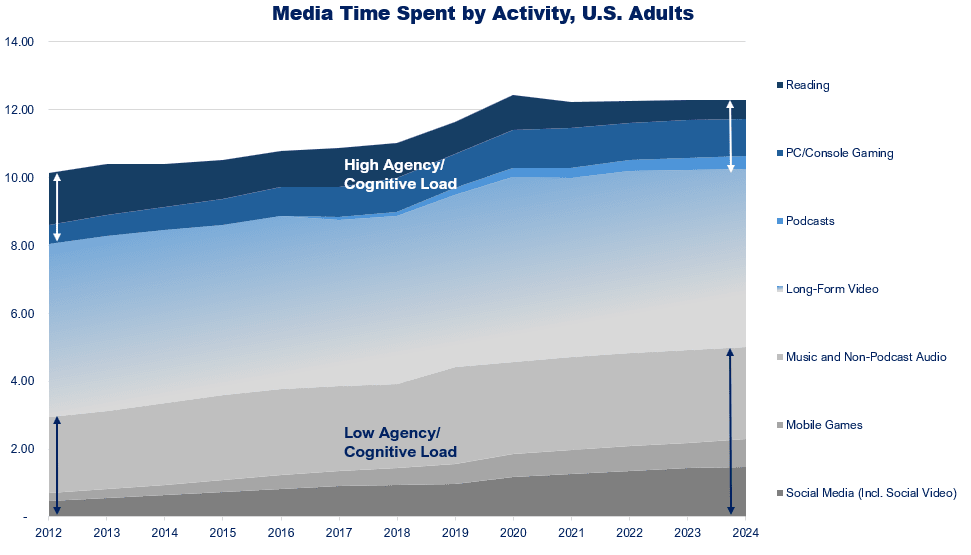
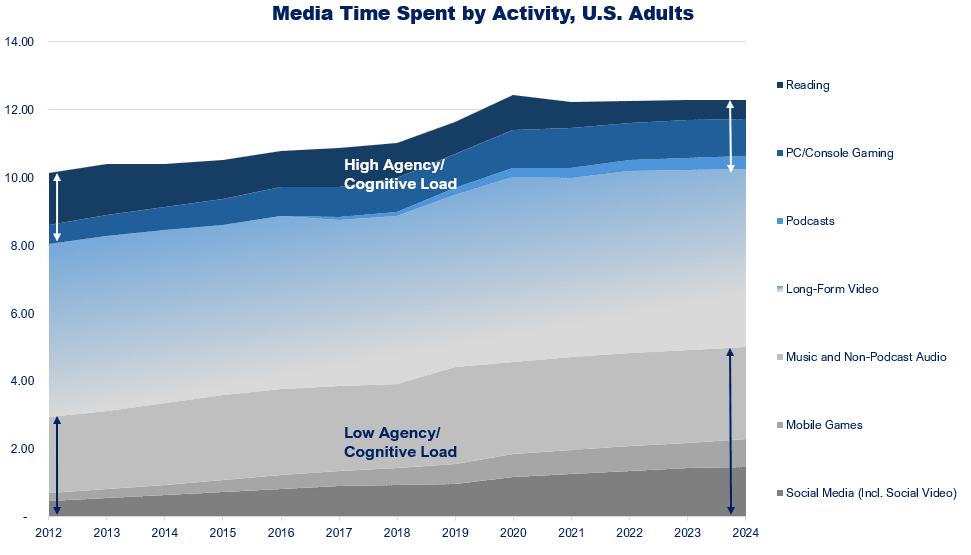
Figure 2. The Shift Toward Low Cognitive Load/Low Agency Content
Source: Emarketer, Activate, Newzoo, The Mediator estimates.
Figure 2 shows my effort to estimate time spent for each of the activities in Figure 1 for all U.S. adults and how this has changed over the last decade or so. This chart uses the logic in Figure 1: social media, mobile gaming, and music are low cognitive load, low agency; long-form video is a kind of middle ground; and podcasts, PC/console gaming, and reading are high cognitive load, high agency. (Neil Postman, author of Amusing Ourselves to Death, would have been horrified to see that TV is in the middle here, but it’s all relative. He never scrolled TikTok.)
It’s not an encouraging trend, but not apocalyptic either.
A few things jump out from this chart:
- It is not quite as apocalyptic as you might have been led to believe.
- Yes, consumption of less intellectually challenging, passive media has increased a lot over the last decade or so.
- However, this has largely driven an increase in total time spent, while time spent with intentional, active media has stayed pretty steady.
- Among this latter category, reading has declined, while PC/console gaming and podcasts have picked up the slack and video is about flat.
I am not arguing this is an encouraging trend or that the articles I referred to above are inappropriately alarmist. Some alarm is warranted. The decline in reading is very concerning, as articulated in Marriott’s article. Some might rightfully object that spending more time with PC and console gaming is cold comfort. Consumers are also spending more time with frivolous media. And keep in mind that this data is for all U.S. adults. If I were able to run the same analysis by age cohort, it would almost certainly show a more extreme shift “down market” for younger consumers. But still, this is a less pronounced share shift to media “junk food” than I expected.
What Happens in an IFPS World?
So, that is our starting point. As a proportion of time spent, media consumption is shifting toward less cognitively demanding content. What happens to our collective media diet over the next decade, as GenAI continues to advance?
GenAI will result in what I call an IFPS (infinite, fluid, personalized, increasingly synthetic) media environment. Will this make things worse or better? The answer is probably both.
What “Infinite, Fluid, Personalized, and Synthetic” (IFPS) Actually Means
It’s hard to conceptualize what the media landscape will look like in 5-10 years. But let’s try to paint the picture. From Infinite Content, Chapter 13, here’s what I mean by IFPS, albeit out of order:
Fluid. When there is a sufficiently high dimensional multimodal latent space, it will be possible to express any content along any number of modalities. A book could be a movie, a serialized vertical video, a game, an album, a podcast, or adapted for any platform (re-cut and formatted for YouTube, TikTok, Twitter, LinkedIn, Instagram, etc). The format and form will no longer be fixed. Similarly, when there is enough cheap compute, it will be possible to create content real time. That will make contextual, emergent, and interactive content feasible. It will make provenance fluid too, as the line blurs between who created something and who consumed it. For the same reason, state will become fluid, as the line blurs between content that is finished and not finished.
So, fluid means fluid along every dimension: plot elements, structure, characters, style, tone, modality, format, state, provenance, you name it. Not only will there be an infinite amount of content, but every single piece of content may have infinite possible permutations.
Personalized. Personalized follows from fluid. Personalization is often reduced to “people will insert themselves as Luke Skywalker,” but it means a lot more than that. Consumers will have the ability to tailor any version of content they want—or have an agent or algorithm tailor it for them—along all those dimensions I just mentioned. It will also be possible to personalize content based on context, need state, preferences, or current constraints (“I only have 12 minutes”).
That doesn’t mean people will always want fluid or personalized content, of course. Many will want to just consume the canonical version of the thing, maybe most of the time. But they could.
Synthetic. There will be a continuum of human involvement in content creation. It will probably range from “entirely” human (although even “entirely” human production may make use of AI for help with ideation, editing, or other final touches); to hybrid productions that involve significant human oversight and judgment, but delegate many production decisions to AI; to fully synthetic. By increasingly synthetic, I mean two things: As the capabilities of GenAI models improve, it will probably make sense for even largely human and hybrid productions to include more synthetic elements. Also, since synthetic content systems will be capable of creating at the speed of computation, over time the proportion of all content that is entirely synthetic will likely increase substantially.
Infinite. Infinite follows from all the above. Consumers will have essentially infinite choice. Not just infinite supply of content, but a bewildering (and effectively infinite) array of options.
AI Will Remove Friction
AI won’t change what we want. That’s the artifact of a few hundred thousand years of evolution. But it will make it easier to get what we’re seeking in any given moment. This works in both directions.
“More Dumber”
When we want cognitive ease, a dopamine hit, or are too worn out to resist, AI will make our feeds even more effective at spoon-feeding us.
Current algorithmic feeds are crude. They learn only by inference and don’t know much about your current state. In an IFPS future, they’ll know a lot more and will have far greater capabilities. Not only will they be able to find content that matches, eventually they’ll have the ability to generate content that perfectly matches our preferences and need states. If you’re worried about dopamine culture now, just wait. It will get worse. In an IFPS world, platforms will be much better at hijacking our attention.
If you’re worried about dopamine culture now, just wait. It will get worse.
More Intentional
At the other end of the spectrum, AI will also dramatically improve our ability to make intentional, enriching media choices—when we want to.
Today, the biggest consumer problem in media is discovery. AI can address it.
Today, arguably the biggest consumer problem in media is discovery. In a sea of choices, how do you find that next show to binge? How do you know which podcasts are worth investing an hour (or, if you’re a Lex Fridman or Tim Ferriss fan, two or three)? How do you comb through all your LinkedIn or X/Twitter posts to know which matter? How do you decide which Substack articles to read? In 2015, this study found that Netflix users spend 18 minutes per day just deciding what to watch. And that’s just within the Netflix app. GenAI will make this choice paralysis so much worse.
What if the current discovery challenge in media is pushing users toward low cognitive load, low agency feeds?
Here’s a thought: what if the current discovery challenge is partly responsible for the shift to low cognitive load, low agency content? Perhaps the difficulty finding the next "worthwhile” thing to watch/play/listen to pushes us into the arms of our feeds?
It seems inevitable that the solution to all this AI will be more AI, as I’ve written before. It isn’t yet clear what form this will take. It could simply be a chatbot with persistent memory that learns your preferences. At the other extreme—and what I think is likely longer term—is that we will have one or more trusted agents that seek out content on our behalf.
Also from Infinite Content, Chapter 13:
It’s not hard to imagine that consumers would have personal content agents. They would work with consumers to understand their areas of interests and preferences; continuously augment that profile by observing their online behavior, perhaps in different contexts; solicit feedback (“what did you think of that movie?”); and, if we’re going out there far enough, maybe even understand their need states through access to biometrics on their wearables—or even monitor their day as it occurs, as in the movie Her.
This idea has obvious potential pitfalls. There is the question of who controls these hypothetical agents and whether they will have some sort of agenda or an outsize amount of power. There is a risk that our current echo chambers become even better insulated, splintering society further. We may also lose serendipity, as everything is carefully pre-selected for us.
AI won’t only hook us into a dopamine drip, like the humans in Wall-E; it has the potential to vastly improve our ability to make intellectually challenging and redeeming content choices too.
These are all fair concerns and we’ll see how or if they resolve. Certainly, consumers won’t have to use their chatbots or agents all the time—maybe sometimes they will want to simply scroll or flick through FAST channels. But the point is that AI won’t only hook us into a dopamine drip, like the lazy, electronically sedated humans in Wall-E; it has the potential to vastly improve our ability to make intellectually challenging and redeeming content choices too.
A Barbelled Future
Concerns about our media diet are surely warranted. The loneliness crisis, gambling and porn addictions, the decline in literacy and critical thinking, and the devolution of public discourse all have real social costs.
As GenAI advances, it is likely that the proportion of our time allocated to vapid, useless, “junk food” content will continue to climb. Some of these problems will probably get worse. For the reasons described above, our willpower is already fragile. It will be even harder to resist perfectly tailored, customized feeds and, eventually, personalized content.
But we’re not necessarily headed straight to hell in a handbasket. It’s more complicated than that. We are not only strung out dopamine junkies, maniacally trying to score our next hit. In our media choices, we also seek social belonging, self-expression, enrichment, and identity reinforcement. AI will also likely improve our ability to achieve those goals. There is even a possibility that better discovery will start to move the needle back.
The likely consequence is that power laws in culture grow even more extreme, something I’ve also written about before (see Power Laws in Culture and Power Laws in Culture, Revisited). As I explained in those posts, popularity distributions in media increasingly look like a power law: a skinny head of a few hits, a dwindling middle, and an effectively infinite tail.
The reason the tail forms is straightforward: there is an almost unimaginably vast amount of content. The head forms for a reason that is a little less intuitive: positive feedback loops on the network. As the quantity of content grows, consumers increasingly use popularity as a signal of quality. At the same time, as it becomes easier to observe others’ content choices and broadcast your own, content choices have more social currency. Both dynamics amplify popularity; popularity begets more popularity, resulting in fewer, larger hits.
Now, let’s weave in AI. AI bots or agents will (probably) have no inherent “taste” and will therefore need to rely in part on collaborative filtering to make recommendations. Why is that? Consider a recommendation agent that is solely based on content metadata, like genre, style, length, artists, narrative elements, etc. How would that deliver good recommendations? Pure feature-matching would likely only recommend what you already know you like, losing the discovery of anything new. And how would you weight all these different content features without some external marker of quality? Some elements of collaborative filtering seem unavoidable.
Any content recommendation agent will likely need to rely at least in part on collaborative filtering.
That will likely further amplify the feedback loops that already concentrate attention at the head of the curve. At the other end, the long tail will become functionally infinite, especially if AI models can generate personalized or contextual content real time.
The middle—casual browsing, serendipitous discovery, the "pretty good" stuff you stumbled onto—likely gets squeezed more. It has neither the strong collaborative signals needed to break through for intentional consumption, nor the hyper-personalized optimization required to compete for passive attention. The power law analyses I’ve published before shows this middle is already shrinking. The middle is a tough place to be. AI will probably exacerbate that.
Interestingly, all were published on Substack, but that is besides the point.
Previous