It’s time to start your content creator era是时候开启你的内容创作者时代了
Length: • 8 mins
Annotated by karik
This post is brought to you by ... my upcoming webinar with Superinterviews!
本篇文章由......我即将与 Superinterviews 合作举办的网络研讨会赞助!
Grab your free seat.
立即预订免费席位。
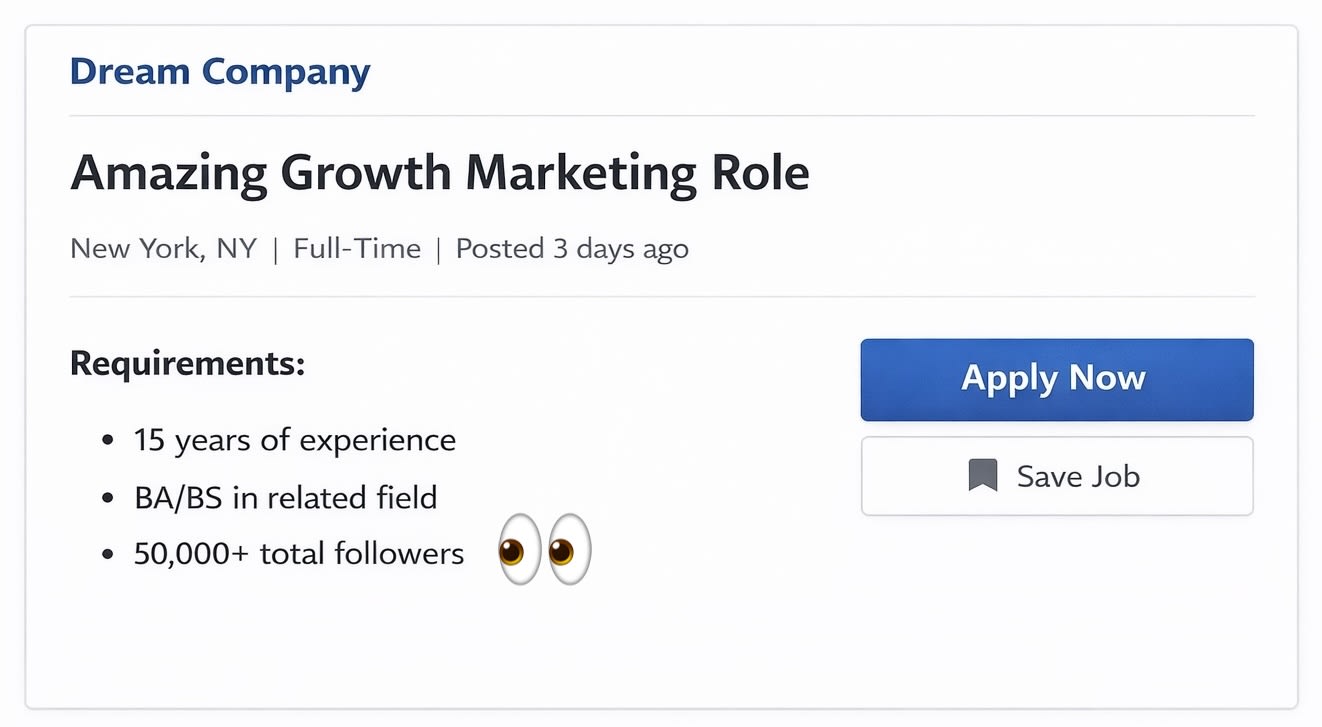
Okay, I made that screenshot up, but we’re not far from these kinds of job postings. If that scares you or makes you mad, it’s probably because you haven’t already invested in creator economy.
好吧,那张截图是我虚构的,但我们离这类招聘启事的出现已经不远了。如果这让你感到恐惧或愤怒,大概是因为你还没有投入到创作者经济中。
But it makes a lot of sense for companies. For two reasons:
但对公司来说,这非常有意义。原因有二:
- Personal audiences are becoming a crucial distribution channel for companies in the trust-first growth era.
在“信任优先”的增长时代,个人受众正成为公司至关重要的分发渠道。 - It is a public proof of agency and understanding of latest growth tactics.
它是个人主观能动性以及对最新增长策略理解力的公开证明。
First: They’re not exactly the same, but acquiring and engaging an audience has a lot in common with acquiring and engaging users or customers. Content creator skills translate a lot to quality marketing and growth. And lots of people say they understand how to build something, but how can you tell if they’re telling the truth? Ideally, you want to see the work... and someone who has been posting their perspective online for years gives you just that. Having a decent-sized audience means you’ve been creating content for long enough that there’s a very public record of how you approach things - any potential employer can go through and see (at least some of) the history of how they got there.
首先:虽然两者并不完全等同,但获取并留住受众与获取并留住用户或客户有很多共同之处。内容创作者的技能可以很好地转化为高质量的营销和增长能力。很多人都声称自己懂得如何构建影响力,但你如何判断他们说的是真是假?理想情况下,你希望看到实际成果......而一个多年来坚持在网上发布观点的人恰好能提供这一点。拥有一定规模的受众意味着你创作内容的时间已经足够长,以至于有一份非常公开的记录展示了你处理问题的方式——任何潜在雇主都可以翻阅并查看(至少是部分)你达成目标的历程。
But that’s not all...但这还不是全部......
Given how essential personal content is for distribution these days, hiring someone with a big audience is practically bringing in a new distribution channel.
鉴于如今个人内容对分发的重要性,聘用一位拥有庞大受众的人,实际上等同于引入了一个全新的分发渠道。
I’m seeing this right now
我目前正亲眼见证这一趋势。
It’s happening at Lovable. If we want awareness about a big update, what do we do?
这种情况正发生在 Lovable。如果我们想让大家知晓某次重大更新,我们会怎么做?
Big push through our PR agency? Nope.
通过我们的公关公司大肆宣传?不。
Paid influencers? Sometimes.
付费网红?偶尔会请。
Our company social? Meh.公司官方账号?效果平平。
Instead, we lean on people specifically to post about it, such as Anton (our CEO), Felix (one of our incredible designers), and me. The official Lovable account will repost what we’re sharing, and we’re building up a team of rising stars in the company who are sharing more and more - and that’s the point: Employees’ social followings are becoming a major asset for companies.
相反,我们更倾向于依靠具体的人来发布内容,比如 Anton(我们的 CEO)、Felix(我们出色的设计师之一)和我。Lovable 的官方账号会转发我们分享的内容,而且我们正在公司内部培养一支由“明日之星”组成的团队,他们分享的内容也越来越多——而这正是关键所在:员工的社交媒体影响力正成为公司的重要资产。
This is wild for me, because in past roles, my social visibility was viewed as a liability! Legal teams were terrified of me. ‘Oh no, what did you post now, can you please take that down?’
这对我来说简直不可思议,因为在过去的工作中,我的社交媒体曝光度被视为一种负担!法务团队对我提心吊胆:“噢不,你又发了什么?能不能请你把它删掉?”
Now, accounts like mine are a major asset. It’s actually part of my job description to go out and talk on podcasts, do more posts on social.
现在,像我这样的账号已成为一项重大资产。事实上,参加播客访谈、在社交媒体上发布更多动态,已经成为了我工作职责的一部分。
Some of this is the stage and size of the company: startups naturally are more flexible and are more aggressive than the large enterprise companies that are more conservative and careful. So, if you’re at a big, old-school company, maybe this isn’t for you. But if you’re at a startup, this is a way to seriously boost your value to the company. Or, if you want to be at one, this could be the reason you get the job or not.
这在一定程度上取决于公司的阶段和规模:初创公司自然比那些保守谨慎的大型企业更灵活、更具进取心。所以,如果你在一家传统的大公司工作,这或许并不适合你。但如果你在一家初创公司,这将是大幅提升你对公司价值的一种方式。或者,如果你想进入这类公司,这可能会成为你是否能获得这份工作的关键。
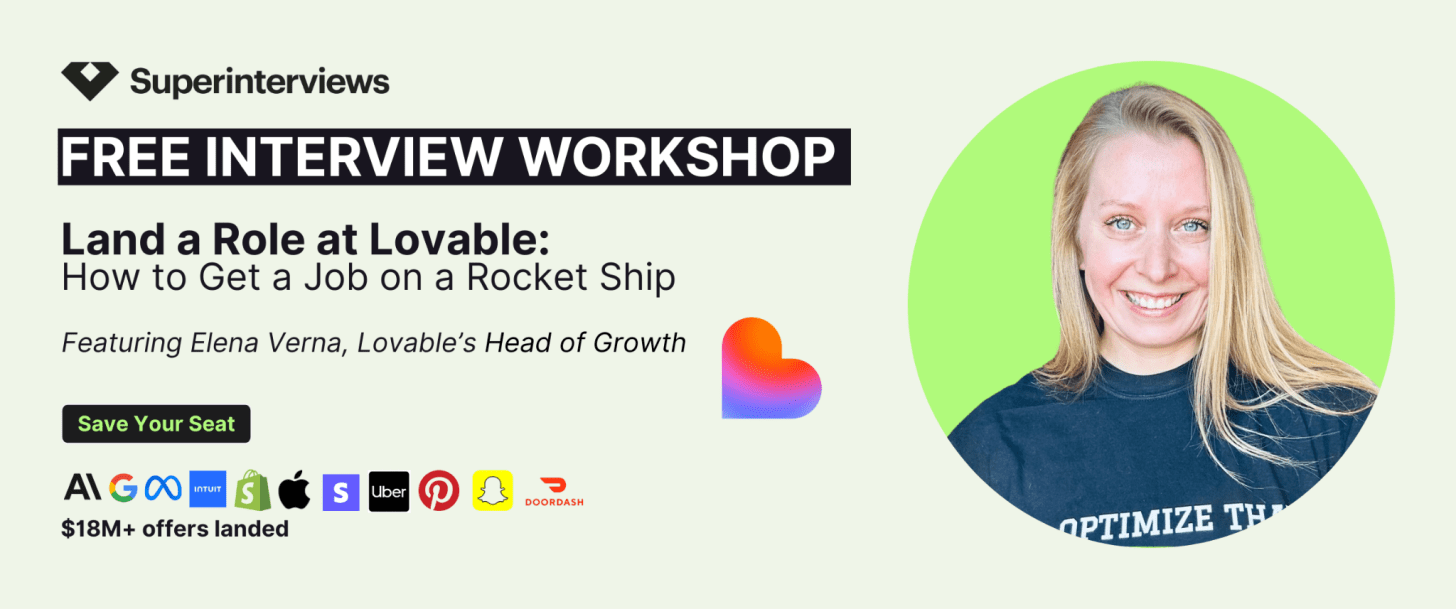
On a related note: I’m teaming up with Superinterviews to break down how we actually hire for hypergrowth at Lovable and what top candidates do differently.
顺便提一句:我正与 Superinterviews 合作,深入解析我们在 Lovable 是如何进行超速增长招聘的,以及顶尖候选人有哪些与众不同的做法。
If you want a real shot, come learn how we think.
如果你想获得真正的机会,快来了解我们的思维方式吧。
But whatever your reason, it’s time to start paying attention. And just to be clear: I’m not talking about ‘building a personal brand’ - I’m talking about proving that you know how to build an audience. This is about being able to think and operate like a creator. Although personal brand does come along with it.
但无论出于何种原因,现在都该开始关注这件事了。需要明确的是:我所说的并不是“打造个人品牌”——我说的是证明你具备建立受众群体的能力。这关乎像创作者一样思考和运作的能力,尽管个人品牌确实会随之而来。
How to get started如何开始
Everyone has to begin somewhere. If you’re just jumping in, do this:
每个人都必须从某个起点开始。如果你正准备加入,请这样做:
1. Pick a platform. Don’t try to do it across everything. Each platform has rules of engagement - techniques, norms, expectations, context. You can add platforms later, but don’t try to start off on multiple at once. For me: It was 100% Linkedin. And if you’re looking to talk about business-related topics, especially in growth or marketing, that’s where you should probably start, too. Why not a newsletter? I think newsletters are a perfect way to level up: You can do deeper dives on topics, create a repository for your insights, and (maybe most importantly) actually own your audience. But it’s a rough place to start - there’s no natural virality to newsletters and the feedback loop is much slower. When you’re trying to figure out the signal from the noise, start in a place that allows you to get reps.
1. 选择一个平台。不要试图在所有平台上齐头并进。每个平台都有自己的参与规则——包括技巧、规范、预期和语境。你以后可以增加平台,但不要尝试同时在多个平台上起步。对我来说,我 100% 选择了 LinkedIn。如果你想讨论商业相关的话题,尤其是增长或营销领域,那里可能也是你的首选。为什么不选时事通讯(Newsletter)?我认为时事通讯是进阶的完美方式:你可以深入探讨话题,建立自己的见解库,并且(或许是最重要的一点)真正拥有你的受众。但它作为一个起点会很艰难——时事通讯没有天然的病毒式传播属性,反馈周期也慢得多。当你试图从杂音中寻找信号时,请从一个能让你快速练习的地方开始。
2. Be unapologetically authentic. The point is that this is your audience! Not your company’s, not your brand’s. This is you. If you don’t use your own voice, it won’t work. If you try to make it feel super polished every time, it will always feel unnatural or yucky. Even if your audience is smaller because of how you’re communicating, that’s fine! You’ll find the people who really click with what you’re discussing.
2. 展现无可替代的真实性。重点在于这是你的受众!不是你公司的,也不是你品牌的。这就是你。如果你不使用自己的声音,它就不会奏效。如果你每次都试图把它修饰得完美无瑕,它总会让人觉得不自然或令人反感。即使因为你的沟通方式导致受众规模较小,那也没关系!你会找到那些真正认同你所讨论内容的人。
3. Pick a specialty you want to talk about. Don’t chase the trends. Posting clickbait for the most viral meme or paraphrasing other people is short-term thinking. At the beginning, choose a lane and then stay in it as much as possible. Your specialty is your wedge. For me: I started with Product-Led Growth (PLG). This was one of the best decisions I made as a creator - staying focused on the topics where I had the most expertise, rather than taking the shotgun-pattern approach. Staying focused was good for readers (they knew what to expect) and good for me (I got better and better in that area, rather than always exploring new topics or fields).
3. 选择一个你想谈论的专业领域。不要追逐潮流。发布针对最热门梗的标题党内容或转述他人的话是短期思维。在开始阶段,选择一条赛道,然后尽可能深耕其中。你的专业领域就是你的切入点。对我来说,我从产品驱动增长(PLG)开始。这是我作为创作者做出的最明智的决定之一——专注于我最擅长的领域,而不是采取“撒胡椒面”式的方法。保持专注对读者有好处(他们知道可以期待什么),对我也有好处(我在该领域变得越来越精通,而不是总在探索新话题或新领域)。
4. Expand carefully. Don’t do this too early. After I’d spent years only talking about PLG, I moved on to Product-Led Sales (PLS), which was kind of my product-market fit expansion. Then... memes! After I’d covered my core, foundational frameworks, I used the humor as a different way to introduce the same concepts without getting stale. As the inescapable wave of AI crashed into everyone, I talked about how I thought that would impact Growth (I was anti-AI initially!). But since joining Lovable, I’m focusing on how companies and careers grow in the AI era, both at AI Native companies and traditional SaaS businesses. But all of these have layered on gradually. And still aren’t too far away from what I was originally known for.
4. 谨慎扩张。不要过早这样做。在我花了数年时间只谈论 PLG 之后,我转向了产品驱动销售(PLS),这算是我在“产品市场匹配”后的扩张。然后......是表情包梗图!在我涵盖了核心的基础框架之后,我利用幽默作为一种不同的方式来引入相同的概念,而不至于显得陈旧。当不可阻挡的 AI 浪潮席卷每个人时,我谈到了我认为这将如何影响增长(最初我是反 AI 的!)。但自从加入 Lovable 以来,我开始关注在 AI 时代公司和职业是如何发展的,无论是 AI 原生公司还是传统 SaaS 企业。但所有这些都是逐渐叠加的,而且仍然没有偏离我最初成名的领域太远。
5. Figure out something worth communicating. What can you share that’s interesting or provides value to the reader? One option is a contrarian viewpoint. It doesn’t have to be insane or shocking, but if you believe something different from what everyone else is saying, share it! And defend it. Make your case. My other go-to: A new framework. Human brains freakin’ love patterns. If you can say “Everyone is doing this” or “We’re all missing this,” it unlocks something in people’s brains. And one more: Share your singular opinion or personal experience. What did you go through or see or feel. This can be scary and make you feel vulnerable, but the goal is connecting with people and good content shows that there’s an actual human person on the other side of the screen.
5. 找点值得传播的内容。你能分享哪些有趣或能为读者提供价值的东西?一个选择是提出反直觉的观点。它不必多么疯狂或令人震惊,但如果你对某件事的看法与大众不同,那就分享出来!并为之辩护,陈述你的理由。我的另一个常用招式是:提出一个新框架。人类的大脑极其热爱模式。如果你能说出“大家都在这样做”或“我们都忽略了这一点”,它就会开启人们大脑中的某种开关。还有一个:分享你的独特见解或个人经历。你经历了什么、看到了什么或感受到了什么。这可能会让你感到害怕或脆弱,但目标是与人建立联系,而优质的内容能让人们感受到屏幕另一端是一个真实的人。
6. Build a habit of collecting ideas. I hear “But I don’t know what to post about” a lot, and this mostly comes down to paying attention to your surroundings. For me, I have a rule that if I say something 3 times, I’m gonna post about it. Whether that’s a recurring question that keeps coming up, or something that I need to explain to several different people. This happened to me 3 times yesterday, so I made a meme about it:
6. 养成收集灵感的习惯。我经常听到有人说“但我不知道发什么”,这主要归结为是否留心观察周围。对我来说,我有一个规则:如果一件事我说了 3 次,我就会把它发出来。无论是一个反复出现的疑问,还是我需要向好几个不同的人解释的事情。昨天这种情况就发生了 3 次,于是我为此做了一个梗图:
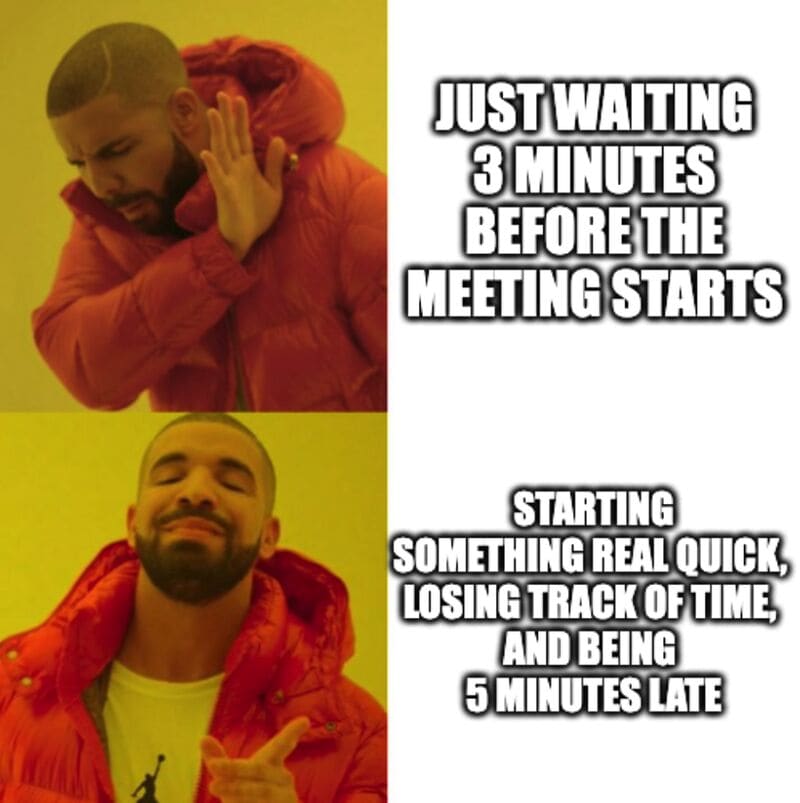
The ‘Rule of 3’ helps my brain to recognize a pattern, which means there’s a chance it may resonate with other people. But whatever it is, get in the habit of either quickly creating posts based on things you’re seeing and experiencing, or setting up a document where you can record your ideas, so you can reference it when it’s time to sit down and post.
“3 次原则”能帮助我的大脑识别出一种模式,这意味着它很有可能也会引起他人的共鸣。但无论是什么,都要养成习惯:要么根据你的见闻和经历快速创作内容,要么建立一个文档记录灵感,以便在准备发布内容时参考。
7. Engage. With. Comments. I put this toward the bottom of the list, but it’s actually my #1 tip. It’s crazy to me that we’re all using social media, but almost nobody uses the social part. Remember: You’re posting to get people’s reactions. If you don’t follow through, you won’t get an actual, engaged audience. Writing the post is 30% of the work... 70% of the work is responding to comments. Can be as simple as “Haha, funny” or “Agree to disagree”... but if you don’t acknowledge people who took time to read what you wrote, why should they keep coming back? You want conversations and dialogue, not a one-way rant or speech.
7. 积极回复评论。我把这一条放在列表靠后的位置,但它实际上是我的头号秘诀。令我感到疯狂的是,我们都在使用社交媒体,却几乎没有人利用它的“社交”属性。记住:你发布内容是为了获得人们的反馈。如果你不跟进,你就无法获得真正有参与感的受众。写文案只占 30% 的工作量...... 70% 的工作在于回复评论。回复可以很简单,比如“哈哈,真逗”或“保留意见”......但如果你不理会那些花时间阅读你文字的人,他们为什么要一直关注你?你需要的是对话和交流,而不是单方面的说教或演讲。
8. Don’t get caught up chasing impressions/likes. This is true for any social media (it’ll crush your soul), but as a creator, it’s dangerous in a different way. Pursuing popular approval will make you generalize your content to appeal to the masses, which drains you of your authenticity, your voice, and your perspective. Not only is it psychologically addicting, but the platforms have structured all of their notifications and analytics to incentivize you to play that game. Stay strong. Don’t dilute who you are. If you’re finding like-minded people and having meaningful conversations, you’re moving in the right direction.
8. 不要陷入追求曝光量/点赞数的陷阱。这对任何社交媒体都适用(它会摧毁你的灵魂),但作为一名创作者,它的危险性体现在另一个层面。追求大众的认可会让你为了迎合大众而使内容泛化,从而消磨掉你的真实性、你的独到见解和视角。这不仅在心理上令人上瘾,而且各大平台的所有通知和分析机制都在激励你参与这场游戏。保持定力,不要稀释自我。如果你能找到志同道合的人并进行有意义的对话,那么你就在朝着正确的方向前进。
Start now and just keep going
现在就开始,并坚持下去
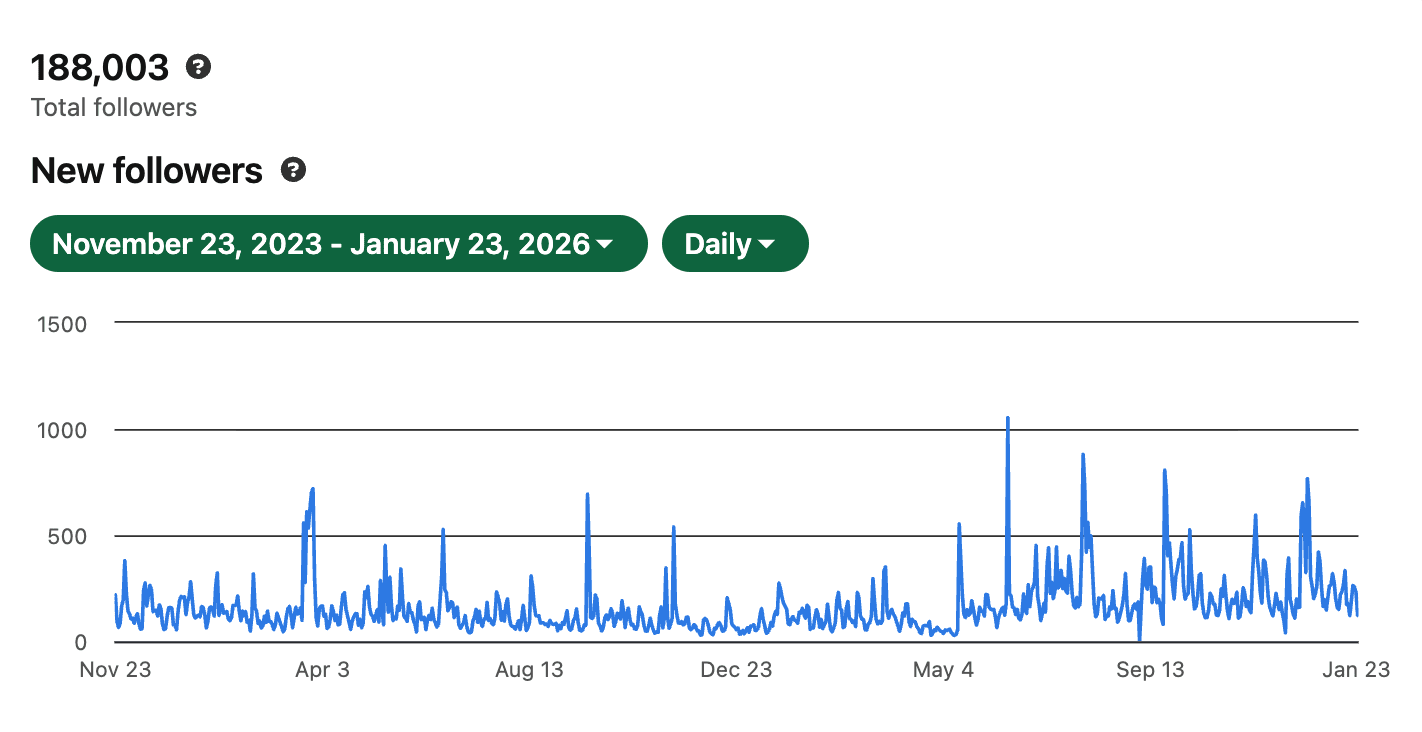
If this wasn’t already clear, I’ll spell it out: there’s no shortcut. Don’t trust anyone who tells you differently. If you look at my growth over the years, it’s been slow and steady.
如果这一点还不明确,那我就直说了:没有捷径。不要相信任何告诉你另有捷径的人。如果你观察我这些年来的增长曲线,你会发现它是缓慢而稳步的。
Look at my LinkedIn new followers graph - it is slow and steady:
看看我的 LinkedIn 新增关注者图表——它是缓慢且稳步增长的:
Or check out the growth of this Substack, it’s just a straight line. Nothing exponential here.
或者看看这个 Substack 的增长情况,它就是一条直线。这里没有任何指数级的爆发。
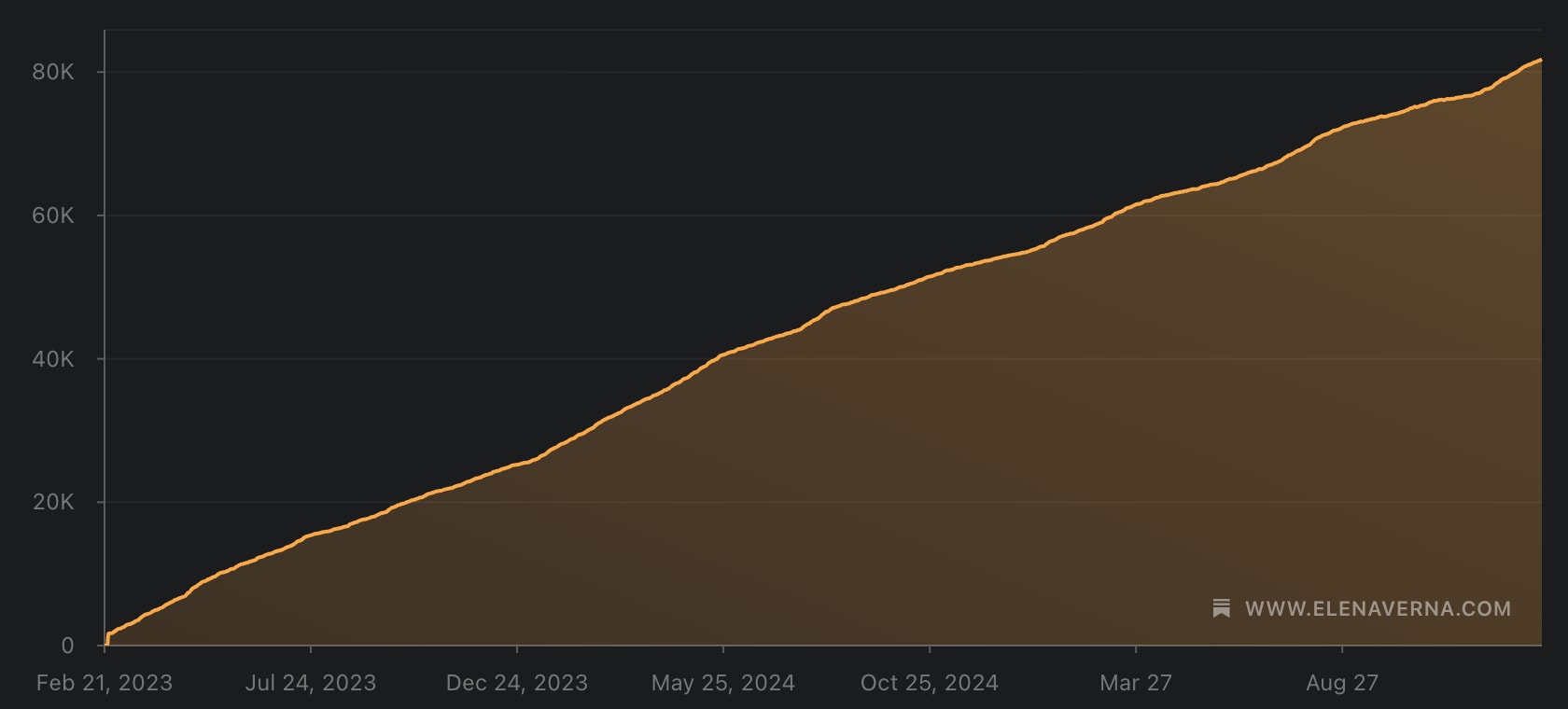
What real creators know is that the way to win is to keep showing up. The best tactics are all built around making it easy for you to do that. Figure out topics you want to talk about a lot, write in your authentic voice, and don’t worry if you’re not going viral - all of these things help you stay in it for the long-term.
真正的创作者深知,获胜的关键在于持续露面。所有最好的策略都是为了让你能更轻松地坚持下去。找准你想要深入探讨的话题,用你真实的口吻写作,不要担心自己没有走红——所有这些都有助于你长期坚持。
It may feel intimidating to get started. Yep, it will take a while. But that’s a feature, not a bug – a real audience that cares about what you have to say is one of the only remaining distribution channels, exactly because it takes so long to build. This is a high-trust channel, and trust takes time.
开始时可能会感到畏缩。没错,这确实需要一段时间。但这正是其特性而非缺陷——一个真正关心你所言所行的受众群体,是目前仅存的几种分发渠道之一,正因为它需要漫长的积累。这是一个高信任度的渠道,而信任需要时间。
So even though it would be great if you were already a creator... there’s no better time to start than now.
所以,尽管如果你早就是一名创作者会很棒......但开始创作的最佳时机就是现在。
Edited by Jonathan Yagel.
由 Jonathan Yagel 编辑。
Previous上一页