You Are Not Smarter Than the Fans
Length: • 10 mins
Annotated by Benji Rogers
Heated Rivalry trusted its audience, ditched TV conventions, and became a cultural force.
emwhitenoise is a monthly essay exploring the future of music through the lens of fandom, technology and culture—from Emily White, a music product builder and Spotify and Billboard alum. Welcome to the 1,000+ new subscribers who joined since December’s essay on the iPod revival!
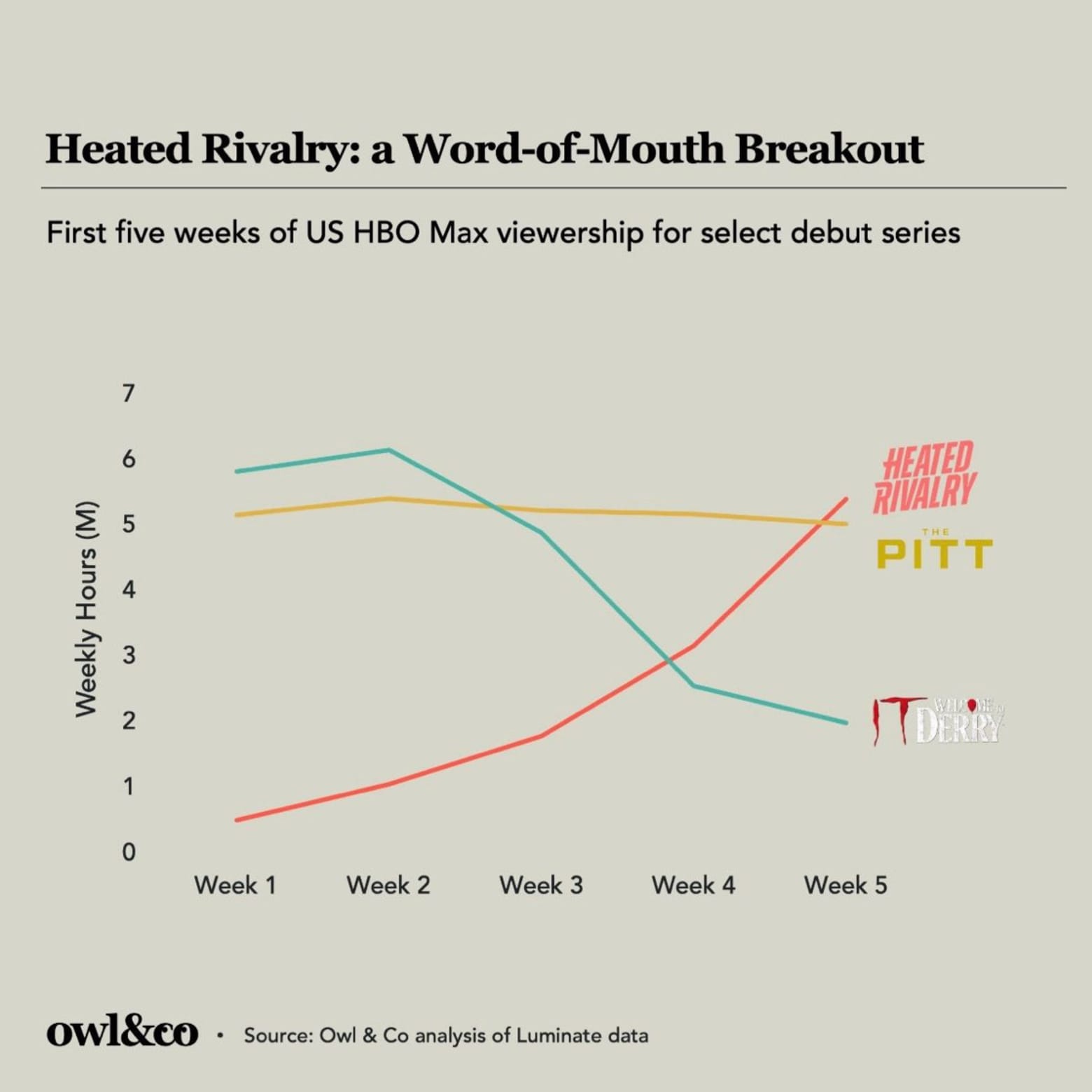
On the surface, Heated Rivalry—a queer hockey romance produced in Canada with unknown leads and a modest budget—seemed to come out of nowhere and take over the internet.
But when you look closer, its trajectory follows the same arc we’ve seen with so-called “overnight” success artists like Chappell Roan, Doechii or Geese:
- Genuine talent
- Staying weird and ditching traditional formulas
- Years of authentic audience-building
The simple (but reductive) explanation for Heated Rivalry’s breakthrough success is easy: sex sells.
Yes, the show is undeniably horny. Show creator Jacob Tierney has called it “premium smut.” But horniness alone doesn’t explain its success.
Rachel Reid’s Game Changers book series (of which Heated Rivalry is the second installment) has sold more than 650,000 copies, topped Kindle charts across all categories, and landed on the New York Times bestseller list. There are 3,000 people on the waitlist to check out Heated Rivalry just at the New York Public library.
The show’s lead actors, Connor Storrie and Hudson Williams, jumped from thousands of followers to 2.7 million each in two months, and from waiting tables to Golden Globes presenters and Olympic torchbearers.
All from a 6-episode TV series that premiered on Thanksgiving with minimal traditional promotion and a publisher that underestimated demand so badly it failed to print additional copies of the book ahead of release, make a promotional cover or ship extra stock to retailers (much to the annoyance of fans and independent book stores).
Amazon Studios reportedly passed on the project despite sitting on a goldmine of Kindle and Goodreads data signaling exactly how large and mobilized this audience already was.
None of this should have been all that surprising.
Romance is the highest-grossing fiction genre in the world and sales are at an all-time high. Hockey is its largest sports subgenre. Sales of queer romance novels have more than tripled between 2021 and 2025.
The audience was already passionate, organized, and deeply invested.
Heated Rivalry succeeded because it trusted its existing fandom and refused to stray from what made it unique or dilute what fans loved most about the story.
The show’s success is a case study in what happens when fandom is treated as core infrastructure, not a side effect.
1. Fandom is a distribution engine.
What we call “overnight” success is usually when fan-driven distribution and traditional distribution begin reinforcing each other.
The Game Changers series first debuted as an e-book in 2018, after Reid shared early drafts on the fanfiction site, Archive of Our Own. It spread steadily through word of mouth, selling hundreds of thousands of copies before it was ever stocked in physical bookstores.
We’ve seen this trajectory before in music. Chappell Roan spent years building a passionate fanbase before the right sequence of events—her standout Tiny Desk Concert performance, opening for Olivia Rodrigo on tour, and single “Good Luck, Babe!”—broke through to the mainstream, making years of work, and an already invested fanbase, look like it came out of nowhere (Heated Rivalry and Chappell Roan have more in common than Saskatchewan!)
By the time the Heated Rivalry TV show was set to premiere, fans were already mobilized: making TikTok edits with only a 90-second trailer to work with and strategizing how to watch a show launching exclusively on the Canadian streamer, Crave (VPNs? Piracy? Fake a Canadian billing address?)
That visible fan momentum is what led to HBO Max picking up the show for distribution in the US and Australia at the last minute, like an indie debut album suddenly getting major-label distribution: “The fans’ involvement in this experience has very much led to these amazing opportunities,” executive producer Brendan Brady told the Hollywood Reporter.
Once traditional distribution kicked in, fan activity only intensified: a subreddit pulling 800K weekly visitors, an absolute flood of meme-caps, Oscar-winning-quality fan edits, in-depth analysis of the show and its press tour, thousands of “Hollanov” playlists and corresponding streaming boosts for the show’s soundtrack, and even sold out Heated Rivalry club nights.
It’s “a sort of Cambrian explosion of a new fandom” writes Katie Notopoulos at Business Insider, “The posts are not tucked away on Tumblr or fanfiction site Archive of Our Own, existing purely for the superfans who seek it out like horny Gollums; it’s taking over the TikTok and Instagram feeds of normies who post under their real names.”
Fan-driven growth is hardly a new concept, but it’s getting more professionalized. Studios now hire “clippers,”—often superfans themselves—to create social content.
Rather than trying to copy fan edits, Lionsgate’s digital marketing team has hired a roster of TikTok editors, “We’re going to the artists that fans are already obsessed with and saying: ‘We want you to create what you’re already doing; we just want to work together,” Felipe Mendez, who manages the Lionsgate account, told Variety.
Music works the same way. Marketers often rely on social tastemakers to drive streams, build communities and shape taste.
As always, the fangirls, gays and theys are the most powerful distribution engine in the world.
The pattern looks like this:
❤️🔥 Fans create signal
👀 Traditional distribution notices and kicks in
📈 Scale gives fans more raw material to remix and share
🔀 Remixing generates new audiences and new press
🔁 The cycle repeats
are you a gen z music fan who loves sharing and curating music? answer a few quick questions to try something new:
2. You are not smarter than the fans.
Heated Rivalry demonstrates what happens when you find an underserved audience and pay attention to and value what that audience specifically loves about something instead of trying to “elevate” or water it down for mass appeal.
When Tierney and Bell Media, which owns the Canadian streaming service, Crave, pitched various partners for additional funding for Heated Rivalry, “We had a lot of people telling us why this wouldn’t work,” Tierney told the WSJ.
Executives wanted to add a female main character, dilute the core storyline with an ensemble cast or delay the central romance until the season finale.
“If these books have become valuable because the fan base is rabid and enthusiastic and you think you’re smarter than the fan base because you’ve made three procedurals, I don’t know what to tell you.” Tierney told The Ankler. “You have to respect the audience.”
Ultimately, to protect the show from outside interference and “death by a thousand studio notes,” Bell Media decided to take a big swing and fully fund the production.
“I knew that if you changed this book, you’re losing the audience that is built in,” Tierney told Evan Ross Katz. “And if you want to betray them out of the gate, I don’t know what you’re doing. I don’t know what the benefit is.”

SHUT UP EVAN: THE NEWSLETTER
A lot of my job is collecting data. I post quite a bit of content about various media and am always deep in the backend, scouring the analytics like an archeologist, digging to find what instigates the biggest response. The “likes” tell the most obvious story, but for me it’s always been about the reshares and the comments. This data helps give me a sen...
“Part of the reason that the romance industry does not get taken seriously is because people don’t care about what pleases women,” Tierney says. “One of the things that is so untapped in culture is our interest in women’s interests. I think that we just don’t listen to women.”
LGBTQ+ audiences and interests are also profoundly underserved, especially amid escalating political attacks, rising anti-LGBTQ violence, and declining on-screen representation.
GLAAD recently released a report finding that more than 200 (41%) of the LGBTQ+ characters on TV across all major platforms will not return, due to series cancellations or endings, limited series format, or a character dying or leaving the show.
Stories of queer joy where no one dies still feel rare and radical.
The lesson for gatekeepers is to stop dismissing what queer audiences and women love as “not serious” or “too niche.” They are almost always early indicators of where culture is going.
3. Attention spans are actually a lot longer than you think they are.
There is a persistent belief that audiences are distracted, half-watching, second-screening and incapable of focus.
Netflix producers reportedly instruct screenwriters to make plots as obvious as possible and have characters announce what they’re doing in dialogue to avoid confusing viewers who are half-watching while they scroll through their phones.
This two-screen trap is a misreading of the data.
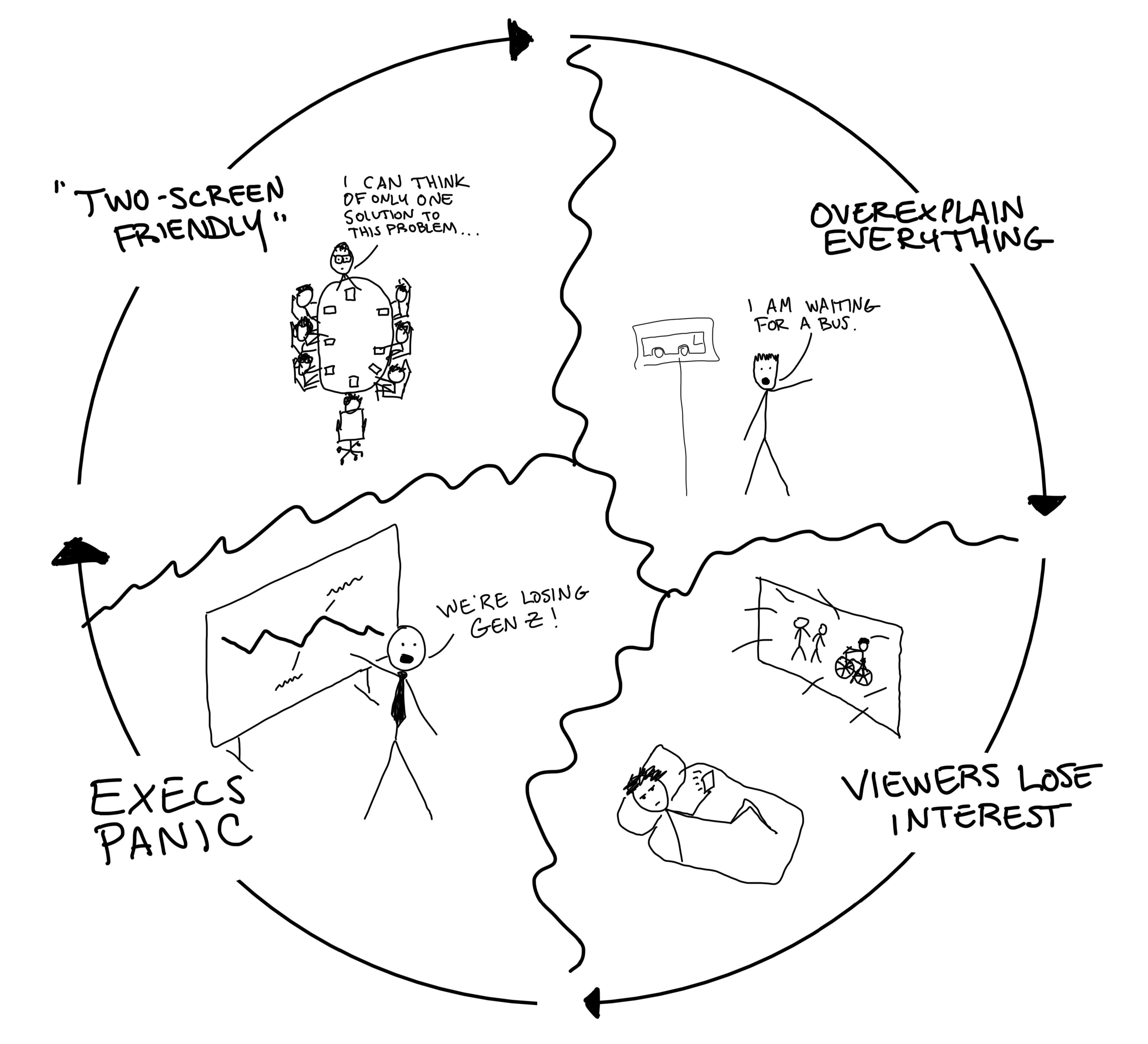

How Not to be a TV Writer
A Medium in Crisis...
People are not on their phones because stories are too complex to follow.
We are on our phones because your show is boring and speaking to us like we are twelve.
The rise of clipping, fan edits, and second screening shouldn’t lead writers to over-focus on “TikTok-friendly” stories because our attention spans are shot.
When the world-building is excellent, fans want to spend more time and attention immersed within it: easter eggs, callbacks, symbolism and worlds they can inhabit, dissect and discuss.
On Crave, a third of viewers rewatched Heated Rivalry episodes, and more than 15% watched an episode five times or more (dubbed the “re-heated” rivalry).
A TikTok account that does scene by scene breakdowns weaving in commentary comparing the book and the show has millions of views. So does Valentina Vee, a cinematographer and director who breaks the show down shot by shot, analyzing the creative use of blocking, camera work and lighting on a limited budget.
This reminds me of another recent “slow burn” show, Severance, that succeeded in part because it was not “two-screen friendly.” If you’re not watching intently, you’re going to miss something.
People crave worldbuilding, story and meaning. Music fans spend hours creating playlists, making edits, analyzing lyrics, re-listening and building entire worlds around artists they love.

4. Niche is universal.
LGBTQ+ programming is often considered too niche by television buyers, so a queer hockey romance was certainly considered EXTRA niche by many.
But when done right, the niche can become universal.
“What we have found with shows that cut through is that the minute you try to water it down to make it more mass-appeal, you lose some of the magic.” Justin Stockman, Bell’s vice president of content development and programming, told the Ankler.
“When you get specific, it can bring out the universality of whatever that topic is (...) You really feel like this story could be real and you feel the intensity and their emotions and you can relate that back to whatever your identity is or whatever your life situation is.”
Deep specificity creates universality. Flattening for mass appeal destroys the very thing that makes the work resonate.
Nobody knows this better than Taylor Swift, who built an empire on hyper-specific storytelling. Or Charli XCX, whose “niche” album with a specific point of view, brat, far outperformed her more “mainstream” pop play, CRASH.
Sinners is also a very “niche” movie on paper: an original (!) period piece (!) horror movie (!) with a complex racial story (!) is now the most Oscar nominated film of all time.
Heated Rivalry leans into specificity and breaks a lot of TV conventions in the process:
- The first episode skips traditional world-building exposition and trusts audiences to keep up with significant time jumps and emotional subtext.
- The romantic leads get together almost immediately (like, in the first 15 minutes)
- The season spans 8 years of a relationship in just six episodes.
“I know it doesn’t start like a normal show, so it’s been so interesting to see people’s reactions to the idea of how you’re supposed to structure TV, especially with regard to world-building,” says Tierney.
Episode five alone contains multiple plot points that each could have been a season finale moment in a lesser show: a coming-out, a death, a reconciliation, a love confession, a critical sports injury, and a big emotional release set to a swelling soundtrack. It reminded me of seeing Chappell Roan perform live and thinking every single one of these songs could have been a closer or encore performance.
5. What can the music industry (re)learn from Heated Rivalry?
So what does all this have to do with music?
The music industry has spent the last decade:
- Chasing algorithms
- Cutting artist development budgets
- Focusing on songs over of artist legacies
- Flattening songs into interchangeable TikTok sounds
Then wondering why there are fewer lasting superstars.
Today’s 16-24-year-olds, typically the drivers of music culture, are less likely than 25-34-year-olds to have discovered an artist they love in the last year (!!!) according to MIDIA. And even when they do discover artists, they are less likely to stream that artist’s music.
That doesn’t mean young people don’t care about music anymore. But they might be bored of how music is being marketed to them.
As Lizzo astutely observed last year, despite plenty of great releases from big artists, there was no “song of the summer” in 2025 because “no one can serve the masses anymore.” Instead, artists should focus on “serving your people”.
The algorithm may be the gatekeeper-final-boss, but culture is still breaking in places outside of the For You feed: Reddit threads, independent and college radio stations, Discord servers, fan edits and niche playlists.
The audience is there. Take them seriously. Serve your people. Invest in fandom.
are you a gen z music fan who loves sharing and curating music? answer a few quick questions to try something new:
Ready for more?
Subscribe