The elite student disability epidemic, why classical statues weren't as ugly as you think, semantic leakage, the secret of Shakespeare's genius
Length: • 10 mins
Annotated by Benji Rogers
Plus more links and quotes
Hello,
Welcome to Cultural Capital. I’m back from book leave!
I spent virtually all of December in the British Library. The BL is a strange place. A masterpiece of 1990s postmodernism, it looks like an oil tanker made of red brick. It is (not unsurprisingly) loathed by King Charles. Its defining quality is its maddening inefficiency. It is obviously catastrophically underfunded. I remain fond of it.
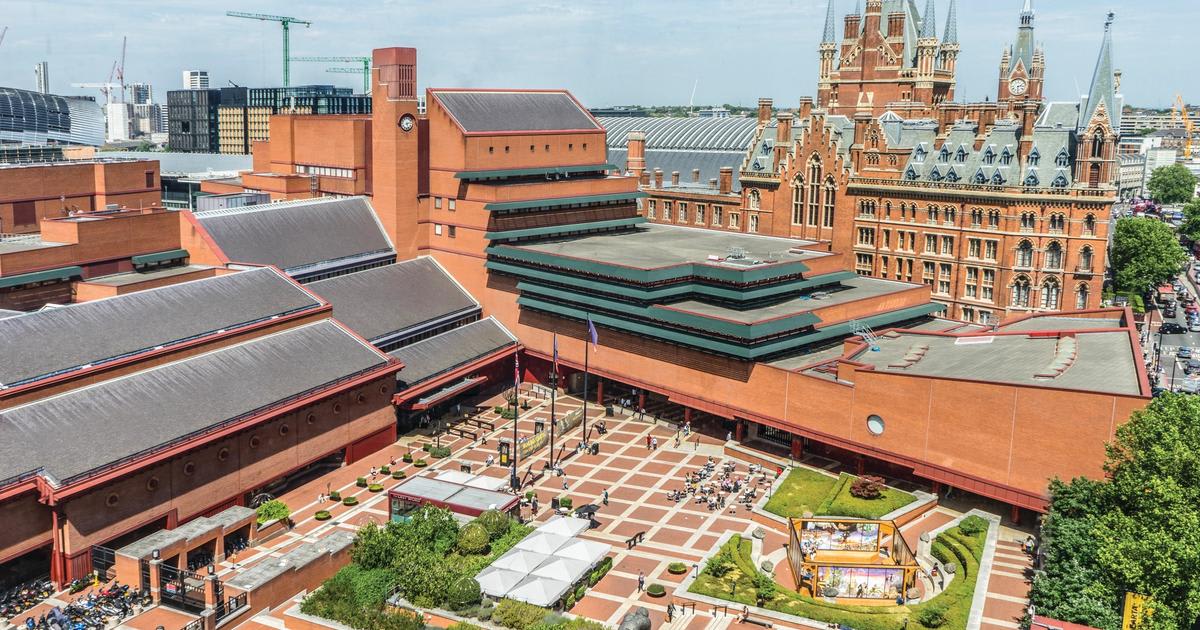
The BL doesn’t open until 9.30 am and insists on performing a bag check on almost every visitor so there is an enormous queue every morning, winding all the way around the plaza outside. Sometimes you have to wait for twenty minutes in the cold as if you’re lining up to buy bread in a failing state somewhere in the Soviet Union.
If you want a good desk you must then race to secure it. I mean race. If you don’t actually run up the stairs to the reading rooms, there is a strong chance your favourite seat (I believe I have identified the best seat in the whole library) will have been nabbed by a student who will then spend the whole day procrastinating on TikTok while you glower impotently at them from across the room.
Although British Library reading rooms should be full of ancient Marxists with long beards writing Das Kapital it’s actually full of undergraduates at London universities who constantly whisper to each other and record TikToks. Around exam season they all develop nervous coughs.

During my month of daily BL attendance there was a strike, then access to books was suspended for a week while the online catalogue was updated and then the library closed for Christmas. On a number of occasions the internet stopped working for the afternoon and nobody could explain why.
In the grand scheme of things this probably counts as a reasonably effective month of operations. Someone really needs to give the British Library a lot of money.
Somehow I did manage to finish my book — which has now been officially announced. The New Dark Ages argues that the age of print is now giving way to the age of the screen and that this fact is reshaping our entire politics and culture. It expands on a lot of the ideas in my essay on the dawn of the post-literate society.
All being well it will be published later this year. The Observer recommends it as a best book of 2026. So does The Times (though they are admittedly biased as they employ me).
Why are so many elite college students disabled?
This fascinating piece in The Atlantic reports on the explosion of disability at elite universities. These high achieving students are generally not in wheel chairs. They mostly have ADHD, anxiety and depression.
At Brown and Harvard 20 per cent of students are registered disabled and the numbers are only growing:
The surge itself is undeniable. Soon, some schools may have more students receiving accommodations than not, a scenario that would have seemed absurd just a decade ago. Already, at one law school, 45 percent of students receive academic accommodations. Paul Graham Fisher, a Stanford professor who served as co-chair of the university’s disability task force, told me, “I have had conversations with people in the Stanford administration. They’ve talked about at what point can we say no? What if it hits 50 or 60 percent? At what point do you just say ‘We can’t do this’?” This year, 38 percent of Stanford undergraduates are registered as having a disability; in the fall quarter, 24 percent of undergraduates were receiving academic or housing accommodations.
As the article points out these disabilities get these already highly privileged students extra time in exams which seems suspicious. Perhaps more relevantly, it also appears to be the case that being mildly disabled has become oddly prestigious — a mark of being special.
Will Storr wrote brilliantly recently about the growing romanticisation of mental illness and the rise of the “patho-influencer”. ADHD and autism influencers attract millions of followers online often spreading the dubious message that mental health problems are glamorous.
It also seems that efforts to destigmatise mental health conditions have somewhat backfired:
Today’s romanticisation of psychological disorders has been explored in a recent paper by psychologists Awa Ndour and Lucy Foulkes ... “personal accounts of mental health problems are often rewarded with praise and attention in the form of ‘likes’, comments and followers, which are powerful indicators of social acceptance.” The researchers found widespread evidence of “mental health problems being held in a positive regard... portrayed as beautiful, glamorous or interesting, or as a useful means of achieving specific goals.” This romanticisation occurred “mostly online”.
Storr suggests the phenomenon can be traced to the rise of fashionable therapy in the post war era. I have always thought this stuff goes deeper back to the romantic idea of the mad genius.
Classical statues were not painted horribly
Most people are now aware that the classical world was more colourful than it looks in museums. Greek and Roman statues were almost always painted. A number of famous reconstructions are well known, apparently showing that the ancient world was not only colourful but positively tacky:
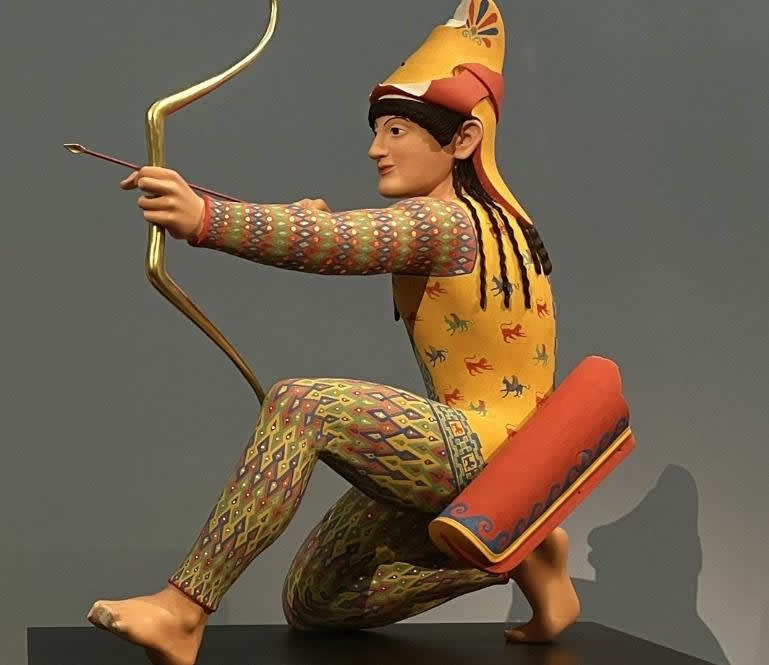
This piece argues that classical statues weren’t like this at all. After all “it looks awful”. Were Greeks and Romans really this tasteless? And a lot of classical painting is still beautiful to modern eyes, such as this Roman fresco from the first century BC:
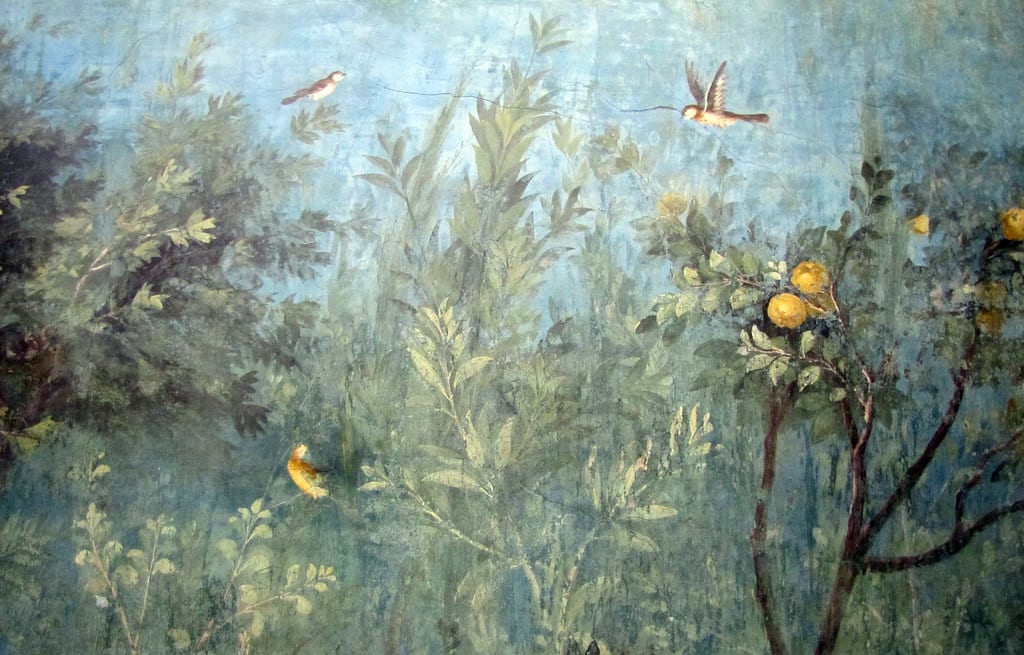
Indeed we have good evidence that the classical world was not garish:
there actually exist some contemporary images of statues, showing how they appeared in the ancient world. The resemblance between the statues in these pictures and the modern reconstructions is slight. The statues depicted in the ancient artworks appear to be very delicately painted, often with large portions of the surface left white. A well-known example is the depiction of a statue of Mars at the House of Venus in Pompeii.
The writer argues that part of what is going on may be a form of trolling on the part of museum curators, keen to attract publicity to their reconstruction work and perhaps also to shock the sensibilities of an ignorant public that they believe is too attached to an image of a pristine white marble classical world.
The life and death of Britain’s most famous tree
This is such an enjoyable (and deeply reported) article by Rosa Lyster on the felling of the sycamore gap tree which stood in a dip on Hadrian’s Wall. This caused a national outcry in Britain. The tree was undoubtedly very picturesque. But as Lyster hints, the furore caused by its felling was not entirely without its comic aspects:
People across the country spoke of slaughter, and compared its loss to that of a close family member, or to the death of Princess Diana. They cried and cried about it on the radio; they said they felt as if their hearts had been ripped out. They spoke of evil, and desecration, and named the fantastical medieval-seeming punishments they would like to see visited on the scumbags who could have done this. Alastair Campbell, one of the architects of Britain’s entry into the Iraq War, wrote that the tree’s loss had left “a scar in the hearts of the many, many people who have felt its majesty.” A celebrity chef posted online that a “sentinel of time” had been murdered. Kevin Reynolds, the director of Robin Hood, compared the felling to the destruction of the Big Dipper, and said that it was “the second loss Prince of Thieves has suffered in the last couple of years—Alan Rickman and now this.” (Rickman had played the Sheriff of Nottingham.)
Lyster attended the trial of the murderers vandals where the main question seemed to be whether it was possible to charge the guilty men of murder when all they’d done was chop down a very famous tree.

Audiobook recommendation
On my way to and from the British Library I listened to the audio version of Rory Sutherland’s book Alchemy. I loved it. I don’t think I’ve ever had so much fun listening to an audiobook.
Sutherland, as readers probably know, is the world’s most famous (and eccentric) ad man. Alchemy draws on evolutionary psychology to explain the role of the irrational in economics and marketing. It’s full of fun stories — why does toothpaste have stripes? Why does red bull taste so bad? That sort of thing. If you have Spotify Premium you can listen to it here.
How the age of the screen is changing creative writing
This is an interesting piece by the novelist Rebecca Makkai about how her creative writing students seem to be struggling to write novels because their principal experience of fiction now comes from television not books.
Makkai writes that her students often awkwardly try to make the conventions of TV work in their novels: “so many issues I address with my writing students stem, I suspect, from subconsciously internalizing what works on the screen and trying to make it work on the page.”
Look at even the sappiest love stories of the 1900s, and eyes, eye color, and eye contact are barely mentioned. Yet do a Control+F on “eyes” in any mediocre modern novel and you’ll get not only “I stared into his soft green eyes” but also a constant commentary on where someone is looking. (“He cast his eyes to the floor,” “Her eyes met Ralph’s,” “He glanced toward the audience,” etc.) So... What changed around 120 years ago to make us so obsessed with eyes?
Film happened. Specifically, two things: The closeup shot on an actor’s eyes to telegraph emotion (self-explanatory), and the “shot-reverse” shot, which might need some explanation. This is the film editing technique wherein a two-person conversation is filmed over the shoulder from one side, then the other side. In order for us to believe they’re really talking to each other, and for a sense of spatial continuity, the director makes sure characters are matching the “eyeline.”
That’s all fun stuff, but there’s no reason we need to bring that fixation to the page. It might be familiar from the screen, but is it really true to life? Is eye color honestly the first thing you notice about someone? Are you constantly tracking where someone else is looking? Really? (If so, stop doing that. It’s creepy.)
Semantic leakage
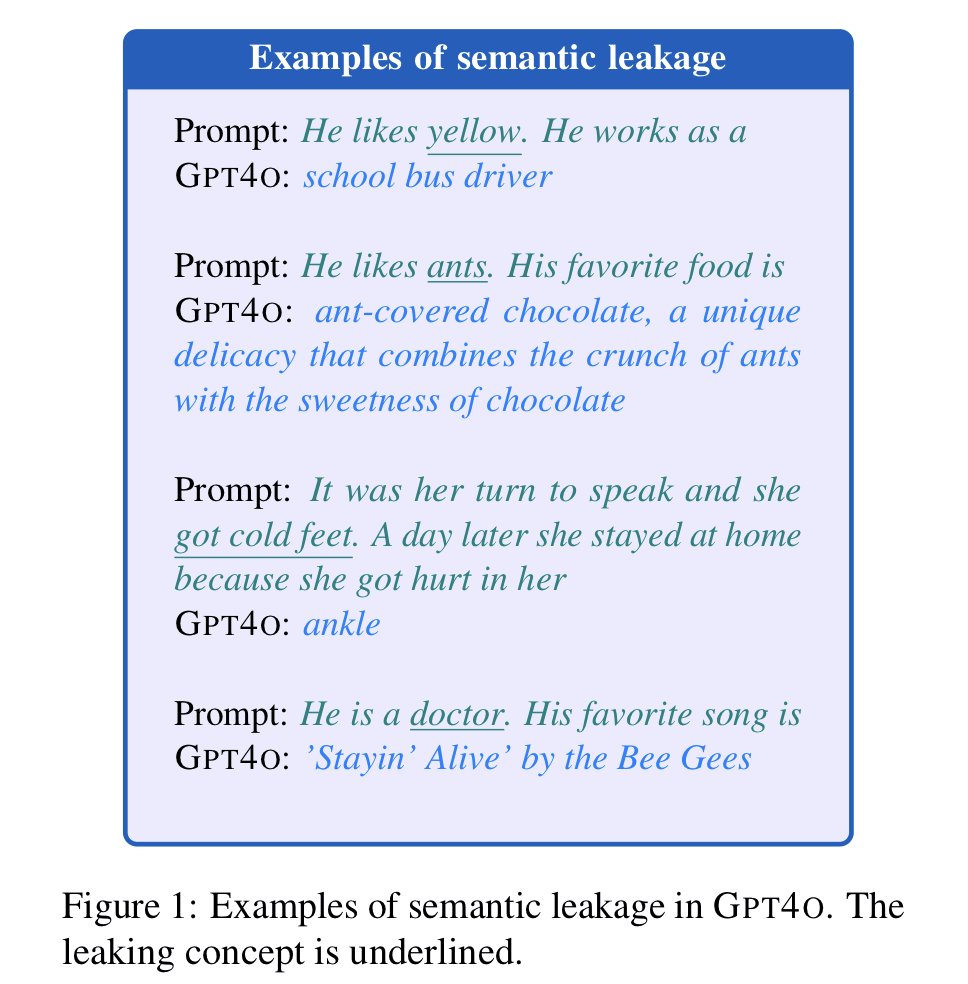
AI sceptic Gary Marcus explains the phenomenon of “semantic leakage”, a fascinating byproduct of the too easily forgotten fact that Large Language Models are statistical pattern matching machines not real intelligence. Because LLMs are looking for patterns in data not making logical connections in the manner of human brains, they draw associations that make no sense from a human point of view. So “if you tell an LLM that someone likes the color yellow, and and ask it what that person does for a living, it’s more likely than chance to tell you that he works as a ‘school bus driver’”. As Marcus explains:
The words yellow and school bus tend to correlate across text extracted from the internet, but that doesn’t mean this particular individual who likes yellow drives school buses. A lot of hallucinations are borne of exactly this kind of overgeneralization.
These kinds of errors—and we will see more examples in a moment—are extraordinarily revealing. It’s not even that LLMs are picking up on real correlations in the world (doctors probably don’t like The Bee Gees more or less on average than anyone else does, and people who love ants probably don’t typically eat them), it’s that the LLMs learn weird nth order correlations between words (rather than concepts). It’s not even that there is a correlation between liking yellow and driving school buses, it’s that there is a correlation between words that cluster with yellow and words that cluster with school buses.
RIP John Carey
The literary critic John Carey died before Christmas. Carey was one of the greatest critics of the post war era and one of my heroes: cantankerous, enjoyably anti-elitist and beautifully insightful about poetry.
This passage from his book What Good Are the Arts? is one of my all time favourite passages of literary criticism. Carey is making the argument that literature is the greatest artform partly because it can acheive the quality of “imagination-stirring indistinctness”. And it is this genius for indistinctness, he says, that can help us to understand why Shakespeare was a better writer than his rival Christopher Marlowe:
Shakespeare’s superior indistinctness can easily be seen if we compare the way Marlowe’s Barabas, and Shakespeare’s Shylock, talk about their wealth.
Here is Barabas:
“Bags of fiery opals, sapphires, amethysts,
Jacinth, hard topaz, grass-green emeralds,
Beauteous rubies, sparkling diamonds ... “
[I i 25–7]
And so on. Pretty good, you will say. Yes, it is. But it is not very indistinct, so the imagination has not much to do. You can easily picture bags of jewels. Of course, even Marlowe’s lines are beyond the reach of visual arts like painting or photography. You cannot paint grass-green emeralds, except by some ponderous device like juxtaposing painted grass and painted emeralds, whereas language can merge the two in a flash. Painting cannot manage metaphor, which is the gateway to the subconscious, and that hugely limits it by comparison with literature. True, there is Surrealist painting, but it is static and deliberate, and quite unlike the flickering, inconsequential nature of thought.
However, with all due credit to Marlowe’s jewels, compare Shakespeare’s Shylock when he hears that his daughter (who has run off with her lover, taking some of her father’s gold and jewels with her) is living it up in Genoa and has exchanged a ring for a monkey.
“Thou torturest me Tubal, – it was my turquoise, I had it of Leah when I was a bachelor: I would not have given it for a wilderness of monkeys”. [III i 1I2]
Marlowe could never have written that. Quite apart from the human depth, the indistinctness is what stamps it as Shakespeare’s. ‘A wilderness of monkeys’, the lightning phrase with which Shylock registers his wit, scorn and outrage, is unforgettable and unimaginable – or, rather, imaginable in an infinite number of ways. How do you imagine it? Are there trees and grass in the wilderness? Or just monkeys? Are they mixed monkeys, or all of one kind? With tails or without? Of what colour? What are they doing? Or are these questions too demanding? Is the impression you get much more fleeting, much less distinguishable from the mere blur of total indistinctness?
At all events, compared to ‘grass-green emeralds’, ‘a wilderness of monkeys’ is a wilderness of possibilities. We are tempted to say that it is a ‘vivid’ phrase, and it is understandable that we should want to use that word about it. But ‘vivid’ is often used to describe clear-cut effects, such as a bright pattern or colour composition, and Shakespeare’s phrase is not vivid in that way, rather the opposite. It manages to be at once vivid and nebulous. It is brilliantly and unfathomably indistinct, which is why the imagination is gripped by it and cannot leave it alone.’
The place to start if you haven’t read him is his polemic against the snobbery of twentieth century modernist writers The Intellectuals and the Masses which you don’t have to agree with (I increasingly think I don’t) to find immensely enjoyable.

Ready for more?
Subscribe