When Change Outruns Us
Length: • 9 mins
Annotated by Michael
Why growth depends on absorption and recovery
In 2007, Nokia was unstoppable. The Finnish company sold more phones than Apple, Samsung, and Motorola combined. Its market share hovered near 40 percent, its margins were envied across Europe, and its brand was a symbol of reliability. Inside the company’s sprawling Espoo campus, engineers spoke in the language of precision and process. Decisions were documented, metrics tracked, and procedures refined. Nokia didn’t improvise; it executed.
But then came the iPhone. What followed wasn’t a single transformation, it was a dozen. Between 2005 and 2010, Nokia reorganized its leadership structure six times. It spun up new software divisions, launched competing internal projects, and replaced process after process in a desperate attempt to rediscover its agility. On paper, the company was moving fast. In reality, it was exhausting itself.
According to a case study by Harvard Business Review titled Nokia: The Inside Story of the Rise and Fall of a Technology Giant, the pace of internal change became so relentless that employees stopped resisting it altogether. “We were constantly reorganizing,” one executive recalled, “but never really improving.” Managers grew fearful of voicing skepticism because tomorrow’s process might make today’s priorities irrelevant. Even when engineers recognized the threat of Apple’s software ecosystem, they had no energy left to fight through another round of reorgs. The company’s culture didn’t calcify, it frayed.
That’s how Nokia lost the race it had once dominated. It didn’t die from complacency. It died from exhaustion.
And that exhaustion has a name.
Researchers call it the acceleration trap, a state where organizations push so hard to stay adaptive that they outpace their own ability to absorb change. A similar pattern appears in research published by the American Psychological Association, which reports that workers experiencing recent or current change were more than twice as likely to report chronic work stress compared with employees who reported no recent. They were also more than four times as likely to report experiencing physical health symptoms at work (34 percent vs. 8 percent).
When a company’s processes evolve faster than its people can adapt, it stops learning. It just spins faster. But how do we reconcile that with statements such as this quote about the need to be constantly growing and thus changing?
“When you stop growing, you start dying,” wrote William S. Burroughs.
Burroughs and many others who have had similar sentiments were right, but in today’s organizations, the opposite can also be true. When you change too fast for your people to change with you, you begin dying in a different way, quietly, internally, without noticing.
Change fatigue isn’t about resistance to improvement. It’s about recovery. Humans can adapt to nearly anything if they have time to make meaning of it. But when every new quarter brings another operating rhythm, another metric, another way of working, adaptation becomes impossible. What’s left is compliance without conviction, a workforce running at full speed with no idea where the road leads.
That’s where many modern companies find themselves. Not in decline, but in motion. Not failing, but fraying.
The hidden cost of constant motion often shows up quietly, long before anyone names it. A team begins by taking on a little extra work, then another initiative, then a new operating rhythm that promises focus or efficiency. At first it feels invigorating, a sign that the company is serious about improvement. After a few cycles, though, the energy shifts. People start asking whether this process will last longer than the previous one or whether the new priorities are merely a prelude to the next reshuffle. Confidence drifts toward caution. Caution drifts toward disengagement. Eventually the organization is still moving quickly, but no one believes the movement leads anywhere.
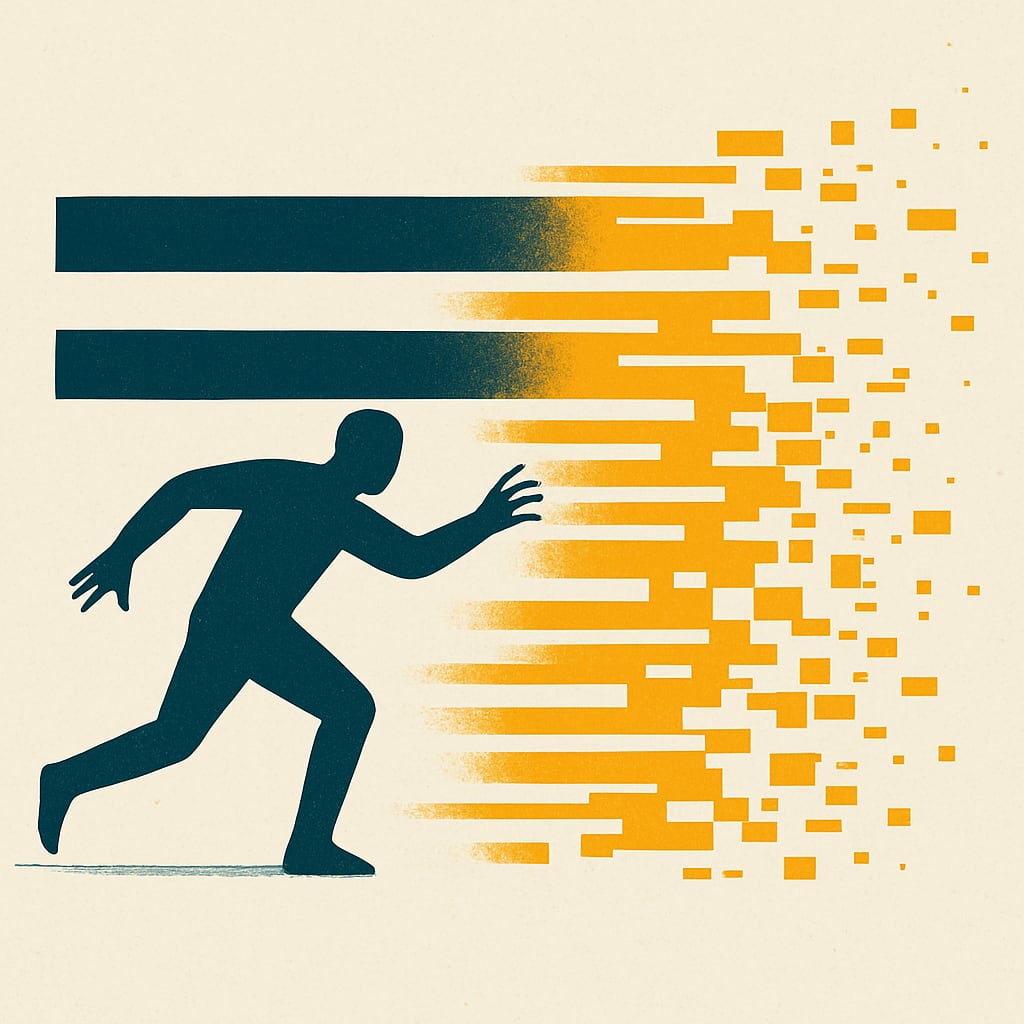
Modern companies rarely suffer from too little motion. They suffer from motion that outpaces meaning. When every quarter brings a new metric and every month a new way of working, teams lose the ability to tell signal from noise. A change that might have been welcomed on its own becomes one more input in an already overloaded system. The human mind can absorb complexity, but not indefinitely. Without time to integrate what changed last month, the next shift feels less like progress and more like whiplash.
This is where the real damage begins. People stop challenging assumptions, not because they agree with them but because they can no longer keep up with which assumptions matter. They stop voicing concerns because they have seen priorities reverse so often that dissent feels pointless. Managers who once coached with conviction start managing around their own uncertainty, softening decisions they know may be obsolete in a few weeks. A company may still appear nimble from the outside, yet inside it is running on a kind of organizational autopilot, guided more by habit than by judgment.
The culture slowly rewires itself. Instead of asking what will create the most value, people ask what will help them survive the next change. Instead of taking smart risks, they stick to safe interpretations of the latest directive. Curiosity contracts. Learning slows. The company moves faster but knows less, a contradiction that rarely shows up on dashboards but always shows up in the work. This erosion is subtle because it hides behind the appearance of activity, but it is also profound because it undermines the very capabilities leaders think they are strengthening.
Eventually motion becomes the story leaders tell themselves to avoid confronting a harder truth: they have confused velocity with direction. Speed becomes an alibi for clarity. The organization keeps spinning, confident that enough activity will eventually add up to progress. Yet beneath that churn lies the real cost, the gradual dimming of imagination, agency, and shared purpose. And once those fade, it no longer matters how fast the company is moving. It has already begun to drift.
A strange irony sits at the heart of modern work. Companies set ambitious goals to grow, transform, and outpace competitors, yet the very pace meant to secure that future often undermines the capacity required to reach it. Growth is not just a matter of adding initiatives or increasing throughput. It is the process of building muscles that can bear more weight. Muscles strengthen only when they have time to repair themselves. Organizations are no different. When leaders stack change upon change without space for interpretation, workers lose the ability to metabolize what any of it means.
Absorption is the missing ingredient. It is the quiet interval in which people make sense of new expectations, renegotiate habits, rebuild trust, and integrate lessons from the last experiment. Without it, even good ideas collide with the residue of previous shifts. A new prioritization framework is adopted before teams understand why the last one failed. A reorg is announced before the dust from the previous one settles. Leaders misread the resulting confusion as resistance, when in reality employees are simply saturated. Their cognitive and emotional bandwidth is gone.
This is why even well intentioned efforts unravel. When a company moves so quickly that its people cannot digest what they are being asked to do, growth becomes performative. Teams mimic the language of progress but cannot embody it. A culture that was once resilient begins to lose its elasticity. Decisions that once flowed now get stuck in hesitation. And rather than learning from each iteration, the organization drags the unresolved debris of one change into the next. You cannot expand your capabilities if you never stop long enough to consolidate them. Growth asks for movement, but it also asks for meaning. Without both, momentum becomes nothing more than noise.
Nature offers a more honest model of transformation than most corporate playbooks. Living systems adapt, but they do so through cycles of stress and recovery. A muscle grows only after it tears and repairs. A forest regenerates only after fire is followed by stillness. Even the brain reorganizes itself during downtime, pruning old pathways and strengthening new ones in the quiet hours of sleep. Change, in biological terms, is not an unbroken sprint. It is rhythmic. It requires periods of integration as surely as it requires moments of strain.
Organizations forget this. They apply constant pressure, believing that continuous motion signals health. Yet no organism thrives under permanent load. Without recovery, strain becomes inflammation, and inflammation becomes breakdown. Teams behave the same way. A new process may be introduced with clarity, but without space to internalize it, the process does not take root. People remember the instruction, not the intention. They adapt for a moment, then slide back into old patterns because nothing in the system supported the rewiring.
Recovery does not mean retreat. It means assimilation. It means time for reflection, calibration, and the small social negotiations that allow people to reestablish shared understanding. These pauses are not inefficiencies. They are the mechanisms through which complexity becomes manageable. Companies that honor this rhythm do not move slower. They move smarter. Their people learn deeply rather than shallowly. Their systems evolve rather than merely mutate. And when the next challenge arrives, as it always does, they have the internal strength to meet it rather than the accumulated fatigue that so often masquerades as resilience.
Adaptive organizations move with an unusual blend of confidence and humility. They introduce change, but they also make room for the organization to absorb it. Their leaders recognize that speed is only useful when the system is strong enough to carry it. So instead of pushing teams through a continuous sequence of reinventions, they create rituals that allow people to process what has shifted, understand why it matters, and recalibrate their work accordingly. These moments rarely look dramatic from the outside. They often appear as simple pauses: a clarified roadmap, a retrospective that digs below surface symptoms, or a steady cadence that privileges coherence over novelty.
In these companies, slack is not a luxury. It is infrastructure. Breathing room is treated as the engine of judgment and invention. Teams use it to repair small cracks before they widen, to refine tools that have lost their edge, and to strengthen the connective tissue that holds their culture together. Change itself becomes less chaotic because people have the capacity to meet it with presence rather than reflex. You can see this rhythm in the most consistently innovative teams. They move quickly, but they also stop deliberately. They build feedback loops that are short enough to catch problems early and honest enough to surface the truth before it hardens into dysfunction.
What distinguishes these organizations is not their appetite for change but their respect for the cost of it. They treat each shift as a hypothesis that must be tested, discussed, and integrated, not as a proclamation that simply cascades downward. Leaders ask whether the system is ready for the next adjustment instead of assuming readiness. They watch for signs of saturation: deteriorating judgment, chronic ambiguity, or enthusiasm that has thinned into compliance. When they see these signals, they adjust the pace rather than insisting the pace is the point. Paradoxically, this restraint allows them to transform more effectively than companies that never pause. Adaptation becomes cumulative instead of cyclical. Each change prepares the ground for the next rather than burying what came before.
By the time an organization realizes it is spinning, it has usually been spinning for a long while. Motion creates its own momentum, a seductive hum that convinces leaders they are on the move even as the quality of thought inside the company slowly fades. It happened to Nokia as its reorgs piled on top of each other. It happens now to countless firms racing to match the tempo of markets rather than the capacity of their people. The danger is never the initial impulse to improve. The danger is the belief that more movement must equal more progress.
Progress feels different. It has texture. It has traction. It comes with a sense of shared direction that quiets noise instead of amplifying it. When you walk into a team that is genuinely progressing, you can feel the steadiness underneath the pace. People understand what they are learning and why it matters. They can connect today’s decisions to last month’s lessons. Their energy is sharp rather than scattered. Their culture bends under change without tearing.
Many companies today are not failing in any dramatic sense. They are simply moving too fast to notice the gradual unraveling at the edges. They look busy, but their capacity for judgment thins. They look productive, but their trust networks weaken. They look dynamic, but their imagination grows brittle. The problem is not motion. The problem is motion without recovery, ambition without absorption, speed without the systems that give speed meaning.
The organizations that endure find the courage to slow their spin. They reclaim the intervals that allow learning to take root. They measure progress not by the number of initiatives launched but by the clarity gained and the capability strengthened. They understand that constant motion exhausts, while deliberate motion transforms. And once they find that tempo, they move again, faster this time, but steadier, guided not by the illusion of momentum but by the quiet certainty of progress.
PreviousNext
Ready for more?
Subscribe