Understanding The Impacts Of Generative Ai Use On Children
Length: • 16 mins
Annotated by Alf Viktor


Understanding the Impacts of Generative AI Use on Children
Introduction
There is a growing body of research looking at the potential positive and negative impacts of generative AI and its associated risks. However, there is a lack of research that considers the potential impacts of these technologies on children, even though generative AI is already being deployed within many products and systems that children engage with, from games to educational platforms. Children have particular needs and rights that must be accounted for when designing, developing, and rolling out new technologies, and more focus on children’s rights is needed. While children are the group that may be most impacted by the widespread deployment of generative AI, they are simultaneously the group least represented in decision-making processes relating to the design, development, deployment or governance of AI.
The Alan Turing Institute's Children and AI and AI for Public Services teams explored the perspectives of children, parents, carers and teachers on generative AI technologies. Their research is guided by the 'Responsible Innovation in Technology for Children' (RITEC) framework for digital technology, play and children’s wellbeing established by UNICEF and funded by the LEGO Foundation and seeks to examine the potential impacts of generative AI on children's wellbeing. The utility of the RITEC framework is that it allows for the qualitative analysis of wellbeing to take place by foregrounding more specific factors such as identity and creativity, which are further explored in each of the work packages.
The project provides unique and much needed insights into impacts of generative AI on children through combining quantitative and qualitative research methods. The research consists of two work packages funded by the LEGO Group, comprising survey research
on opinions of children, their parents and carers and teachers, and qualitative research through school-based workshops, which explored children’s experiences and perspectives around generative AI with a focus on multi-modal generative AI tools such as ChatGPT and Dall-E. Each of the work packages and their respective findings are outlined below. Additionally, overarching recommendations for policymakers and industry about future approaches for the safe and responsible design, development, and deployment of generative AI technologies that support the promotion of children’s wellbeing are provided. This research contributes to a body of evidence on the opinions of critically important stakeholders, as well as the potential impacts of generative AI on children and their online lives.
WP1: Surveys
Approach
The research was undertaken through two online surveys which looked to explore the impact of generative AI use on children's learning, development, and overall wellbeing. With a focus on the UK, the first of these surveys was of 780 children aged 8-12, and their parents or carers. The second of these surveys was of 1,001 teachers working in primary or secondary schools with children aged 1-16.
This work package’s foundational survey research investigates the impacts of generative AI on children’s wellbeing, with a specific focus on learning through play and creativity.
The findings from the surveys allowed the team to develop a more holistic view of children’s generative AI use, both within and outside of the classroom, and how this use impacts children’s wellbeing.
Key Findings
Nearly a quarter of children aged 8-12 report having used generative AI, with the most used tool being ChatGPT.
22% of children reported using a generative AI tool, with the majority (72%) reporting using it once a month or more. Our results show a slight gender difference, with 24% of female children reporting using generative AI compared to 19% of male children. The most popular tool used amongst children is ChatGPT, with 58% who use generative AI reporting using this tool. This is followed by Gemini at 33%, and My AI by Snapchat at 27%. We also find that, amongst children with additional learning needs, the rate of ChatGPT usage is significantly higher than those without additional learning needs, at 78% compared to 53% (respectively).
Children are mainly using generative AI to explore their creativity, find out information or learn about something, and for digital play, though these uses vary within sub-groups.
43% of children report using the tools for creating fun pictures and to find out information or learn about something, and 40% report using it for entertainment and playing around. Our findings show interesting variations by age, gender, and additional learning needs. 8-year-olds mainly use the technology for entertainment, 9-year-olds mainly use it to find out information or learn about something, 10-year-olds mainly use it for creating fun pictures, 11-year-olds mainly use it for entertainment and finding out information or learning about something, and 12-year-olds mainly use it for help with homework or schoolwork.
Children with additional learning needs report using generative AI at significantly higher rates for communication and connection, which includes playing with friends (30% vs 19% of children without additional learning needs), getting advice on something personal (39% vs 16%), and chatting and keeping themselves company (37% vs 22%).
Children who attend private schools are far more likely to report having used generative AI than children who attend state schools. Similarly, teachers working in private schools report higher student usage of generative AI than state schoolteachers.
52% of children attending private schools report using generative AI, as opposed to 18% of children in state schools. Children attending private school also report more frequent use of the technology, with 72% of these children reporting using generative AI at least a few times per week, compared to 42% of children who attend state schools.
We observe similar trends in teachers’ awareness of their students’ use of the technology; 57% of private schoolteachers report awareness around their students' usage of generative AI for schoolwork, compared to 37% of state schoolteachers.
Parents and carers are mostly optimistic about their children’s use of generative AI, but many report concerns over their children’s access to inappropriate or inaccurate information.
The majority (76%) of parents or carers whose children use generative AI feel positively about their children's use of the technology. Despite these reported levels of optimism amongst those whose children use generative AI, we still find that all parents and carers hold significant concerns around the potential impact that the technology could have on their children's exposure to inappropriate (82% of all parents) or inaccurate information (77% of all parents). Interestingly, we find that parents and carers report the lowest levels of concern around their children's use of generative AI for cheating in school, with less than half (41%) reporting feeling concern over this.
Parents, carers, and teachers all report similar levels of concern over the negative impact that generative AI may have on children’s critical thinking skills.
Our findings show that parents, carers, and teachers all share similar levels of concern over the impact the technology may have on children's critical thinking skills. 76% of parents and carers indicated they were concerned their children may be too trusting of
the technology and not think critically about the information it provides. 72% of teachers share a similar concern around the negative impact that the technology might have on their students' critical thinking skills.
Teachers report that more than half of students who are using generative AI for schoolwork use the tool to submit AI-generated work as their own.
Of the teachers who reported awareness of their students' use of generative AI for schoolwork, 57% reported these students were using the technology to submit AI- generated work as their own. When broken down by private versus state school, we find that 47% of teachers working in private schools report awareness around this type of use by their students, compared to 60% of teachers in state schools. Taken together, however, these findings stand in relative contrast to the concerns that parents and carers have around the negative impact the technology might have on their children, with the lowest reported levels of concern around the use of generative AI for cheating at school.
The majority of teachers who use generative AI are optimistic about its use in their work, reporting high levels of confidence and trust in the technology. These teachers also report improvements in their performance on various teaching tasks, aided by the use of generative AI.
85% of teachers that report using generative AI at work agreed that the technology had increased their productivity, with a further 88% agreeing that they felt confident using the tools they listed. More than half of teachers (61%) also reported trust in the systems they use, and 82% agreed that they felt the technology had a positive impact on their teaching. When asked to assess whether or not the technology had significantly improved the quality of their performance on the activities and tasks they indicated they had used generative AI for, over 75% of teachers agreed that it had.
Teachers are less optimistic about the impact that students' use of generative AI may have – with the exception of its use as a tool to support students with additional learning needs.
Our survey shows that teachers have mixed feelings around the potential impact of generative AI on students' schoolwork and wellbeing. 64% of all teachers believe that generative AI is a great tool to support students with additional learnings. However, 49% of teachers who are aware of their students' use of the technology for schoolwork indicated they believe the technology has had a negative impact on their students' engagement in classwork, and 48% believe it has made the ideas that students are submitting less diverse. 40% of teachers agreed that generative AI may have a positive impact on the creativity of students' work, with the remaining 60% either disagreeing or feeling neutral. Overall, nearly half (49%) of all teachers report concern around the impact that generative AI may have on students' wellbeing.
When it comes to generative AI's impact on student creativity, our survey found mixed results. Of teachers who reported awareness around their students' use of generative AI, 40% agreed with the statement that the technology has had a positive impact on the creativity of these students' work, as opposed to 43% who disagreed. A separate statement, presented to all teachers, sought to elicit their views on the technology's ability to foster creativity. Here, we find that 45% of all teachers agreed with the statement, as opposed to 23% who disagreed. These mixed results indicate that teachers hold opposing views around the technology, expressing hope and simultaneous concern around the technology's impact on student creativity.
WP2: School-based Engagements
Approach
The research was undertaken through workshops run in collaboration with Children’s Parliament in two state-funded schools in Scotland. 40 children aged between 9 and 11 took part in three days of workshops exploring generative AI through creative, rights- based activities and discussing their hopes and concerns about the ways that generative AI is developed and used. This work package provides insights into children’s experiences with generative AI, and importantly children's own views on the ways that generative AI should be developed and used.
Key Findings
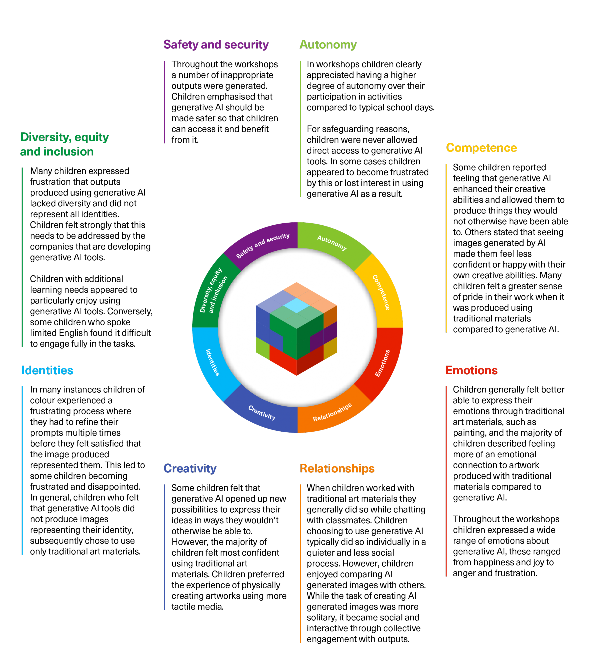
The research findings were analysed in relation to the Responsible Innovation in Technology for Children (RITEC) Framework. This framework identifies eight key factors which underpin the extent to which digital technologies support children’s wellbeing. The image below summarises the ways that children’s experiences with generative AI in this study reflected the RITEC dimensions.
In addition to considerations relating to the RITEC dimensions, children had a range of concerns about the ways that generative AI is developed and used. In particular, children had significant concerns about the environmental impacts of generative AI, and this was a major factor influencing children’s feelings about the technology. When asked how they would like generative AI to be developed and used in the future, many of the children’s responses related to actions they felt need to be taken to address the environmental impacts of generative AI.
Trust was another key theme which emerged as a central consideration in both schools with children expressing concerns about potential AI-generated misinformation and
disinformation and the difficulty of being able to reliably identify what is real and what is AI generated.
In discussing potential future uses of generative AI, children demonstrated a strong preference for it to be used in ways that would benefit society while keeping children safe online. Children expressed particular interest in generative AI being used in ways that would support children with additional learning needs.
This research demonstrates the competence and enthusiasm of children to add valuable insights to shape future decision-making about the development and governance of generative AI. It finds that children make active choices about when and how to engage with generative AI and are enthusiastic to engage in consideration of the risks and benefits of AI. Children in this study demonstrated a preference for offline tools such as arts and crafts, where these are available, particularly for creative activities. This is important when considering the choices children make around accessing digital technologies: these choices are influenced not just by the technology, but also by the environment and context in which those technologies are available, and the alternative options (or sources of entertainment/education) accessible to children.
Synthesis
By combining findings from large scale quantitative surveys with an in-depth exploration of children’s experiences through direct engagement and observation, this research provides unique insights into children’s relationships with, and feelings about, generative AI. A key strength of the research is the combination of quantitative and qualitative research methods which have enabled both a rich overview of current experience and attitudes, and a detailed look at how children engage with generative AI, and how attitudes or perceptions change and adapt through greater understanding and
experience with the technology. This combination of methods leads to a depth and breadth of insights which would not otherwise be possible.
With acknowledgement of the differences in the methodological approaches of each respective work package, there were several themes that were present across both. For example, both work packages supported the notion that generative AI – when developed safely – could be used to support young people with additional learning needs. The observations from the school-based engagements demonstrated that children with additional learning needs seemed to particularly enjoy using generative AI tools, and children mentioned that they felt generative AI could support children who find certain topics difficult or have different ways of learning. Indeed, children in the workshops pointed to this as an area in which they would like to see generative AI developed and used in the future. This was also evidenced through the surveys, where 53% of children with additional learning needs reported that they “always” used these tools to help express thoughts they couldn’t easily communicate on their own, compared to 20% of their peers without additional learning needs. The survey also found that teachers, while less optimistic about the overall impact of students’ use of generative AI, were generally supportive of the use of generative AI by learners with additional learning needs.
Another common theme centred around concerns regarding inappropriate and harmful content being produced by generative AI and accessed by children. The workshops evidenced that simple prompts occasionally resulted in inappropriate content being generated (these outputs were not shown to children in line with the project’s robust safeguarding protocol). The survey results evidenced that, ‘all parents and carers hold significant concerns around the potential impact that the technology could have on their children’s exposure to inappropriate (82% of all parents) or inaccurate information (77% of all parents)’. The research in both work packages demonstrates that children are increasingly interacting with generative AI tools which present risks of children being exposed to inappropriate or harmful outputs. This needs to be addressed urgently to ensure that children can benefit from the opportunities that generative AI presents while being kept safe and protected from risks.
There were also several areas in which the two work packages revealed different sets of findings, reflecting methodological differences. For example, this was evident in relation to the connections between level of experience with generative AI and attitudes towards the technology. The surveys found that respondents with more experience of engaging with generative AI tools typically reported more positive attitudes about the technology and its utility. However, in the school-based engagements there were a significant number of children who became less positive about generative AI after they had engaged with the tool. In particular, children who felt that the outputs of generative
AI did not reflect their identity or interests were less likely to want to use generative AI in the future. This highlights that experiences with generative AI are different for children from different backgrounds, in particular Work Package 2 found that children of colour often felt frustrated or upset that generative AI tools did not produce images that represented them. While the survey did not enable comparison in responses in relation to ethnicity, this points to an area in which further research, and action, is needed to understand how generative AI is experienced differently by different (particularly minoritised) groups, and to address inequitable impacts of generative AI.
The surveys found greater experience of generative AI tools among children and teachers in private schools compared to state-funded schools. Similarly, survey respondents at private schools typically reported more positive attitudes towards generative AI and its uses compared to those at state-funded schools. It is therefore noteworthy that the two schools engaged in Work Package 2 were both state-funded. As such the awareness and attitudes revealed through the workshops may reflect this distinction. Indeed, while workshop participants had a range of knowledge and experience about AI, many of the children reported that they were learning about generative AI for the first time through the workshops. The research findings indicate the importance of ensuring equitable access to new technologies across educational settings, and also of ensuring opportunities to learn about generative AI and the ways it can be used safely and responsibly.
An important feature of this research is its child-centred approach, seeking to understand children’s own experiences, thoughts and ideas, in addition to those of parents, carers and teachers. In doing so the research has revealed some differences in the ways that adults and children engage with this topic. In particular, the survey of teachers found that teachers were generally more positive about their own use of generative AI compared to children’s use of these tools. In particular, teachers expressed concerns that children’s use of generative AI may negatively impact their wellbeing and their schoolwork. While the workshops with children revealed varied concerns about the potential impacts of generative AI, they also demonstrated children’s ability to engage in nuanced discussions about the technology and to make informed choices regarding when, or for what purposes, to use generative AI. This reveals the importance of engaging children directly to understand their experiences, needs and concerns in relation to generative AI, and also highlights that with adequate information about generative AI, including about its limitations and potential uses, children can be supported to make informed choices about their own use of the tools.
These themes are explored further in the two full-length reports and form the basis of the recommendations detailed in the following section.
Recommendations
The recommendations stem from the nuanced perspectives of children, teachers, and parents and carers that highlighted the mixed benefits and risks of generative AI.
It is critical to note that one of the key takeaways from the research was that there can be benefits to generative AI technologies when developed safely and responsibly and with the meaningful involvement of children and young people. However, at present, there are various concerns surrounding the lack of involvement of children, low AI literacy, the presence of inappropriate and harmful content, and the negative environmental impacts of the technology. The recommendations below are divided into thematic headings and set out concrete actions that can be taken to mitigate the risks and allow for generative AI to be a tool that provides benefits to young people who use it.
Recommendations For Policymakers and Industry
Promote Child-Centred AI and children’s participation
Children are increasingly exposed to generative AI tools. The survey found that nearly a quarter of children aged 8-12 report having used generative AI. However, these tools have not been developed with children's interests in mind. Our recommendations are:
- Policymakers should actively solicit children’s perspectives and learn from their experiences in policy-making processes relating to AI, ensuring their rights and needs are not neglected in decisions about governance, innovation and investment.
- Pre-teens routinely interact with AI tools designed for older audiences. Developers must consider how their tools impact children’s needs and interests and meaningfully engage them during the design, development and deployment of generative AI – even when these tools are not intended to be used by children.
- Develop safe, age-appropriate generative AI tools so that children can benefit from generative AI without being exposed to potentially harmful or inappropriate content.
- Introduce guidance or certification schemes to identify AI tools that are safe for use in classroom settings, achieve learning outcomes and can support the agency of students.
- Both children and teachers in our research support the use of generative AI to help children with additional learning needs. Engage with children and teachers to identify and pursue opportunities to develop appropriate generative AI tools to support children and young people with additional learning needs.
Our research found that in creative tasks children have a strong preference for tactile, offline art materials over generative AI. Our recommendations are:
Support children’s diverse forms of play and creativity – both online and offline
- When advancing or investing in uses of generative AI within educational contexts, develop approaches which support wider infrastructure simultaneously, ensuring generative AI adds value alongside – not instead of – more tactile materials and approaches.
- Consider the wider context in which children may access generative AI, recognising that choices about uses of generative AI are shaped by the environment and context in which those technologies are available, and the alternative options (or sources of entertainment/education) accessible to children.
The survey results indicate that more than half of children had not previously heard the term generative AI, with significantly lower levels of awareness among children at state schools compared to private schools. Even where children had heard of, or used, generative AI, most did not appreciate the risks it can pose or fully understand how to most effectively, and safely use it. Our recommendations are:
Improve AI literacy
- Incorporate lessons about what generative AI is and how to use it safely into the formal curricula, considering educational content that may be appropriate for both primary and secondary school children.
- Educational resources that support children to learn about generative AI should inform children not only about effective use but also ethical considerations such as bias and environmental impacts, as well as academic integrity considerations such as plagiarism.
- Produce guidance for parents on how to navigate generative AI technologies with their children.
Representation is key to adoption: when children did not feel represented in outputs from generative AI, they chose not to use the tools. Children are concerned that
Address bias to improve representation in generative AI
generative AI produces biased outputs, and they want this to be addressed. Our recommendations are:
- Where AI tools may be used to augment creativity or be employed in a learning context, outputs from those tools must represent children of diverse backgrounds and experiences.
There is an existing division in access to generative AI tools: 52% of private school children reported using generative AI, compared to 18% of state school children. This has the capacity to widen the digital divide with impacts for the competence of state school students in a key future technology. Our recommendations are:
Ensure equitable access to generative AI
- Consider government support for the targeted deployment of appropriate AI tools in state schools, promoting equitable access for state school students to help bridge the current digital divide.
- Develop and provide free resources for schools to support with learning about generative AI and ways to use it safely and appropriately.
Environmental impacts of generative AI are a major area of concern for children. During our engagements, some children chose not to use generative AI after learning about its associated energy and water costs. Our recommendations are:
Address the environmental impacts of generative AI
- Implement transparent reporting of environmental impacts to end users of the technology, using terms and metrics that children can understand.
3 out of 5 teachers are using generative AI in their work, with the highest reported uses in lesson planning and research. This points to the necessity of oversight and guidance for responsible use of AI among teachers. Almost two thirds of teachers who use generative AI are accessing these tools through a personal license. Our recommendations are:
Ensure responsible use of generative AI among teachers
- Develop resources and training as part of the formal curricula to support teachers to understand generative AI and develop confidence to use it safely and appropriately.
- Consider allocating resources for teachers to enable them to access generative AI tools through institutional licenses. Access to institutional licenses, when paired with clear guidance on use, could allow for educators to use this technology in accordance with policies and established methods of best practice.