I don't think people understand how close we're getting to...
Length: • 3 mins
Annotated by Erik
I don't think people understand how close we're getting to being able to make genetically engineered superhumans. We're probably 5-10 years away from seeing babies with a life expectancy of ~100 and an IQ of ~150.
Already, with current data, we could increase IQ of future generations by 25-50 points using gene editing
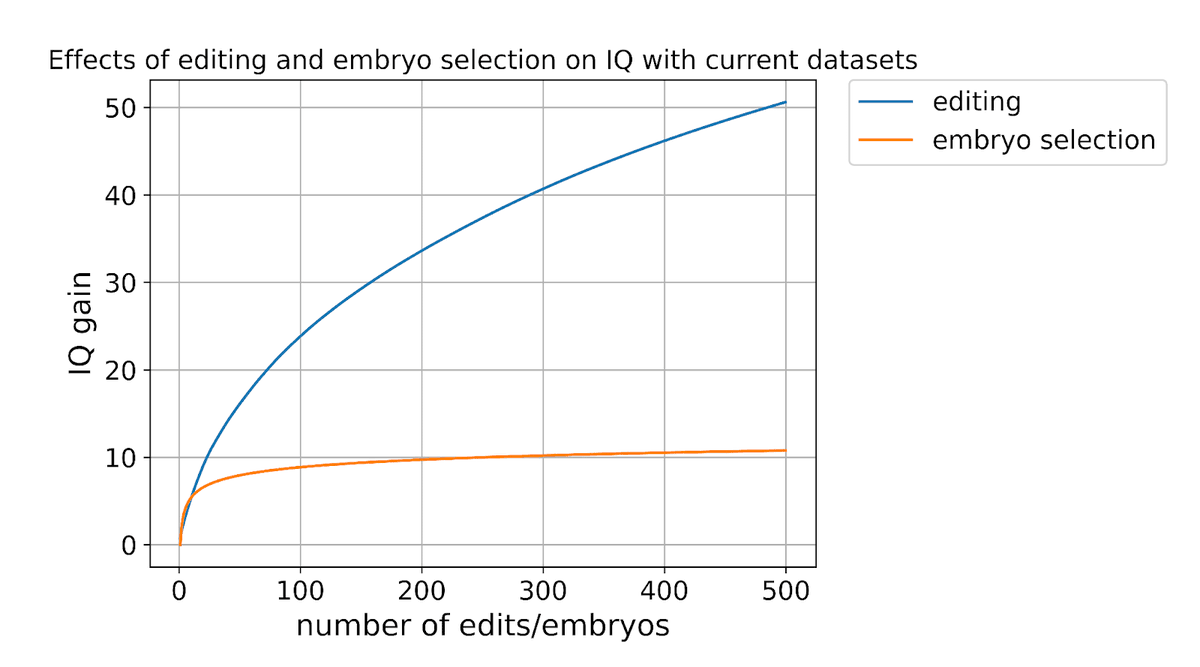
But this is just the lower bound of what's possible. Like machine learning, genetic engineering has scaling laws. The more data you have the bigger the impact from editing

We can also increase life expectancy, but our ability to do so is more bottlenecked by lack of data
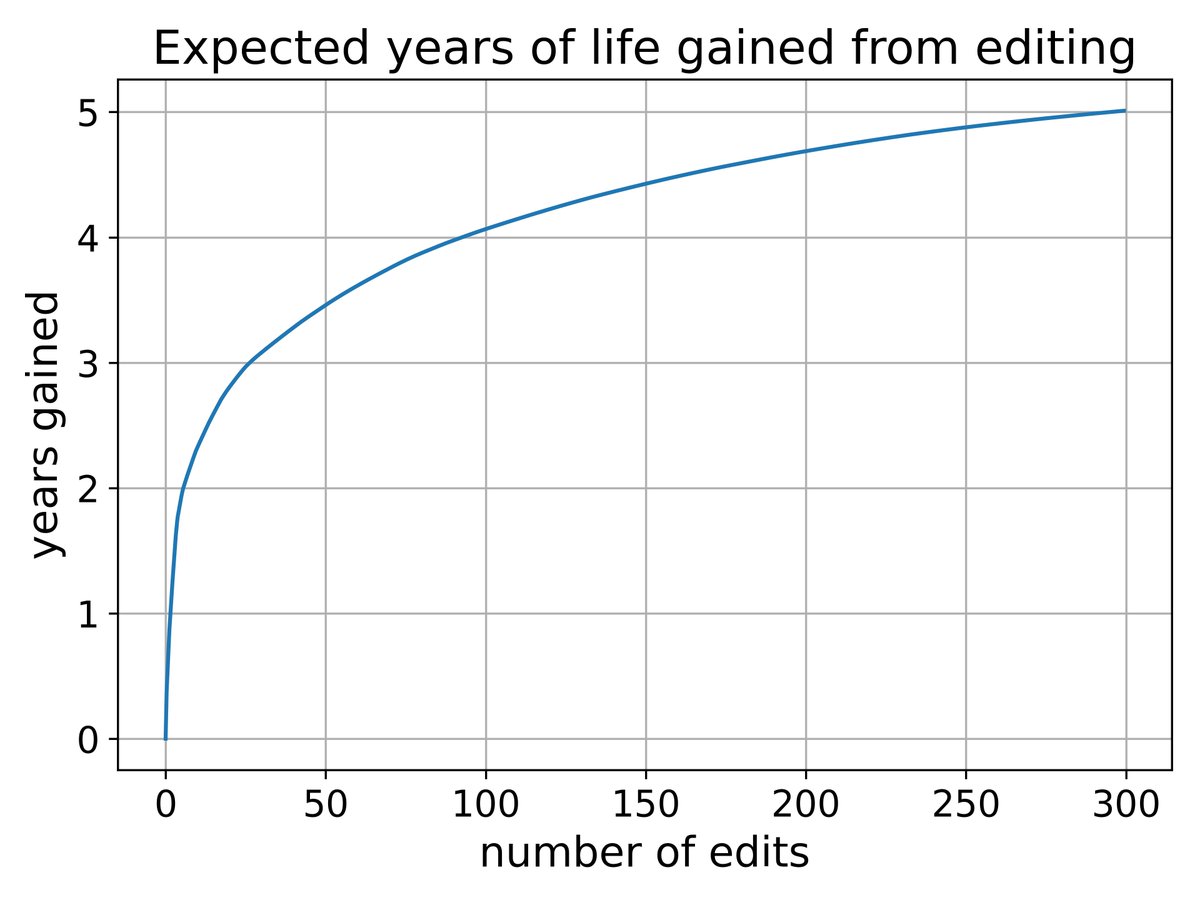
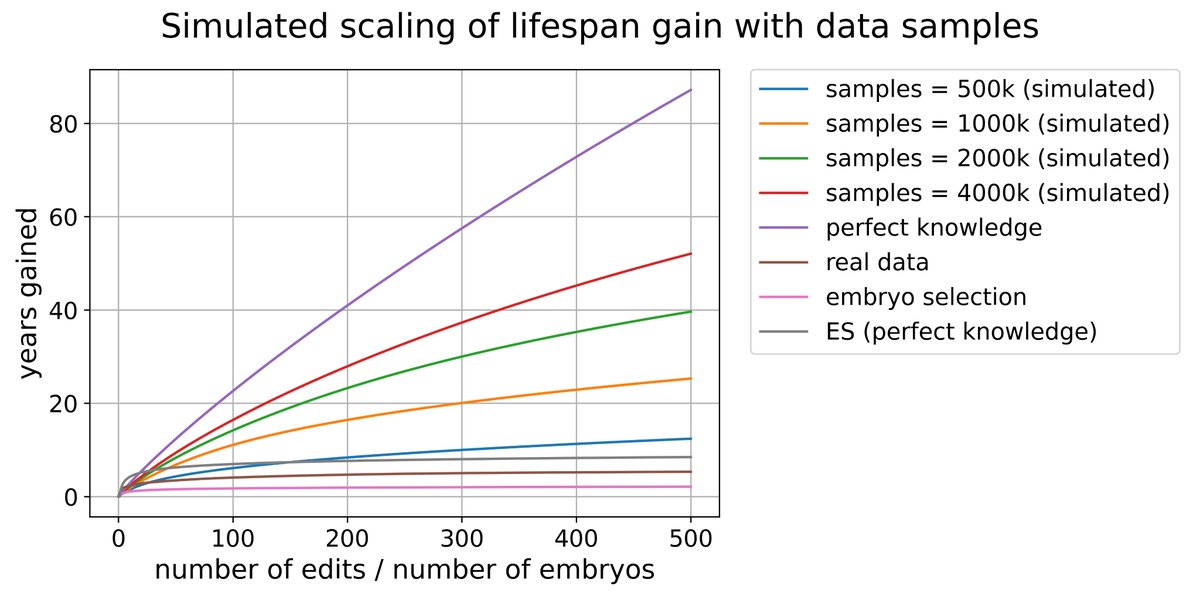
With more, we could 10x the impact on life expectancy. 4 million genomes would be enough to increase it to ~130.
We can also just target diseases directly. Gene editing could quite literally make Alzheimer's, Parkinson's, diabetes and breast cancer a thing of the past

People always ask about unintended side-effects and unexpected interactions of gene edits, but these aren't as big of a deal as you might think.
For one thing, genetic variants don't interact that much. You can do a shockingly good job predicting traits by just adding up all the effects of all the genes involved in a trait (hat tip to Steve Hsu for this graph)

For another, you don't need to worry about side-effects that much. Most genetic variants are doing mostly one thing. You can see this in charts showing genetic correlations between diseases. Most of them aren't very correlated!
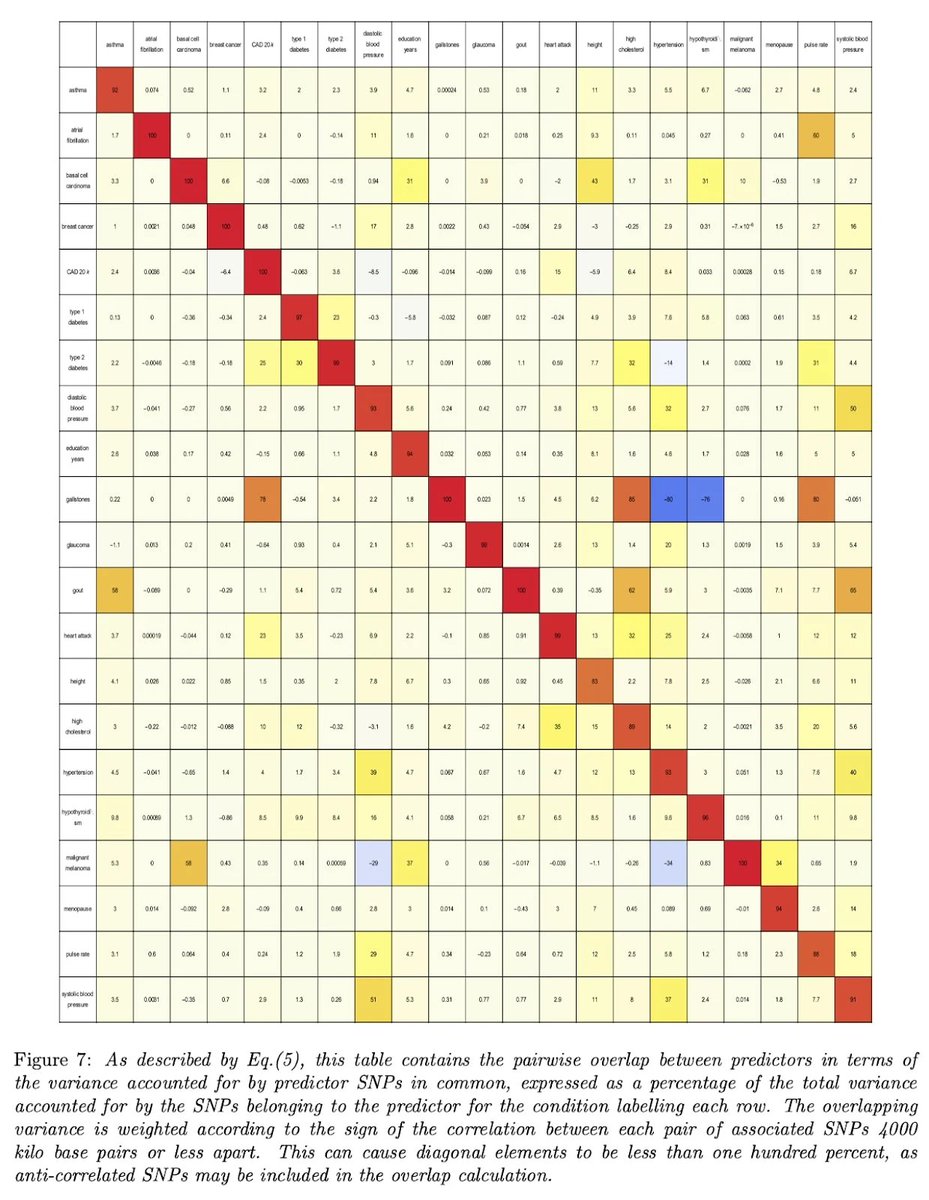
To the extent they are, the correlations mostly work in your favor: editing to reduce the risk of hypertension will also reduce basal cell carcinoma by a tiny amount.
People sometimes ask me why this tech isn't already in the clinic. It kind of is! You can literally increase your future child's IQ by ~6 points and their life expectancy by a few years RIGHT NOW with embryo selection:
lesswrong.com/posts/yT22RcWr...
But for the really powerful stuff isn't in the clinic yet and there are basically two bottlenecks to making it available:
1) Being able to make enough edits in a stem cell
2) Converting the edited cell into an embryo
Stem cells have a shelf life and editing shortens it. We can currently do ~10-20 edits in a stem cell before it loses genomic or epigenomic stability. We need to increase this to ~100-500 to have a truly massive impact.
There are dozens of little tricks to get more edits, like modifying the guideRNAs or adjusting the ratios between the guideRNA and the editor. This is what my company is working on.
The other bottleneck is being able to turn the edited cell into an embryo. You can do this by directly converting a stem cell into an embryo via reprogramming, or you can use it to make a sperm or an egg.
Here's what a protocol for making an embryo from an edited stem cell might look like:

Another option is making an egg. There's a half dozen companies like Conception and Ovelle already working on this. The big bottleneck there is primate trials; you have to test this stuff out in monkeys before you try it in humans and that's going to take a couple of years.
Making sperm might actually be easier than making eggs but no one is working on it. If you can make an edited spermatogonial stem cell you could potentially reinsert it into the testicles and have the body do the rest.
And there are other approaches. This isn't even an exhaustive list of how we could make superbabies. There's other weird stuff like chromosome selection which literally no one in the world is working on right now.

I dive into much more depth on all these topics in "How to Make Superbabies":
lesswrong.com/posts/DfrSZaf3...
Humanity is kind of dropping the ball on this right now. We could be making the smartest, healthiest generation to ever walk the earth and instead we're content to throw billions at yet another Ozempic knock-off.
We've spent decades arguing about "eugenics" as if making the generation healthier, smarter and less depressed is somehow ethically impremissable. This is obviously wrong!
We can and should work on improving the genetics of future generations. This is going to seem very obvious to most people in a decade or two.
If you’re interested in making this happen, be it as a biologist, a funder, or a policymaker, please reach out to me. We're going to try to make superbabies a reality.
You can reach me at genesmithlesswrong@gmail.com or just send me a DM.