The Perverse Magic of Long Ago: John Greyson on His Landmark Film Lilies
Length: • 15 mins
Annotated by Rick Powell
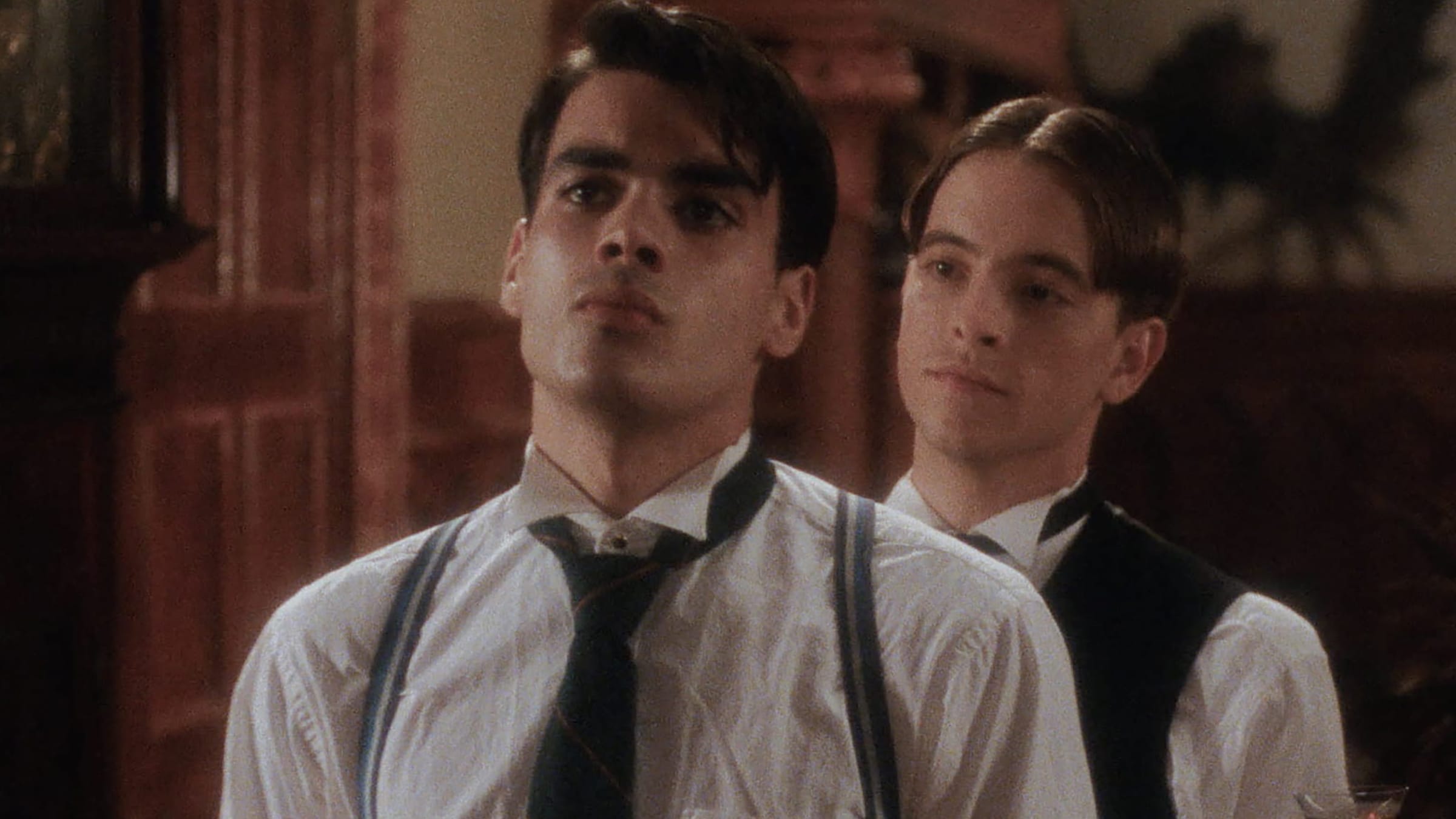
Before he made Lilies (1996), the feature that became his grand masterpiece, John Greyson was already known for his groundbreaking work in video. Identified by his irreverent humor, dance-hall pastiches, fierce political commitment, and brash inventiveness, the Canadian artist had amassed a global following through various showcases, including in New York and at the Berlin Film Festival. I met him when he was just starting out as a young man in New York City championing video and, as he would go on to do throughout his career, the work of other artists.
Based on a play by Quebec playwright Michel Marc Bouchard, Lilies was Greyson’s first adaptation and his first work to be made in 35 mm. The film wraps its transgressive themes—forbidden sexuality, race, gender, the Catholic Church, murder, and the miscarriage of justice—in a voluptuous style that alternates polished tableaux of an imagined 1912 with rougher scenes staged forty years later. Hallucinatory and pleasurable, Lilies became a breakthrough hit and won Canada’s Genie Award for Best Motion Picture of 1996 (beating out David Cronenberg’s Crash) as well as prizes for Best Art Direction/Production Design, Best Sound, and Best Costume Design.
Like the original theatrical production, the film moves not only between dual time frames but also between two locations—rural Quebec and a makeshift stage in a prison chapel. In the historical section, a romance between two young men, Simon Doucet and Vallier, arouses both resentment and desire in their repressed classmate Bilodeau, who exacts a terrible punishment for being rejected. On the shores of Lac Saint-Jean, an exotic beauty named Lydie-Anne descends in a hot-air balloon, and ultimately falls in love with Simon and plans to marry him. Meanwhile, Simon’s mother, the Countess (Brent Carver), decides to “leave for Paris,” a euphemism for taking her own life. In the parallel action set in 1952, an adult Simon serves an unjust prison sentence and contrives a way to bring the Bishop (the adult Bilodeau) to justice via a jailhouse pageant.
These switch-ups of couples and fates are Shakespearean in their variety and complexity, and Greyson succeeds in merging his own interests with Bouchard’s original explorations (small-town prejudices, historical wrongs, prison codes) to create a syncretic work that thrilled audiences in Canada and beyond.
I remember seeing Lilies for the first time at a private screening in Toronto. Greyson had just finished mixing, and soon the movie would be going to the Toronto Film Festival, but he wanted a small, friendly audience to see it first. I think I went with the filmmaker Lynne Fernie and some other pals, and I remember being absolutely stunned by it. I realized that this was not just a new phase in Greyson’s filmmaking but a brave new world entirely. Lilies went on to the New York Film Festival, where Stephen Holden reviewed it for the New York Times and described it as “an extravagantly mannered revenge fantasy . . . [that] raises the level of protest at religious prohibitions against homosexuality into a piercing operatic cry.”
In this conversation, I speak with Greyson nearly thirty years after the film’s premiere to unpack its origins, his intentions, and how Lilies plays today.
I’d like to talk a bit about the film’s place as a lynchpin in your development as a filmmaker, marking a turn from your early video work to features. In the 1980s and early ’90s, video was mostly a short-form medium that could not be projected in theaters, and was not considered to be “real” filmmaking. You were very much the king of video when you made this transition, but in your move to films you never left behind any of the mischief and audacity of your video years. What happened at that moment that made you migrate like an immigrant with official papers into the world of 35 mm?
Forged papers, I think!
Okay! Let’s start by revisiting that moment. What was inspiring you?
You know best what that moment was about, because you named it: the “New Queer Cinema.” There was an incredible community of people making work, and the festivals were enabling us and creating dialogues between all of us, and it was very global. I think of Isaac Julien’s extraordinary early work in London, alongside Stuart Marshall and Derek Jarman; the auteurs all over the U.S. and Canada, all over the world, doing extraordinary work. I remember vividly the first time that I saw Jarman’s Edward II and the first time that I saw Todd Haynes’s Poison, in 1991 and 1992. Both of those films seemed to give me permission to take this clunky, backward-looking form called “the feature film” and blow it wide open. The feature film goes back and forth, like a pendulum, from wild experimentation to conformity, and we were in a moment of its opening up. In fact, two or three years earlier was really the moment of permission that had made my earlier film Zero Patience (1995) possible. I thought, maybe, Trojan-horse-style, we could occupy this fluffy, discredited form—the movie musical—and fill it up with some ACT UP activism. Then Lilies came along, and there were suddenly possibilities that I hadn’t seen coming at all.
How did you happen to come across Lilies (Les feluettes), a Montreal theater production in French, when you were the quintessential Torontonian?
I’d seen Lilies in its first English production at Theater Pass, because my friend Damon D’Oliveira was starring as Simon. And the whole [queer] community loved the play. What’s not to love? It’s an extraordinary play, very heartfelt. Also, my mom had just died, and the play’s central narrative around the death of the mother became powerful and important to my response.
But it was all really Anna Stratton’s fault. She was the play’s producer, and she was friends with Linda Gaboriau, Michel Marc Bouchard’s translator. Anna was working with me on Zero Patience. She was the one who said: there’s this guy I want you to meet. So I met Michel for lunch, and we both came out of it thinking that this could be something interesting: for his first play to be adapted for the screen as my first time directing someone else’s work. And we both thought those two firsts could make for an interesting experiment.
You’ve referred to the New Queer Cinema moment of 1992–93 as a time when not only was there enthusiasm for the work, but suddenly there was money, too, that enabled the making of feature films, both in Canada and in the U.S. independent scene. How were you viewed by the Canadian entities you approached? I just wonder if there was an immediate “yes” because of the moment, or whether there were still walls to be scaled in terms of this project and its much larger budget.
No, acceptance was not immediate! But the Canadian Film Center was key. In 1991, I’d gone through the CFC [Canadian Film Centre], an institution that Norman Jewison had set up as a sort of mini-atelier for a new generation.1This conversation took place shortly after Jewison’s death. Jewison founded the CFC in 1986, a few years after the launch of the Sundance Institute, with a similar mission of training new generations of filmmakers. There were six of us that year, all writer-directors.
It was The Making of Monsters (1991) that changed things for me. It was a half-hour musical about antigay violence, taking the songs of Brecht-Weill and turning them inside out. And it was a big success. It won prizes in Berlin and San Francisco and at Tisch [NYU]. It changed the conversation around producing my next film, Zero Patience. Suddenly funders were saying, oh, he’s had all this success. And everyone was very aware there was a new sea change. After the success of Zero Patience, things got easier. Also, Lilies was a coproduction between Quebec and Ontario, so there was real funding—$2 million in total, which was serious for that time.
And the money’s on the screen! There’s a hot-air balloon, period sets and costumes, even a real bear.
And it’s a true coproduction, with a cast and crew that was half English-speaking, half French-speaking.

I once read a great statement you made, explaining that Lilies was a sort of cross between Genet and Fellini.
Actually, when we gathered for our first script reading and our first rehearsal with the cast, when everyone was meeting everyone for the first time, I insisted we had to screen Genet’s only film, Un chant d’amour. It’s the great prison film. I wanted to set the right tone.
Genet was such a big influence on the early New Queer Cinema, I have to say. I’m not sure that’s acknowledged enough.
He’s casting a shadow, big and broad, over my life today. My new film Photo Booth shows his influence. Photo Booth is my BDS film, my BDS manifesto, centered on the Eurovision Song Contest, which we’re all trying to boycott this year.
Seeing the bishop in Lilies, at the center of the prison section, I can’t help but think of how much of ’80s AIDS activism was directed against the Catholic Church: the demonstrations, especially at New York’s Saint Patrick’s Cathedral, and all those early ACT UP actions.
And, flashing forward, there’s that great episode of Pose where they restage the invasion of Saint Patrick’s!
How did you see this film in terms of that standoff?
I don’t think it was anything direct. What was much more present for both Michel Marc and myself was our shared history of growing up Catholic. I was an altar boy and a choirboy. He was growing up in rural Quebec in the utter grip of the post–Vatican II Council revolution, with Catholicism just emerging from the legacy of a very repressive church. I think both of us were accessing not the contemporary urgency brought by ACT UP—which also targeted Wall Street, the pharmaceutical industry, and Ronald Reagan—but our own pasts.
Can you talk more about growing up in the church? I haven't heard this before.
Absolutely. I was a true believer: choirboy, altar boy. And as you do when you’re twelve, you have faith. And my parents were reform Catholics: we went to the church down the road, the university church, with guitar masses and trips to Toronto to see Hair—“It’s what the young people are talking about.” And then we would have serious sermons about Hair. Sadly, we didn’t have any parish productions of Hair—that would have been great fun. But it was definitely a ’60s moment: the Church of the Poor, a global church, thinking about liberation theology. It was timid in many ways but definitely a progressive church.
Then came my teenage rebellion: I moved downtown to join a choir that sang Latin masses in a much more conservative church. And I started being a much more conservative choirboy. It was because that’s where my friends were, and friends trump family when you’re twelve. And I loved our choirmaster, who could make tone-deaf people like me believe they could sing.
Then I turned fourteen and discovered Patti Smith and I was moving on . . . as we do. But it was an important moment. I could identify with what was torturing Vallier, Simon, and Bilodeau, who are torn between church, family, society. I think Lilies is a study not only of church but of the small-town society of that time and its values, feeling trapped and wanting to escape.
The chapel setting was a change from the original. In the play, Simon has already been released from prison, and a group of ex-prisoners get together with him in a warehouse to kidnap the bishop and stage the play. The process of this adaptation was very collaborative. And Michel Marc actually really liked this change. We wanted to up the stakes by making the narrative a sort of prisoner action, with a feeling that at any moment they could be caught.
And one thing led to another. For instance, we recreated Lac Saint-Jean by flooding the prison chapel! All the possibilities of that act, what it means to occupy that space and what they’re doing in there—it’s utter sacrilege.

But you are also offering up every Catholic gay man’s fantasy of the Church turned around, right?
Turned around, upside down, and on its knees.
Often the problem with adapting theater is a failed staginess that overwhelms the filmmaking. But I think you were really able to change that by accentuating the theatricality in the present and then opening up the screen to wonderfully lush sequences reimagining the romance of the past.
Michel Marc had a few offers for adaptation before mine. Those versions would have all been in French, which would have preserved all the layers of language, from rural Quebecois right through to aristocratic Parisian. But all those proposed adaptations wanted to mess with his innovations: men playing women, male prisoners playing women. They all wanted to make it into a much more naturalistic work. And he was going, no, no, the magic of hallucination is essential.
Michel Marc had a bit of a Sophie’s Choice decision to make: the extraordinary poetry of the original French versus staying true to the gender and cultural concerns that he was exploring. Anna persuaded him. And she was in on bringing together the actors and crew to make it happen.
I guess the others wanted some sort of Merchant Ivory version of all this.
And we wanted Jarman.
I think that one of the gifts that Derek Jarman gave to other filmmakers in that period was the gift of violating historical realism—the gift of anachronism and the jump cut.
Edward II is even more radical in terms of form. Suddenly, in medieval England, there are Queer Nation demonstrations, naked rugby boys, and Annie Lennox in the castle singing “Ev’ry Time We Say Goodbye.” And especially as Jarman got closer and closer to the end of his life, he was just so liberated—liberated by the abyss. And I think people forgot how to say no to him.
Yes, he’d become sacred! When you look back at Lilies now, what are some of your favorite elements?
I love Sarah Polley’s book, Run Towards the Danger: Confrontations with a Body of Memory. It’s extraordinary—a mantra for the moment, a mantra for us all. I took that idea as a run towards theatricality. Everyone was nervous about making the film too theatrical. It’s such a curse! And I insisted, no, we have to run towards it. And we went for it: flooding the chapel, staging the sunset . . .
I love the story of Linda Gaboriau coming up with the film’s title.
Yeah, the original title was The Delicate Ones, the literal translation of Les feluettes. Nothing else quite landed. But she focused on that symbol of lilies. And I don’t know if you can see it, because it’s quite subtle on today’s small screens, but there’s a procession of types of lilies in the film—ones made of newspaper, then nicer paper, then parchment, and so on. The art department had the most fun origami session. The Countess carries these successive bouquets, up to the point when she’s fully at the hotel and the balloon is landing, then Lydie-Anne gives her a bouquet of real lilies.
I hadn’t known before that the gay cult of lilies goes back to Oscar Wilde. I knew about violets for women, going all the way back to Sappho. And there are pansies, too, of course. And let’s not forget, in the early days of the Smiths and Morrissey, the stage would get covered with gladiolas by rabid Morrissey fans.
Jarman also did videos for the Smiths. And for the Pet Shop Boys, Marianne Faithfull [Broken English], and so many others. He had a parallel career directing music videos.
My very first time at the Berlinale, I stayed at Tom’s Bar, a notorious Berlin leather bar with a guesthouse upstairs, and so the waiter was coming out at breakfast in leather chaps. Who do I meet at the breakfast table the next morning but Derek, with an entourage. And we had these beautiful breakfasts with him during the entire Berlinale. At the time, he was focused, I think, on making War Requiem or The Garden. I think this was around 1988 or 1989. And he wasn’t sick at the time. But he was very focused on a dear friend who was sick, whom he was taking on one last trip before he passed. It was unforgettable.
And that’s the only time we met. Another Berlin moment for me was seeing Jarman’s last film, Blue, in an empty Berlin theater. It was me and Glenn Schellenberg, the composer for Zero Patience, which was showing at the Berlinale. It’s funny how much Lilies and Berlin and Derek are all wrapped up together for me. Maybe it’s just all Derek’s fault!
Well, I think a lot of it was John Greyson’s fault too!
I have to say, though, that there are so many influences from that time. There were the Italians, of course, that earlier generation [Pasolini, Visconti]. There was Isaac Julien’s extraordinary aesthetic, which was inspiring and infecting us all. I really feel as if Lilies had a lot of collaborators. We were all making sure we looked at all these references and we were feeding on them all.

But clearly with your own personal stamp on it. I think that what Isaac Julien did was to make it okay to embrace beauty. And that’s something that wasn’t there before: there was perhaps too much rejection of beauty back then.
Also, I think Marlon Riggs’s legacy is just as important in terms of shaping a particular spirit of Lilies. There’s something about the very liberationist spirituality of Marlon that’s there.
And the losses . . . Every time you turned around you were at a funeral. So the cumulative loss and grief was what we were channeling. And there was a relief in turning our attention, in the period sequences, to Lac Saint-Jean in 1912. It’s nice to be able to leave and take a break from representing the thing that’s in your breakfast every morning. It was a way to get through it, through a time we’ll never forget. We were changed ultimately and forever.
I think it’s important for people to remember that a lot of the work of this time is so personal: it was about who you knew, the moments of encounter. A lot of these films wouldn’t exist in the way they do without those elements of serendipity. It didn’t happen online.
I’m thinking of your work before Lilies, too, especially The ADS Epidemic, Urinal, all the short video pieces that you made earlier. And the way in which, as time has moved on, you’ve taken on more and more issues in more and more formats.
You know, you’re supposed to climb the ladder: start with your shorts and your little video-art pieces, and then your first feature, second feature, third feature, while you do episodic work on the side. I had my decade of doing episodes of Queer as Folk, too, and then I jumped off the ladder, thanks to the safety net of academia and tenure. And I’ve returned in the past two decades to a practice that’s much more in sync with those early video-art projects from the ’80s. I’m still doing features. This new one, which is all about Baghdad, is the third feature in three years. It’s a return to the core ideas that were defined very much in Urinal and my early video-art work. I stuck my neck out with collaborations and other formats, but I realized in the end that my priority was always going to be the scripts that I write. That’s where the joy is.
Well, that’s wonderful to hear. I just looked at what I wrote for the preface of that encyclopedic anthology on your work that was published a decade ago [The Perils of Pedagogy: The Works of John Greyson, edited by Brenda Longfellow, Scott MacKenzie, and Thomas Waugh]. I said that your work was an incendiary blend of five essential elements: humor, music, history, desire, and sociopolitical outrage.
And that remains utterly true.
But I’d add today the lineage of the music hall, the lineage of the cabaret. You’ve just talked a lot about theater, and I think these popular forms, which are much more of the street, get polished up in Lilies. I think that mix is a big part of your work: those improvisational forms that crossed barriers and crossed audiences have always been the real basis of what you take on.
On the other hand, for almost twenty years, there has been an increasing interest in avant-garde opera and new opera—and that’s so the opposite of the popular. When we made Zero Patience, the musical had descended into the utter depths of disrespectability. And now we’re in a resurgence: the musical’s back. At that time, it was really dead, so it felt very subversive and quite deviant to embrace that form. And I think that a bit of that spirit is now embracing the form of opera, the most elitist and the most discredited of our fine art forms, filling it up with urgent content, and seeing that there is this underground movement of fellow travelers now, doing new opera in pretty queer ways.
An extraordinary Australian composer discovered Lilies through our film and loved it, and that triggered him to reach out to Michel Marc and say, let’s do an opera. And they did. It’s unbelievable. They restored the French and much of the original staging.
That’s just one of the Lilies spin-offs; there have been many. Another, more recent one that was really memorable was an all-Black-and-Indigenous production, transgressing this very white Canadian Quebec narrative and making it speak to today. There are scenes in which the Countess is speaking in Cree. So much extra stuff woven in! And interestingly, Alexander Chapman, who played the original Lydie-Anne, was cast in the play as the Bishop. All sorts of knots were tied that night.
B. Ruby Rich is professor emerita at University of California, Santa Cruz, and editor at large of the journal Film Quarterly. She is the author of New Queer Cinema: The Director’s Cut (2013) and Chick Flicks: Theories and Memories of the Feminist Film Movement (1998). She is the recipient of the Distinguished Career Achievement Award from the Society for Cinema and Media Studies and is a member of the Academy of Motion Picture Arts and Sciences. She lives in Paris and San Francisco.