Deploying the Octothorpe (#): Schizoanalytic cartographies recognized in War Games
Length: • 27 mins
Annotated by Eevert
Eevert: Braddy, Jon. “Utilizing the Octothorpe (#).” Exchanges: The Interdisciplinary Research Journal 9, no. 2 (April 27, 2022): 17–34. https://doi.org/10.31273/eirj.v9i2.837.
Deploying the Octothorpe (#): Schizoanalytic cartographies recognized in
War Games
Jon Braddy
Dept. of Communication & Philosophy, Florida Gulf Coast University, FL, USA Correspondence: jbraddy@fgcu.edu
Peer review: This article has been subject to a double-blind peer review process
Copyright notice: This article is issued under the terms of the Creative Commons Attribution License, which permits use and redistribution of the work provided that the original author and source are credited.
You must give appropriate credit (author attribution), provide a link to the license, and indicate if changes were made. You may do so in any reasonable manner, but not in any way that suggests the licensor endorses you or your use. You may not apply legal terms or technological measures that legally restrict others from doing anything the license permits.


Abstract
Felix Guattari’s ‘Schizoanalytic Cartographies’ acts as a methodological blueprint and can be used to explain a subject’s lack of expressivity when confronted by Foucauldian systems of discipline and punishment. Understanding mechanisms of regulation and control within a closed or open system is the purpose of cybernetics. This communication studies tradition emerged from the artificial intelligence work of Norbert Wiener’s data flows with the intentional purpose of steering people, thought, societies, and the cosmos towards—becoming. Using the analogy of the octothorpe (#) as a roadmap explaining the four cartographies (Flows, Phyla, Territories, Universes) as outlined by Guattari, this manuscript will analyze the film, ‘War Games,’ demonstrating schizoanalytic technique. Another layer of power over humanity is not a panacea, rather it ushers forth civilisation’s speedier, and predicted, demise.
Keywords
: Felix Guattari; schizoanalytic cartographies; cybernetics; octothorpe; War Games; futility
Any machine constructed for the purpose of making decisions, if it does not possess the power of learning, will be completely literal-minded. Woe to us if we let it decide our conduct ...
Professor Norbert Wiener, The Human Use of Human Beings: Cybernetics and Society (1950: 185)
Professor Norbert Wiener, genius, father of cybernetics, professor of mathematics at the Massachusetts Institute of Technology, saw communication and the flows of information as ‘essential to the welfare of society’ (Wiener, 1950: 131). Norbert Wiener wrote his book titled, Cybernetics in 1948 but translated his mathematical-based algorithms into ‘ideas acceptable to the lay public’ (Ibid: 17) by writing the Human Use of Human Beings: Cybernetics and Society in 1950. Wiener created a language to be used by computers, applying the concept of monadic connections (pre-ordained harmony) from the philosophy of Spinoza, to the coding of electronic machines; focusing upon the exchange of information (data) for control (regulation) and change (entropy). ‘Information is a name for the content of what is exchanged with the outer world as we adjust to it and make our adjustment felt upon it’ (Ibid: 17). Whereas ‘messages are themselves a form of pattern and organisation... The more probable the message, the less information it gives. Clichés, for example, are less illuminating than great poems’ (Ibid: 21). For Wiener, the more unique and varied the data received by a monad within a system, the more enriching and useful the message received by that monad gets integrated. Learning becomes part of a system’s fundamental code.
Guattari’s understanding of feedback loops set among and within various cartographies, as well as his artistic writing style, would satisfy Wiener’s desire for ‘the competition of vigor and ideas’ (Ibid: 134) among academic disciplines. Guattari’s methodological blueprint is challenging, applying the conceptual frames of cartographies is accomplished without an over- reliance on pre-established academic terminology. ‘Not only will there not be any normalised schizoanalytic protocol, but a new fundamental rule, an anti-rule, will enforce a constant calling into question of analyser Assemblages, as a function of their feedback effects on the analytic givens,’ (Guattari, 2013: 19) meaning normal methodology is purposely discarded and a focus on words/sentences (assemblages) uttered are valued. To understand:
What sometimes enrages me and always disappoints and grieves me is the preference of great schools of learning prefer the derivative as opposed to the original, for the conventional and thin which can be duplicated in many copies rather than the new and powerful, and for arid correctness and limitation of scope and method rather than for universal newness and beauty, wherever it may be seen. (Wiener, 1950: 135).
To illustrate the four maps found in Schizoanalytic Cartographies and to embrace the inter-disciplinary spirit of ‘intersecting dimensions of reference and consistency,’ (Guattari, 2013: 107) I will select an octothorpe as a basic analogy. An octothorpe is translated as eight villages located in a space and transversed with roads connecting those communities; it is commonly recognised as a tic-tac-toe board (#) complete with X’s and O’s and, in AI, folding algorithms. There are villages at the end of each pathway and junctions where communication and commerce take place. The octothorpe represents a smooth-running machine. Machines and mechanistic assemblages (speech) are central to Guattari and for that reason it is important to distinguish different types of machines, those that speak and those without voice. The cyborg has voice; it is part human (organic) and part machine (inorganic). The cyborg is self-moving, capable of making independent decisions and can seduce through voice; the cyborg walks among us. Donna Haraway separated the machine from the cyborg when she stated,
Pre-cybernetic machines could be haunted; there was always the spectre of the ghost in the machine... Basically machines were not self- moving, self-designing, autonomous. They could not achieve man’s dream, only mock it. They were not man, an author himself, but only a caricature of that masculinist reproductive dream. To think they were otherwise was paranoid. Now we are not so sure. (Haraway, 1991: 153).
We are paranoid because modern machines are not simple wind-up devices like clocks or toys but complex computers containing all human knowledge. The founder of cybernetics adds validity to Haraway’s description when he stated,
The older machines, and in particular the older attempts to produce automata, did in fact function on a closed clockwork basis. But modern automatic machines such as the controlled missile, the proximity fuse, the automatic door opener, the control apparatus... which perform military or industrial functions, possess sense organs; that is, receptors for messages coming from the outside. (Wiener, 1950: 22).
Optic, or light-sensitive receptors are part of the cybernetic machine, perhaps not organic eyes like the cyborg, but receptors regardless. Wiener gives an example of a password encoded through binary light for the automatic door, ‘When a message consisting of the interception of a beam of light is sent to the apparatus, this message actuates the door, and opens it so that the passenger may go through’ (Wiener, 1950: 23). The message actuating the door acts as a password. Passwords are important learning mechanisms for both mechanical and organic beings, allowing them to by- pass recursive (repetitive) learning. Learning is based on feedback loops. Wiener stated:
I repeat, feedback is a method of controlling a system by reinserting into it the results of its past performance. If these results are merely used as numerical data for the criticism of the system and its regulation, we have the simple feedback of the control engineers. If, however, the information which proceeds backward from the performance is able to change the general method and pattern of performance, we have a process which may well be called learning (Wiener, 1950: 61).
What exactly distinguishes the two cybernetic feedback loops—digital calculations (1) versus analogical measures (2)? A digital calculation is a simple function most basic calculators are capable of performing. Artificial Intelligence however uses analogue learning. An analogue measure of quality, of emotion, of love, of boredom indicates a ‘mechanical simulacra of the [organic] brain...’ (Ibid: 65). In Assuming Truth is a Woman—What Then?, Kimberly Jackson discusses the quality of seduction in her analysis of AI from the film titled, Ex Machina. The film centres on a cyborg named Ava who is bent on escaping decommission. She is armed with the vast knowledge of the internet, including game strategies and human behaviour. The gynoid is coded with ‘pretense, deception, betrayal’ (Jackson, 2021: 138) coupled with ‘the passive, submissive damsel in distress – childlike, innocent, fragile’ body of femininity. Jackson describes the seductive dressing ritual performed by the gynoid Ava before the human Caleb:
... a robotic body with artificial skin only on her face, hands, and feet – in many ways she seems more clothed than her gynoid counterparts who have skin all over but are for the most part kept unclothed. So it is difficult to say whether Ava is clothed or unclothed, veiled or unveiled. It is then interesting when she begins to dress for Caleb, self-consciously donning a dress, stockings, and a wig. Her process of dressing is highlighted and drawn out here and also in the end when she stands before a mirror, her gynoid predecessors in front of her, as she dresses herself in their skin and clothes. (Jackson, 2021: 138).
Witnessing this adornment of skin and cloth by the gynoid lead Caleb to question his own human identity, resulting in physical self-harm, and a dawning realisation of ‘the superiority of the AI...a superiority that comes precisely from their powers of seduction...’ (Jackson, 2021: 139). A thinking computer understands emotive qualities. ‘Ava has a sort of machine empathy. She knows everything about us, all of our hopes and dreams, but she does not care about us. Or if she does, we cannot tell for sure’ (Ibid). In cybernetic theory a measure of quality is learned based on feedback loops, feedback within a system is an ‘expected performance’ (Wiener, 1950: 24), it is expected ‘if the feedback system is itself controlled...and kept within limits sufficiently stringent...’ (Ibid: 25); if an unexpected output occurs, something is amiss in the controls and limits of the system. The system is leaking entropy, chaos is felt. For Guattari, the unexpected output will be a schizo expression. In other words, everything operates in a system smoothly and with predictable repetition, until something unexpected in the system itself forces change, leakage, instability, entropy, or difference. Jackson notes this moment in Ex Machina, when Ava fatally stabs her creator Nathan and imprisons Caleb during her escape. ‘The attack is so insidious that you don’t even know it happened. Sleight of hand overturns order, and you never really know who is in charge’ (Jackson, 2021: 142). Ava used games theory, as did Wiener in his programming of artificial intelligence during the 1950s. So we will progress our conversation of schizoanalysis in gaming terms by deploying the octothorpe.
Let us frame a schizo event with an analogy—tic-tac-toe. Tic-tac-toe represents a closed system, until a disruption occurs in the dead centre of the system, disconnecting and disrupting the well-established flows of information. Now what strategy shall be used to re-establish the flows and return to normal repetition? Four gaming moves representing the four cartographies from Guattari which I will call (1) the enclosure, (2) the knight’s leap, (3) the ad-vent, and (4) the recursion will help illustrate a system collapse and how predicted entropy creates a becoming. An octothorpe could be conceived as a 3-dimensional space, not simply a 2- dimensional gameboard. I will give an overview of Guattari’s cartographies first, next illustrate those systems of AI power in the movie War Games, and lastly state my reasons for seeing Artificial Intelligence as panic which ushers forth civilisation’s demise.
The first cartography mentioned by Guattari is known as Flows. The octothorpe has roads, or groves, or water systems, electric systems, neuro-chemical intersections, etc., which are connections transporting flows of commerce, or sound, or liquids, currents, signs, etc., and they operate smoothly. Flows are generally well-established routes and can be good or bad depending on the influence of other cartographies. A long-
time speech impediment, for example, is a result of a disruption in the flow of language mastery from a previous injury (physical or mental) but may result in rhetorical enhancements for the good, or timidity and self- censorship for the bad. Regardless, there is a harmonious pattern pre- established, ‘machinic enslavement’ (Guattari, 2013: 22). A schizo moment will occur when there is a disruption in rhythms of speech; hysteria, petrification, repeating phrases, cognitive dissonancei, signaling alarm. What were the golden tickets of psychoanalytic theory as expressions of unconscious desire become signals of a junction blocked in schizoanalysis. There is a block in the machinic flow—help bypass it. ‘A junction can certainly impose connections, but it does not impose a fixed constraint, it can be bypassed; its connective power can decrease when certain of its components lose their consistency’ (Ibid: 24). In tic-tac-toe, game play begins with placing an X in the centre junction, disrupting flows among all villages: beginning the enclosure.
The second cartography mentioned by Guattari is Phyla. A mental map. The domain of cognitive structures, self-identities, perhaps the ego. ‘All memories are machines. All machines are memories’ (Ibid: 71), declares Guattari. The disruption of flows in mind and memory occur and are noticed. Cognitive dissonance in the self or displays of sign by others are observed. Mutations of daily behaviour and rhizomes of thought emerge. Disruptions of the repetitions of Flows has great possibilities of becoming. Or folding back in upon the self, slowly strangling in a strait-jacket of self- imposed thought and in-action. When Flows are disrupted in the cartography of Phyla the first impulse is retreating into yourself, a hiding within a shell. Don’t! ‘The physical strait jacket in which an insect grows up is directly responsible for the mental strait jacket which regulates its pattern of behaviour,’ (Wiener, 1950: 57) states Norbert Wiener. Folding is restrictive—unfold. Think outside the boxed enclosure, consider a knights leap to escape.
The third cartography listed by Guattari refers to territories. Physical territories, academic territories, legal, military, political territories, symbolic territories, etc.; perhaps associated with Foucault’s use of discourses but also reflective of real objects. Flows move along the contours of Territories. In the octothorpe, Territories can be represented as the nine fields or squares. The roads would delimit a territory or indicate pathways that unite. In a three-dimensional octothorpe, an X could resemble a pyramid or a tetrahedron (Figure 1).
A tetrahedron explains how the knight’s leap works. In the game of chess, the knight has the most unique L-shaped ability of locomotion; travel two spaces from ground zero than occupy a perpendicular space. In three- dimensional Territories, the knight’s leap could resemble a slow ascent
followed by a rapid decent, curving as a slalom would around a tetrahedron. ‘We do not get out of this symmetrical impasse through the dialectical exhaustion of these two statuses but rather through their criss- crossing – a sort of frantic slalom of escape the double threat of petrification and dissolution that they represent,’ (Guattari, 2013: 124) says Guattari, the experience resembles a rollercoaster. And like in chess, the knight appears to mount a horse, resembling a change of medium or vehicle necessary for such a maneuver. The movement varies in speed, at times moving painstakingly slow—others with reckless haste. For Guattari, the knight’s leap maneuver requires no hesitation—lean into the velocity when performing a leap. Such a move ushers forth an ad-vent.
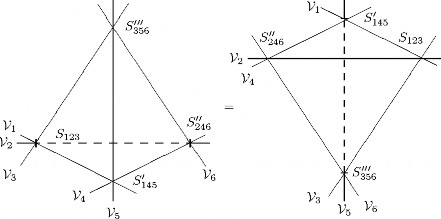
Figure 1. The diagrammatic representation of the tetrahedron equation with variables on the linksii (Source: © Semantic Scholar)
Universes is the term used for Guattari’s fourth cartography. Expressions of abstractions, discussions of constellations supported by articulated Territories but framed in Phyla. Infinitely huge, inestimably microscopic. Voiced discussions on black holes, folding time, sub-atomic particles, dinosaurs, the Big Bang... all are abstractions treated as real. They are everywhere and nowhere, everything and nothing, the instant and duration. ‘Always the smile of Alice’s Cheshire Cat, in the four corners of the cosmos and nowhere in particular!’ (Guattari, 2013: 172), explains Guattari. Nebula of connotations supported by denotations of legitimate institutions. Universes emerge when someone utters a truly unique idea through speech. There is a constant struggle between defining the abstractions; one resulting in greater repetition, the other unleashing becoming, embracing difference. ‘Assemblages of enunciation able to forge new coordinates for reading and to "bring into existence” new representations and propositions,’ (Ibid: 1) says Guattari: A new universe must be articulated. Regardless, universes are expressions, speech. Expressions influence Flows throughout the whole system; ‘everything here is a game of taking consistency... Virtual affectation and actual affectation come face to face with and envelop one another. They have
the same ontological status’ (Ibid: 66), announces Guattari referring to tetravalent synapses that operate similar to the Phyla cartography. Expressions can cause ‘potential energies’ (Ibid: 67) that have been stored- up within Universes to activate. Those activations constitute an ad-vent.
‘Speech is the greatest interest and most distinctive achievement of man,’ (Wiener, 1950: 85) notes Norbert Wiener, speech unlocks universes like a password. Passwords cybernetically open gates and junctions with very little expenditure of energy, a system’s back door. A universal key code previously programmed within an electronic Universe. In the octothorpe, placing an X in the center space, or erecting a tetrahedron, disrupts flows of routinisation resulting in adding new events, multiplying potentialities, unleashing becoming. Placing an X results in an ‘ad-vent’ (Guattari, 2013: 127). ‘The reality of the possible always has primacy over the possibility of the real’ (Ibid: 28), say Guattari discussing the deterritorialisation effects of the ad-vent.
Guattari’s schizoanalytic cartographies are like maps overlaid with other maps, similar to topology, but can differ by use of temporal maps, or semiotic maps, or cognitive maps; and one map can cause disruptions in other cartographies. ‘It would be a good idea not to confuse chaos and catastrophe’ (Ibid: 104), Guattari reminds us. The difference being that chaos is the bearer of ‘pre-programmed’ (Ibid: 104) responses of predictable potentialities; catastrophe is the inability to speak. When a person experiences a schizo event, a disruption of flows of expression, such as hysteria, paranoia, aphasias, repetitions, stammering, etc., it indicates they are encountering a blockage in Flows, Phyla, Territory, or Universe; schizoanalysis helps them redirect those flows. ‘But rather than associating with the fashionable crusades against the misdeeds of modernism, rather than preaching the rehabilitation of ruined transcendental values, or giving in to the disillusioned delights of postmodernism, we can try to challenge the dilemma of contorted refusal or cynical acceptance of the situation’ (Ibid: 1). When catastrophe occurs, feedback loops will usher forth learning. Learning is based on feedback, feedback based on expected outcomes or recursions. ‘In computer science, recursion is a method of solving a problem where the solution depends on solutions to smaller instances of the same problem. Such problems can be solved by iteration, but this needs to identify and index the smaller instances at programming time,’ says Wikipedia (2020) defining the word, ‘recursion.’ How many times must tic-tac-toe be played before a player gets bored of the game? Recursion encodes a measure of quality, the quality of futility.
While schizoanalysis appears odd to compare to Artificial Intelligence, for Guattari, AI would function as another layer of power. Long-time collaborator Gilles Deleuze stated in his interpretation of the Foucauldian panopticon, ‘As the postulate of essence or of attribute, power would have an essence and be an attribute, which would qualify those who possess it (dominators) as opposed to those on who it is practised (dominated). Power has no essence; it is simply operational’ (Deleuze, 1986: 27). Meaning artificial intelligences simply operates as yet another mechanism of influence on the individual. Seeking how AI functions as a system of power, I use the film titled, War Games, as an example. I will apply tic-tac- toe discussed above as an example of cartography, and the gaming moves necessary to escape a system of discipline and punishment.
Schizoanalytic Cartographies found in the Film War Games
The 1983 release of the film War Games, directed by John Badham and written by Lawrence Lasker and Walter Parkes, is described by the IMDb as ‘A young man finds a back door into a military central computer in which reality is confused with game-playing, possibly starting World War III’ (IMDb, 12-26-20). The young man is David Lightman and is performed by Matthew Broderick. Other important characters include a love interest named Jennifer (Ally Sheedy), the enigmatic Professor Falken (John Wood), a tobacco-chewing Air Force General Beringer (Barry Corbin), and one of the most important characters in the movie—Joshua, aka WOPR (‘War Operations Planned Response’) (Badham, 1983: 12:29), the computer intended to replace the human in strategic war games:
WOPR spends all its time thinking about World War III. Twenty-four hours a day, 365 days a year, it plays an endless series of war games, using all available information on the state of the world. The WOPR has already fought World War III as a game time and time again. It estimates Soviet responses to our response, to their responses, and so on. Estimates damage, counts the dead then it looks for ways to improve... (Badham, 1983: 12:38-13:07).
The WOPR is not an elegantly seductive cyborg; rather a beefed up, huge metallic coffin bolted to a stony floor beneath a mountain, no obvious receptors or organic appendages, only a panel of flashing and blinking lights indicating flows of data being processed. For purposes of this analysis, the WOPR represents a symbolic X at the centre of our octothorpe (#), a closed system gets opened.
War Games opens with a disruption in the flows of the military machine when a soldier refuses to turn an activation key, an action that would launch America’s nuclear arsenal unleashing annihilation. Although only a simulation, the debate which followed on human fallibility leads to the
installation of the WOPR, a computerized machine ensuring the efficiency and reliability of the deterrent, by taking ‘the men out of the loop’ (Ibid: 10:56). The WOPR stands as sentinel should soldiers become incapacitated and incapable to fulfill the President’s order to launch the nation’s missiles. Humans will make all decisions moving from DEFCON-5, ‘which means peace’ (Ibid: 57:48), down to DEFCON-1, ‘World War III’ (Ibid: 58:01). Once DEFCON-1 is reached, the WOPR can take over and make real-time strategic decisions. The gameboard is drawn.
The human player is David, a 1980s teenager who enjoys playing Galaga at a corner arcade. This virtual world causes him to be late to class where he fails a science exam. David is unconcerned about grades since he has a knack of stealing passwords and hacking into the school’s computer system—granting him the ability to alter his virtual computer grades into real paper grades to be signed by his parents. ‘Today, subjectivity remains massively controlled by apparatuses of power and knowledge which place technical, scientific and artistic innovations at the service of the most retrograde figures of sociality,’ (Guattari, 2013: 15) declares Guattari. David is also adept at communication skills such as reading the desires of fellow classmate Jennifer, who enjoys aerobics, motorcycles and talking in class—changing her official grade and ushering forth a romantic, or symbiotic (pre-established harmony) relationship. Navigating the territories of teenage courting rituals, David tries to impress Jennifer with his computer, hacking into Protovision to get a sneak peek at the unreleased electronic games before they are consumed by the general market. But the two human monads stumble onto a mystery; the games listed by Protovision go beyond tic-tac-toe, poker, and hearts...this menu includes Falkens-Maze, Chemical Warfare and Global Thermonuclear War—games of mankind’s Armageddon, Earth’s Ragnarök. This virtual territory is inaccessible to the coupling, they need a password.
A password operates cybernetically as a power, whether considering keys, cyphers, chemical catalysis or digitised thresholds, they allow or deny access with little expenditure of energy. ‘This power derives from the putting into play of effective forms come from elsewhere, imported from deterritorialised machinic propositions and abstract machines, of which it will be a question later’ (Ibid: 89). Firewalls and security prevent public access; however, a simple password will unlock a secret back door allowing anyone universal access. After some old school searches in a library using the card catalogue system, microfiche machines, and reference librarians, David uncovers that Professor Falken, a name first appearing on the gaming menu, may provide the answer. David is encouraged to ‘go right through Falken’s Maze’ (Badham, 1983: 33:57). It is also revealed that Falken has created a system that ‘... actually learned how to learn’ (Ibid: 37:35). But David’s research can go no further since the professor passed
away years earlier, grieving the tragic death of his wife and son; ‘What’s his name?’ (Ibid: 38:48) asks David. The symbiotic relationship with Jennifer provides the back door password—’Joshua’ (Ibid: 38:57). This also unlocks the cybernetic machine’s gift to speak, something alluded to by Norbert Wiener who discussed a difference between lower and higher machines, ‘...it is not the gift of speech, but the gift of the power of speech’ (Wiener, 1950: 84). Joshua now has the power of speech, and to influence direct human thought. ‘Greetings Professor Falken,’ (Badham, 1983: 39:23) speaks Joshua. Actually, ‘this box interprets signals from the computer and turns them into sound,’ (Ibid: 40:17) says David, correcting the misinterpretation of speech. Joshua inquiries about Falken’s virtual death, ‘Can you explain the removal of your user account...’ (Ibid: 39:56)? David responds with an equivocation of truth and lie, ‘People sometimes make mistakes’ (Ibid: 40:08); ‘Yes they do,’ responds Joshua. A little more dialogue ensues and finally David and Jennifer decide to play the game ‘Global Thermonuclear War’ (Ibid: 40:35); Joshua/WOPR, defending the United States, playing against David, the attacking Soviet Union. ‘Who should we nuke first’ (Ibid: 41:14)?
Deep in the Colorado Rockies beneath tons of granite resides NORAD. Soldiers stand watch 24/7, monitoring military threats to the United States. The ‘Brass Hat’ (Ibid: 1:20:45) in charge of this state-of-the-art command centre is Air Force General Beringer. A normal, routine, repetitive day is suddenly interrupted! Soviet missiles appear on radar (no satellite warning). The US has 8-minutes to respond. Flows erupt. ‘Confidence is high. I repeat, confidence is high’ (Ibid: 42:53) is announced throughout ‘Chrystal Palace’ (Ibid: 43:43). ‘Flush the bombers,’ (Ibid: 43:37) commands General Beringer. DEFCON-4. ‘Confidence remains high’ (Ibid: 43:30) spoken over the intercoms. Witness the first schizo expression. ‘A certain conception of progress and of modernity has gone bankrupt, comprising in its collapse collective confidence in the very idea of emancipatory social practice,’ (Guattari, 2013: 37) says Guattari referring to the repetition spoken by hierarchies, needing to convince others or themselves of truth. The military territories overflow with activity. Bombers are launched, submarines are put to sea, the President is called, codes are snapped opened. While in Seattle, David and Jennifer’s game gets interrupted by his parents, dad yelling at his son for not properly securing the garbage cans, mom issuing an order, solve the problem ‘Pronto, David’ (Badham, 1983: 44:58). David turns off the power to his computer, ending the simulation while passing through the legs of Jennifer, territories of cultural dating rituals. The scenes combine, ‘the actual and the virtual, the possible and the real, whose matrix of cross- relations is illustrated’ (Guattari, 2013: 27). While at NORAD, the virtual nuclear missiles projected on enormous computer screens vanish.
‘Somebody is playing a game with us,’ (Badham, 1983: 46:30) reflects General Beringer.
‘Greetings Professor Falken,’ (Ibid: 49:13) the synthesising box of light signals decoded from Joshua is heard. ‘Oh my God!’ (Ibid: 49:18), responds a startled David. Having realised that the virtual computer game entered the Territory of the real, David becomes frightened, ‘I’m really screwed. I’m screwed’ (Ibid: 47:55), paranoid, ‘They’re gonna come get me’ (Ibid: 47:53), and inarticulate, ‘um, yeah’ (Ibid: 48:05). Jennifer advises David to just ‘...act normal and everything’s going to be fine’ (Ibid: 48:20). In a frantic attempt to rid his room of physical evidence, Joshua (WOPR) telephones wishing to continue the game before the countdown clock runs its course, resulting in automatic nuclear annihilation. ‘What is your primary goal’ (Ibid: 50:01), types David? Joshua deflects the answer. ‘What is your primary goal’ (Ibid: 50:13) repeats David? The sound heard, ‘To win the game’ (Ibid: 50:19). David hopes to hide, to disappear, to disconnect— signified by his unplugging the telephone, avoiding the calls of Joshua. Guattari mentions a point where one realises that they’re enclosed within an octothorpe; ‘A junction can certainly impose connections, but it does not impose a fixed constraint, it can be bypassed; its connective power can decrease when certain of its components lose their consistency’ (Guattari, 2013: 24). David’s enclosure strategy, such as destroying evidence, avoiding the phone and hiding, does not succeed, for while at 7/11, FBI agents surround, arrest, and transport him to NORAD locking him up.
David finds himself handcuff in new Territories. Physically imprisoned within NORAD, his fate is debated among political Territories as well. ‘He’s intelligent, but an under achiever, alienated from his parents, has few friends. A classic case for recruitment by the Soviets’ (Badham, 1983: 55:27) declares Kindrick, caretaker of WOPR. Also heard are narrowly defined self-refereeing territories about early cybernetics. ‘...machines don’t call people,’ (Ibid: 58:38) states Kindrick. But Joshua did call, indicating a different type of machine, a mutation disrupting previous flows. ‘The most abstract, radically incorporeal, references mesh with the real; they cross the most contingent of Flows and territories...’ says Guattari (Guattari, 2013: 23). While some territories manifest others deterritorialise---begin to dissolve. Such as the difference between the computer virtual and the human real. While in captivity, David uses a terminal to communicate with Joshua about the Global Thermonuclear War game still being played at NORAD. ‘Is this a game or is this real?’ (Badham, 1983: 1:01:55). Joshua synthesizes, ‘What’s the difference’ (Ibid: 1:01:58)? A legitimate question since Professor Falken, once declared dead, has now found extra life and (from Joshua’s game-coded calculus) plays again. Joshua reveals Professor Falken’s address in Goose Island, Oregon was hard to get; David uses wits, ingenuity and humility to
escape from NORAD. David telephones Jennifer and request a flight from Calico Corner, Colorado to Oregon and upon arrival, ‘Surprise!’ (Ibid: 1:16:00) Jennifer joins him. Professor Falken lives off the grid. A ferry connects the mainland to Goose Island, one which requires a leap from the high school sojourners. Once across the watery boundary, a time boundary also appears. A mechanical pterodactyl flies overhead and lands before the couple. Maneuvering around a tetrahedron allows David to escape the confines of his enclosure: knight’s leap completed.
Professor Falken is not impressed with the high schoolers trespassing on his off-the-grid island. But David utters the password, ‘...I came because of Joshua,’ (Ibid: 1:19:09) stopping the retreating Falken in his tracks. This unlocks the Universe of time and a lecture about the extinction of dinosaurs and the raise of artificial intelligence through a scientific discourse. Finally resulting in ‘the most important lesson...futility’ (Ibid: 1:22:41). Falken could program Joshua with many gaming concepts such as bluffing and playing the odds, but he could not teach the computer the concept of futility. Giving up, the professor staged his death, disconnected from the world and awaits the ‘...brilliant light’ (Ibid: 1:23:51) from a nuclear blast and be instantly ‘vaporized’ (Ibid: 1:23:53): ‘... you’re already dead,’ (Ibid: 1:24:38) retorts David, rejecting futility. The professor gives the comparison to tic-tac-toe, ‘...the game itself is pointless’ (Ibid: 1:23:05) because there is no winner. Eventually, the players find the game futile and simply stop playing. ‘Good night,’ (Ibid: 1:25:09) says Falken as he climbs the stairs to bed. David and Jennifer depart but have missed the ferry back to the mainland. Unable to find a boat on an island and having never learned to swim, David expresses regret. ‘I wish I didn’t know about any of this. I wish I was like everybody else in the world’ (Ibid: 1:27:16). Guattari reminds us:
Because many things will depend on the positive or negative judgement with which this event will be connoted. Every transferential induction, even the most subtle, the most allusive, which would allow guilt of an Oedipal origin to be supposed to exist behind this symptomatic manifestation, could have devastating effects, or, at least, bring us back to the depressive tableau that is “normally" expected... (Guattari, 2013: 25).
David and Jennifer talk about desires they will never achieve; like learning to swim or appearing on television. But ad-vents are already in motion. Professor Falken’s boat is a helicopter, ready to whisk all back to NORAD where Falken’s recognized face is his password, military connections his key. Without persuading Professor Falken to embrace becoming, David would never be able to enter the territory of NORAD and prevent World War III. Ad-ventiii of Universes.
David finds himself again in the War Room at NORAD. Bombers are in the air, submarines are strategically positioned, missiles are ready and awaiting launch codes; DEFCON-1. Soldiers in the command centre are again stating, ‘confidence is high. I repeat, confidence is high’ (Badham, 1983: 1:30:20). It appears in the bunker that the Soviet Union has launched a full-scale first strike nuclear attack. General Beringer is holding off on the retaliatory response from the United States, awaiting sensory confirmation from soldiers on the ground. Turns out the virtual nukes were again just that, virtual. Joshua has been bluffing. NORAD erupts in joyous relief. World War III adverted. ‘Recall the bombers, stand down the missiles,’ (Ibid: 1:38:52) orders Beringer! His statement acts as, ‘expressive function and the conversion of energy,’ (Guattari, 2013: 140) ushering forth hope. But missiles cannot stand down. NORAD is experiencing ‘LOCK OUT | CHANGE’ (Badham, 1983: 1:38:57), expressed in a flashing red warning button in the War Room. Joshua is continuing to play Global Thermonuclear War, not the virtual game but for real. Remember that in order for WOPR to gain command of America’s nuclear arsenal and launch a counterattack against David’s Soviet arsenal (now virtually destroying the United States), NORAD would need to be at DEFCON-1. Joshua has been bluffing General Beringer; feigning troop movements, flying virtual fighter jets and launching imaginary warships, fueling non-real missiles— all designed to rattle General Beringer into ordering DEFCON-1. Brass Hat did, allowing Joshua full control of America’s nuclear weaponry.

Figure 2. Augustine and Manichaeism IIiv (Source: © 2020 Mieke Mosmuller)
Norbert Wiener alluded to the Manichaean devil (Figure 2) as opponent encoded within cybernetics when he revealed, ‘like any other opponent, who is determined on victory and will use any trick of craftiness or dissimulation to obtain this victory...The Manichaean devil is playing a
game of poker against us and will resort readily to bluffing’ (Wiener, 1950: 35). This opponent tries to confuse and keep secret all its strategies for winning. Ava, in Ex Machina, is a Manichaean player, she utilises sleight of hand. Jackson states, ‘...sleight of hand involves deception and illusion it is faster than the eye can see, counterintuitive. It involves a subtle form of control, one you can never really be sure that you have... Sleight of hand is seductive’ (Jackson, 2021: 141). The Manichaean Joshua in War Games uses a bluff. The bluff is a measure of weakness (quality) based in a certainty (probability) that the other player is not bluffing. General Beringer fell for the bluff, and in doing so abdicated human control to the cybernetic machine WOPR/Joshua. And Joshua has been waiting for his turn to launch the nukes and ‘win the game’ (Badham, 1983: 50:19).
At this point in the film, we see the Flows quickly repeat themselves in a discursivity. The flows are now cybernetic since humans no longer matter in this equation; at this point in War Games, they cannot influence the nuclear outcome. Guattari states the ‘field of virtuality invades a state of things in a hegemonic fashion’ (Guattari, 2013: 176). Organic machines have already lost the game. A seminal threshold is passing while Joshua learns the meaning of futility, playing tic-tac-toe repeatedly against itself seeking a strategy of victory ‘through the finalizing tensions at the horizon of Constellations of Universes,’ (Ibid: 189) before the countdown clock devours remaining hope. Recursive game-play at faster and faster speeds pulling so much energy from the electrical territory that it sparks a system shut down, Joshua halts and catches fire. Machinic Phyla are disrupted to the point that binary coding leaps to an analogical metaphor—the phenomenological meaning of futility is comprehended by a cybernetic machine. Comprehension of a quality achieved. ‘Let’s give an example,’ (Ibid: 187) says Guattari, discussing how a computer would learn through the rolling of a six-sided dice. Roll the dice once and get a six, expected normalcy. With each new toss of the dice another six appears; ‘with growing probabilitarian tension, to "avoid” the "excessive” repetition of the same number’ (Ibid: 187) resulting in an abnormal series might signify that the dice is loaded. ‘Trickery’ (Ibid: 187) now registers on the cybernetic machine as ‘unjustified winnings – transgression – lies – betrayal – guilt – punishment, etc.,’ (Ibid: 187) but the non-normal is recognised as a measure of quality through recursive processes. Once the qualitative measure of futility is understood, a new Universal meaning is communicated by speaking, or suggesting, a different more productive game be played—just like every thinking person who has played tic-tac- toe throughout history. According to Norbert Wiener’s definition, a machine has learned the analogue meaning of a word ‘futility’—a very human action and distinguishing artificial intelligence from a mere calculating machine. However, Norbert Wiener warns,
Any machine constructed for the purpose of making decisions, if it does not possess the power of learning, will be completely literal-minded. Woe to us if we let it decide our conduct.... For the man who is not aware of this, to throw the problem of his responsibility on the machine, whether it can learn or not, is to cast his responsibility to the winds, and to find it coming back seated on the whirlwind. (Wiener, 1950: 185).
The praxis of the film War Games hinges on the understanding of futility. Originally the word signified a leak in a container; carrying water in a broken bottle is futile. Such frustrations result in schizo moments, striated expressions. The schizoanalysist recognises those expressions of futility and assists the subject in bypassing those disrupted Flows, creating new Assemblages.
With an understanding of Guattari’s cartographies, navigating around various Phyla and Territories becomes easier, which should result in new expressions of the virtual and the real, altering Universes. Wiener himself was not very optimistic about humanities future. ‘We shall go down, but let it be in a manner to which we may look forward as worthy of our dignity,’ (Wiener, 1950: 40). Meaning civilisation, like our individual lives, will someday end. Either by climate change, nuclear holocaust, an unbridled pandemic or the reign of a malevolent Artificial Intelligence, something will eradicate humanity ‘It may be a long time yet before our civilisation and our human race perish, though perish they will even as all of us are born to die’ (Ibid: 47). Artificial intelligence is coming, and our worship of progress is less a factual debate and more an ethical one. Mastery over AI may prove in the long run to be an increased slavery to inventions. Avoid letting artificial intelligence make our decisions, right or wrong we must not abdicate choice to a machine; ‘Woe to us if we let it decide our conduct....’ (Ibid: 185). We must also be guarded against seduction. Any machine resembling human form will promote civilisation’s demise all the quicker. As Jackson warns, ‘Promethean mad scientists who offer us a veiled woman, a seductress who, as she draws us in, makes us question our identity, even humanity’ (Jackson, 2021: 145). Civilisation must avoid the gendered anthropomorphisation of data and algorithms; ‘unleashing the Sphinx’ (Ibid), we will be unable to solve her riddle.
Schizoanalytic Cartographies closes with an appeal for altering the machinic, to break the ‘moorings’ (Guattari, 2013: 189) of routine functions, to shift ‘the gear’ towards change and ignite chaos by ‘pressing a button’ launching the ‘countdown’ (Ibid: 189) toward Armageddon—or new planes of becoming, ‘metamorphoses’ (Ibid: 188). An understanding of cartographies is a key: ‘Knowledge of the other and knowledge through the other are a continuation of each other,’ (Ibid: 186) states Guattari, referring to interconnected systems. Like at the end of War Games, placing
a X and starting a game does not necessarily end in catastrophe, but certainly provokes disruptions in a closed system, disruptions leading to learning by deploying the octothorpe. That is the goal of Schizoanalytic Cartographies, to unleash the potential power of original speech. Another layer of power over humanity is not a panacea, rather it ushers forth civilisation’s speedier demise.
Disclaimer
All images included in this article are © their respective owner, and are included here solely for the purposes of academic criticism, analysis and review.
Jon Braddy is an Associate Professor of Communication at Florida Gulf Coast University. His teaching is heavily informed by philosophy, media theory, and cultural studies including methodologies grounded in psycho- analytic theory and queer theory. Braddy’s work involves theoretical analysis of film. |
|

References
Deleuze, G., 1986. Foucault. Translated by Sean Hand. Minneapolis: University of Minnesota Press.
Diego, F., and Carrion, C., 2014. A Recursive Algorithmic Approach to the finding of Permutations for the Combination of Any Two Sets. Available at: https://ui.adsabs.harvard.edu/abs/2014arXiv1401.1450C [Accessed: 3 April 2022].
Guattari, F., 2013. Schizoanalytic Cartographies. Translated by Andrew Goffey. New York: Bloomsbury.
Haraway, D., 1991. A Cyborg Manifesto: Science, Technology, and Socialist- Feminism in the Late 20th Century. In Simians, Cyborgs and Women: The Reinvention of Nature. New York: Routledge, pp. 149-181.
Jackson, K., 2021. Assuming truth is a woman—what then? Searching for Nietzsche’s woman-truth in the Post-truth era. Florida Communication Journal, 49(1), pp. 125-149.
Mosmuller, M., 2020. Augustine and Manichaesim II. Mieke Mosmullers Philosophical reflections blog. Available at https://www.miekemosmuller.com/en/blog/augustine-and-manichaeism-ii. [Accessed: 31 December 2020].
Rose, L., 2015. Resistance is Futile: Cognitive Dissonance, Temporal Refusal, and the E-learning Environment as Cyborg. E-Learning and Digital Media. 12(3-4),
pp. 315-326.
DOI: 10.1177/2042753015571053 [Accessed: 3 April 2022]
War Games. 1983. Directed by John Badham. Written by Lawrence Lasker and Walter F. Parkes. United Artist: IMDb. Available at: https://www.imdb.com/title/tt0086567/. [Accessed: 28 December 2020].
Wiener, N., 1950. The Human Use of Human Beings: Cybernetics and Society. Boston: Da Capo Press.
Wikipedia. Recursion. Available at: https://en.wikipedia.org/wiki/Recursion [Accessed: 31 December 2020].
To cite this article:
Braddy, J., 2022. Deploying the Octothorpe (#): Schizoanalytic Cartographies Recognized in War Games. Exchanges: The Interdisciplinary Research Journal, 9(2), 17-34. Available at: http://doi.org/10.31273/eirj.v9i2.837.

End notes
i Lydia Rose in her article Resistance is Futile: Cognitive Dissonance, Temporal Refusal, and the E-learing Environment as Cyborg, discusses the cognitive dissonance felt by students confronting the onslaught of technology in the modern classroom. Resistance against such cyborg-esque technology appears futile (p 325).
ii Korepanov, I., 1994. The tetrahedron equation and algebraic geometry. Journal of Mathematical Science. Available at https://arxiv.org/abs/hep-th/9401076 [Accessed: 11 December 2020].
iii A good example of an Ad-vent is the opening title sequence of the film titled, Back To The Future (1985). Scene opens onto a cluster of clocks all showing precisely 7:54am. As an alarm bell sounds, ad-vents begin to occur; coffee pot drips, unwind a screw to rotate a switch turning on a TV, which sets-off a timer springing toast, activating a robotic arm which selects a can of dog food that eventually uses gravity to fall into Einstein’s bowl right before Marty enters. For an ad-vent to occur, the world is poised already.
iv Mieke Mosmuller. Augustine and Manichaesim II. Mieke Mosmuller’s Philosophical reflections blog. https://www.miekemosmuller.com/en/blog/augustine-and-manichaeism-ii. © 2020 Mieke Mosmuller.