Why this Assam MP’s doomed-to-not-pass Bill could still hit a home run
Length: • 5 mins
Annotated by Ayush
Ayush: Pradyut Bordoloi, first-time MP from Assam, has introduced a Private Members Bill in the Parliament called The Climate Migrants (Protection and Rehabilitation) Bill, 2022, to establish a policy framework for the protection and rehabilitation of internally displaced climate migrants. The bill seeks to create a legal framework for the protection and rehabilitation of climate migrants, who face displacement due to climate change-induced natural disasters such as floods, cyclones, and droughts. According to the UN, about 17% of the population of Bangladesh may need to be relocated due to global warming, and the World Bank estimates that by 2050, cities like Bengaluru will become the preferred destination for the nearly 40 million people in South Asia who will be forced to leave their homes. The Bill calls for a dedicated climate fund and for periodic surveys in climate change-prone areas to assess the scale of the displacement. Bordoloi believes that while the Bill is unlikely to pass, it can still trigger a consensus-building process.

Wednesday, 21 December 2022
Staggering insights about climate change and its impact on business, tech, finance and politics. Someone sent you this? Sign up here
Good Morning Avantika,
The end of the year is nigh. Lionel Messi has added a World Cup winners’ title to his CV. All the waves—crypto, resignation, regret, remorse, whatnot—seem to have subsided...
And with that, a sense of relief and optimism is washing over some of us that 2023 will be better.
To be honest, I wanted to write about something light, or even funky in this edition—like how using psychedelics can unlock the “codes to environmental and social change”. But then I stumbled upon this piece of news: Pradyut Bordoloi, first-time MP from Assam, who served three terms as MLA in the Assam Legislative Assembly before that, has introduced a Private Members Bill in the ongoing session of the Parliament. (Some 16 new bills are being tabled in 17 days this winter).
Bordoloi’s private bill is called—The Climate Migrants (Protection and Rehabilitation) Bill, 2022. And it is meant to “establish an appropriate policy framework for the protection and rehabilitation of internally displaced climate migrants and for all matters connected therewith and incidental thereto”.
Now, as many of you will be aware, a private member’s bill is rarely ever passed in any House of the Parliament. Why then even take the trouble of tabling it, right?
Well, for one, politicians (can) do this to appease their constituency. But Bordoloi tells me that though the immediate motivation for this bill is the acute displacement in the riverine belts of Assam, it is, however, a burgeoning national issue that needs consensus across parties. And he thinks that the tabling of this Bill can trigger that consensus-building.
And you and I can play a role in initiating a public discourse. I’ve said this before—climate change is political; it requires grassroots debates and solutions.
It also requires city-level discourses.
Because the World Bank estimates that, by 2050, cities like Bengaluru will become the preferred destination for the nearly 40 million people in South Asia who will be forced to leave their homes.

Why do people have to move?
Short answer: they don’t have a choice.
To get a small picture of how such things play out, you should check out this evocative short documentary by the New Yorker that follows a Nepali family grappling with the personal side of climate change. It’s titled, What Happens to a Family “When Glaciers Go”.


Screenshots from What Happens to a Family “When Glaciers Go”, New Yorker
Back in Assam, says Bordoloi, all along the Brahmaputra—which, along with the Barak river, forms the two main water systems of the region—there are riverine islands (locally known as Char or Chapori) which are now disappearing.
Many years ago, migrants came to these fertile islands from all over the country, but the majority were from east Bengal and east Pakistan. Of course, some of these islands would get eroded over the course of a few decades, but now, they are being eroded away in just three to four years.
Deforestation in the upper reaches of Brahmaputra and climatic shifts are the main reasons, Bordoloi says.

Once these islands disappear, people living there, already the third or fourth generation migrants, get displaced once again. Because of the polarised political situation [in the state], they have nowhere to go. They look for reserve forests, try to put up tents there, but the authorities bulldoze them out; they run from pillar to post.
According to an Action Aid report, he says, 14 million people have already been displaced in India due to climate change. “Another ~50 million will be compelled to migrate by 2050 due to climate-related events, such as floods, cyclones, and droughts. And these numbers are based on projections that are very conservative.”
In May 2021, when cyclone Tauktae struck Gujarat, it was the most powerful cyclone recorded in India in 20 years; at least 200,000 people had to be evacuated. While India’s early warning systems have gotten better, and most of the lives are now saved during such events, oftentimes, survivors don’t have a place to return to.
Bordoloi’s Bill asks for a legal framework for the protection and rehabilitation of such internally displaced migrants. “Both central and state authorities eye such people with suspicion, dubbing them as Bangladeshi intruders. They have no humanitarian support,” he tells me.
Speaking of Bangladesh, which is one of the world’s most vulnerable places when it comes to climate change, the United Nations predicts that about 17% of its population will need to be relocated if global warming continues at the current rate.
The hard sell
Governments are usually quite chary of any policy that deals with migration. We know this; it doesn’t get votes. Migrants, therefore, are rarely welcome.
That said, there’s no getting away from the fact that today, the number of climate migrants have exceeded all other types of migrants in history. (Writer Parag Khanna documents this in his 2021 book, Move, and argues that the coming decades will see a large portion of the global population moving “inland, upland, and northwards”.)
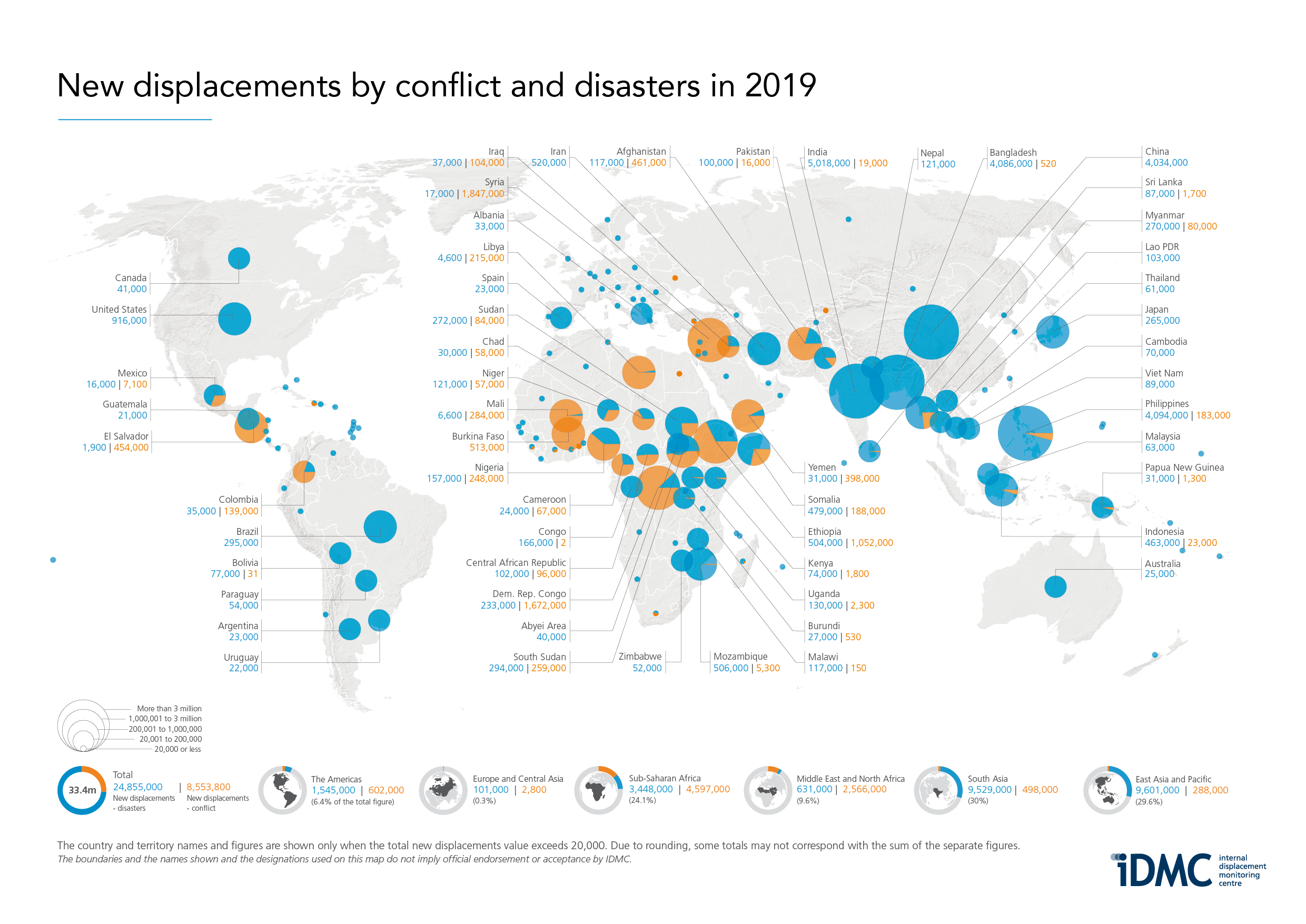
India, Philippines, Bangladesh, and China top the list of countries that face maximum displacement due to climate change-induced natural disasters.

Source: Internal Displacement Monitoring Centre
Apart from the increasing internal pressure, India will soon also have to take a stance on providing refuge to international climate migrants.
Under present international laws, there are few legal options available to such migrants since it is not always possible to pin down climatic reasons as the primary cause of migration. As per the 1951 Refugee Convention, legal protection is afforded only to those fleeing their home “owing to a well-founded fear of being persecuted for reasons of race, religion, nationality, membership of a particular social group, or political opinion”.
In 2018, New Zealand dropped its idea of granting climate refugee visas due to political pressure, but many other countries are laying the groundwork for welcoming or handling climate migrants in the future. It’s a crisis, rather a global reality, which needs a visa policy of its own.
And already, people like Khanna advocate that India should accept climate migrants from Maldives, an island state that is projected to become uninhabitable by 2050.
But before India makes up its mind on taking international climate refugees legally, it must get its internal climate displacement issues under control. Bordoloi’s Bill provides for a dedicated climate fund and for periodic surveys in climate change-prone areas to assess the scale of the displacement. Here’s a screengrab from the tabled Bill:

But this Assam MP is also realistic.
“We will not see the legal culmination of this Bill, but it’s important for generating a national discourse. It may even inspire a government legislation. You can all play a role in this,” he told me during our conversation.
And so can you, dear reader. The debate on the consequences of climate change are now settled. What remains is for legal frameworks to be made and implemented, though it’s still unclear who exactly will make or implement them.
That’s a wrap for this week. Do keep writing to greenmargins@the-ken.com with your thoughts and suggestions, and I’ll be back in your inbox next Wednesday.
Take care.
Regards,
Seema Singh
Share this edition
Here's the link to this edition for you to share. Or you can use the easy share buttons below
https://the-ken.com/greenmargins/why-this-assam-mps-doomed-to-not-pass-bill-could-still-hit-a-home-run/


Green Margins is published by The Ken—a digital, subscription-driven publication focussing on technology, business, science and healthcare.
This newsletter was sent to fdsepe6r@duck.com. Something wrong? Tell us at support@the-ken.com
Someone forwarded it to you? Try Green Margins for free! Or, check out our newsletter bundle here
Want to unsubscribe from Green Margins, our premium weekly newsletter? set your email preferences here
© 2021 The Ken