Report an issue
Tell us what's wrong and we'll take a look.
Thanks – we got it. We'll review and follow up if needed.
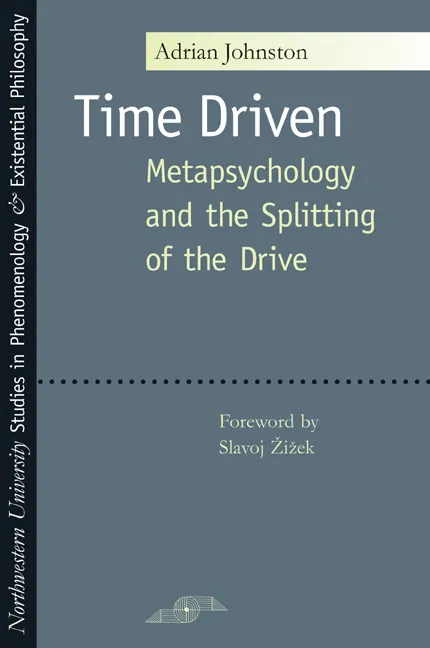
Johnston draws on Jacques Lacan's oeuvre in conjunction with certain philosophical resources-elements from transcendental philosophy, structuralism, and phenomenology-to rectify the inconsistencies within the Freudian metapsychological model of drive. In doing so, he helps to answer a question haunting Freud at the end of his career: Why is humanity plagued by a perpetual margin of discontent, despite technological and cultural progress?
In Time Driven, Johnston is able to make sense of Freud's metapsychology both as a whole and in its historical development of Lacan's reinterpretation of Freud, and of the place of both Freud and Lacan in modern philosophy.
Adrian Johnston
Adrian Johnston (PhD, Philosophy, Stony Brook; Diploma, Psychoanalysis, Emory) is Professor of Philosophy at the University of New Mexico and Assistant Teaching Analyst at Emory Psychoanalytic Institute, a division of the Emory University School of Medecine. He is the author of Time Driven: Metapsychology and the Splitting of the Drive (Northwestern, 2005), Zizek's Ontology: A Transcendental Materialist Theory of Subjectivity (Northwestern, 2008), Political Transformations: The Cadence of Change (Northwestern, 2009), Prolegomena to Any Future Materialism, Volume One: The Outcome of Contemporary French Philosophy (Northwestern, 2013), Adventures in Transcendental Materialism: Dialogues with Contemporary Thinkers (Edinburgh, 2014), and co-author (with Catherine Malabou) of Self and Emotional Life: Philosophy, Psychoanalysis, and Neuroscience (Columbia, 2013).
More by Adrian Johnston




Why Readwise Books?
Readwise Books is an ebook & audiobook platform that automatically logs how much you and your friends read, making it fun and easy to read more. Learn more →