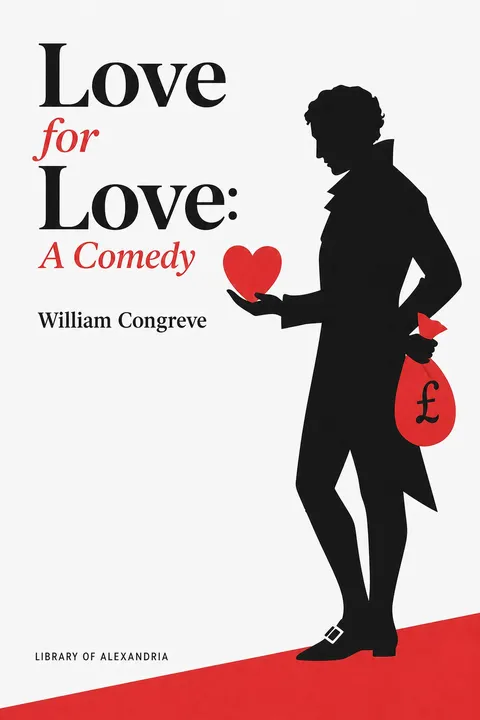
Love for Love: A Comedy
Restoration Theatre and Social Satire, Where Courtship Meets Fortune
Report an issue
Tell us what's wrong and we'll take a look.
Thanks – we got it. We'll review and follow up if needed.

When affection comes with a financial bargain, who can afford to be sincere? Courtship, inheritance, and family ambition collide in this witty Restoration play.
First staged in 1695, William Congreve's Love for Love follows Valentine, a young man burdened by debt and in love with Angelica. His father, Sir Sampson Legend, offers financial relief on the condition that Valentine surrender his inheritance to his younger brother, Ben. What follows is a contest of intentions, evasions, and performances, in which romantic promises are never far from questions of property.
Around this central struggle, Congreve gathers a lively company of schemers and eccentrics, including the superstitious Foresight and the plain-speaking sailor Ben. Their clashing expectations turn marriage into both a social transaction and a test of judgment. The play has lasted not simply because its dialogue sparkles, but because its satire catches something recognizable: the difficulty of knowing whether people want us for ourselves or for what we possess.
What readers find inside:
- Courtship and calculation - Valentine and Angelica's relationship tests the distance between declared affection and genuine commitment.
- An inheritance bargain - Sir Sampson's proposal brings money, parental authority, and family rivalry into direct conflict.
- Restoration wit - Verbal sparring and double meanings make conversation a means of pursuit, concealment, and self-defence.
- Comic contrasts - Ben's seafaring directness and Foresight's superstition expose different varieties of human folly.
- Social satire - Marriage and reputation reveal a society eager to dress self-interest in respectable language.
This play will appeal to readers of classic English drama, lovers of sharp social satire, and theatre enthusiasts interested in the Restoration stage.
Enter Congreve's world of risky bargains and quick replies, where every promise deserves a second hearing.
William Congreve
William Congreve (1670-1729) was an influential English playwright and poet, best known for his sharp wit and satirical comedies of manners that reflect the sophisticated and often morally ambiguous society of the late 17th and early 18th centuries. Born in Bardsey, Yorkshire, he was educated at Kilkenny College in Ireland and later at Trinity College, Dublin, where he met future literary figures like Jonathan Swift. His most famous work, The Way of the World (1700), is considered a masterpiece of Restoration comedy, notable for its complex characters, intricate plotting, and sparkling dialogue. Despite its initial lukewarm reception, the play has since been recognized as a classic and is frequently performed today. In addition to his plays, Congreve also wrote poetry and translated works from French and Latin. Despite his relatively short career-he retired from playwriting in his mid-thirties-Congreve left a lasting impact on English literature. He spent his later years in relative comfort, supported by a government pension and his friendship with influential figures such as the Duchess of Marlborough and Alexander Pope. William Congreve's contributions to the English stage have earned him a place among the great playwrights of his era, and his works continue to be admired for their cleverness, insight, and enduring relevance.
More by William Congreve







Why Readwise Books?
Readwise Books is an ebook & audiobook platform that automatically logs how much you and your friends read, making it fun and easy to read more. Learn more →