
Report an issue
Tell us what's wrong and we'll take a look.
Thanks – we got it. We'll review and follow up if needed.
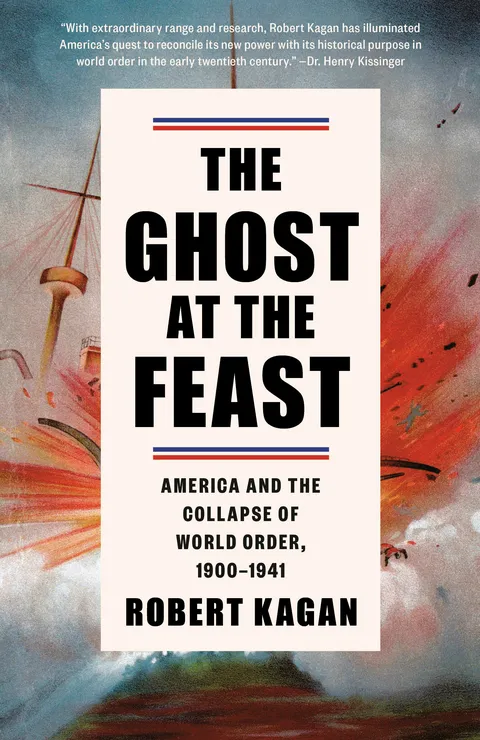
"With extraordinary range and research, Robert Kagan has illuminated America's quest to reconcile its new power with its historical purpose in world order in the early twentieth century." --Dr. Henry Kissinger
At the dawn of the twentieth century, the United States was one of the world's richest, most populous, most technologically advanced nations. It was also a nation divided along numerous fault lines, with conflicting aspirations and concerns pulling it in different directions. And it was a nation unsure about the role it wanted to play in the world, if any. Americans were the beneficiaries of a global order they had no responsibility for maintaining. Many preferred to avoid being drawn into what seemed an ever more competitive, conflictual, and militarized international environment. However, many also were eager to see the United States taking a share of international responsibility, working with others to preserve peace and advance civilization. The story of American foreign policy in the first four decades of the twentieth century is about the effort to do both--"to adjust the nation to its new position without sacrificing the principles developed in the past," as one contemporary put it.
This would prove a difficult task. The collapse of British naval power, combined with the rise of Germany and Japan, suddenly placed the United States in a pivotal position. American military power helped defeat Germany in the First World War, and the peace that followed was significantly shaped by a U.S. president. But Americans recoiled from their deep involvement in world affairs, and for the next two decades, they sat by as fascism and tyranny spread unchecked, ultimately causing the liberal world order to fall apart. America's resulting intervention in the Second World War marked the beginning of a new era, for the United States and for the world.
Brilliant and insightful, The Ghost at the Feast shows both the perils of American withdrawal from the world and the price of international responsibility.
Robert Kagan
Robert A. Kagan is Professor Emeritus of Political Science and Law at the University of California, Berkeley. He is the author of numerous works on regulatory enforcement and compliance and on the relationships between political structures, legal systems and courts, including Regulatory Justice: Implementing a Wage-Price Freeze; Going by the Book: The Problem of Regulatory Unreasonableness; Adversarial Legalism: The American Way of Law; and Shades of Green: Business, Regulation, and Environment. He is a fellow of the American Academy of Arts and Sciences, recipient of the Law and Society Association's Harry Kalven Prize for distinguished sociolegal scholarship and its Stanton Wheeler Award for teaching and mentorship, and a Lifetime Achievement Award from the Law-Courts Section of the American Political Science Association. He has served as co-editor of Regulation and Governance and as director of the Center for the Study of Law and Society at Berkeley.
More by Robert Kagan













Why Readwise Books?
Readwise Books is an ebook & audiobook platform that automatically logs how much you and your friends read, making it fun and easy to read more. Learn more →