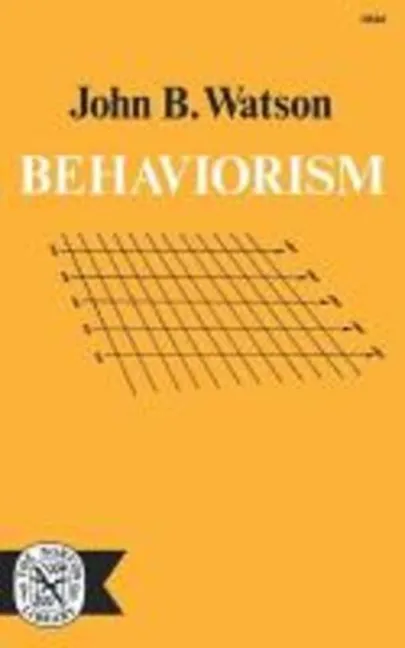
Behaviorism
Report an issue
Tell us what's wrong and we'll take a look.
Thanks – we got it. We'll review and follow up if needed.

"Two opposed points of view," John B. Watson wrote in 1925, "are still dominant in American psychological thinking: introspective or subjective psychology, and behaviorism or objective psychology." His statement is still true today. Reacting against traditional psychology's emphasis on feelings and introspection, and its lack of precise categories, Watson proposed a methodological approach to psychological problems that would be logical, precise, and scientific. Consciousness, he believed, was not a usable hypothesis: the proper subject of human psychology is the behavior of the human being. Behaviorism aimed to free psychology from elusive, vague concepts and establish it as a true natural science.
John B Watson
John Watson (1878-1958) was an American psychologist who in the early 1900's codified and forcefully publicized behaviorism, which became the dominant school of psychology in the United States during the 1920s and 1930s. Watson served as professor of psychology at Johns Hopkins University, and also as lecturer at the New School for Social Research. In addition to Behaviorism he authored Psychology From the Standpoint of a Behaviorist.
More by John B Watson

















Why Readwise Books?
Readwise Books is an ebook & audiobook platform that automatically logs how much you and your friends read, making it fun and easy to read more. Learn more →