Report an issue
Tell us what's wrong and we'll take a look.
Thanks – we got it. We'll review and follow up if needed.
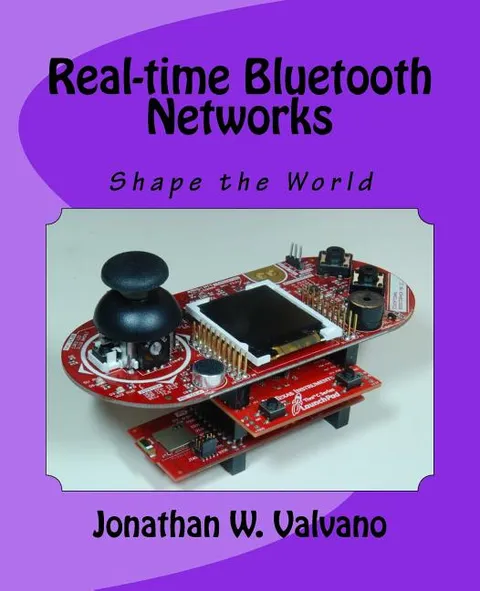
Welcome to Real-Time Bluetooth Networks - Shape the World. This book, now in its second printing December 2017, offers a format geared towards hands-on self-paced learning. The overarching goal is to give you the student an experience with real-time operating systems that is based on the design and development of a simplified RTOS that exercises all the fundamental concepts. To keep the discourse grounded in practice we have refrained from going too deep into any one topic. We believe this will equip the student with the knowledge necessary to explore more advanced topics on their own. In essence, we will teach you the skills of the trade, but mastery is the journey you will have to undertake on your own. An operating system (OS) is layer of software that sits on top of the hardware. It manages the hardware resources so that the applications have the illusion that they own the hardware all to themselves. A real-time system is one that not only gets the correct answer but gets the correct answer at the correct time. Design and development of an OS therefore requires both, understanding the underlying architecture in terms of the interface (instruction set architecture, ISA) it provides to the software, and organizing the software to exploit this interface and present it to user applications. The decisions made in effectively managing the underlying architecture becomes more crucial in real-time systems as the performance (specifically timing) demands go beyond simple logical correctness. The architecture we will focus on is the ARM ISA, which is a very popular architecture in the embedded device ecosystem where real-time systems proliferate. A quick introduction to the ISA will be followed by specifics of TI's offering of this ISA as the Tiva and MSP432 Launchpad microcontroller. To make the development truly compelling we need a target application that has real-time constraints and multi-threading needs. To that end you will incrementally build a personal fitness device with Bluetooth connectivity. The Bluetooth connectivity will expose you to the evolving domain of Internet-of-things (IoT) where our personal fitness device running a custom RTOS will interact with a smartphone.
Jonathan W Valvano
Jonathan Valvano is Professor of Electrical and Computer Engineering at the University of Texas at Austin. His tenure at UT Austin began in 1981. He holds bachelors and masters degrees in computer science and electrical engineering from the Massachusetts Institute of Technology and a PhD in Medical Engineering from Harvard-MIT Division of Health Sciences and Technology. He is a leading authority on embedded systems having written 23 referred archival papers, 63 referred papers, and five book chapters in the fields of embedded systems, biomedical instrumentations, and bio-heat transfer.
More by Jonathan W Valvano


Why Readwise Books?
Readwise Books is an ebook & audiobook platform that automatically logs how much you and your friends read, making it fun and easy to read more. Learn more →