
Fanny Burney (Madame Da̓rblay)
Report an issue
Tell us what's wrong and we'll take a look.
Thanks – we got it. We'll review and follow up if needed.
This work has been selected by scholars as being culturally important, and is part of the knowledge base of civilization as we know it. This work was reproduced from the original artifact, and remains as true to the original work as possible. Therefore, you will see the original copyright references, library stamps (as most of these works have been housed in our most important libraries around the world), and other notations in the work.
This work is in the public domain in the United States of America, and possibly other nations. Within the United States, you may freely copy and distribute this work, as no entity (individual or corporate) has a copyright on the body of the work.
As a reproduction of a historical artifact, this work may contain missing or blurred pages, poor pictures, errant marks, etc. Scholars believe, and we concur, that this work is important enough to be preserved, reproduced, and made generally available to the public. We appreciate your support of the preservation process, and thank you for being an important part of keeping this knowledge alive and relevant.






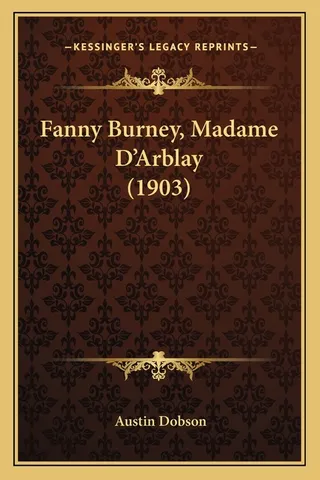

Fanny Burney
Frances Burney, also known as Fanny Burney and later as Madame d'Arblay, was an influential English novelist, diarist, and playwright, born on June 13, 1752, in King's Lynn, England. She was the daughter of Charles Burney, a renowned musicologist, and Esther Sleepe. Burney gained significant recognition for her sharp wit, keen social commentary, and insightful observations of 18th-century English society. In addition to her literary work, Burney held a prominent position in the royal court as the "Keeper of the Robes" to Queen Charlotte, wife of King George III, from 1786 to 1790. This role exposed her to the intrigues and rigid formalities of royal life, experiences which influenced her later works. In 1793, at the age of 41, Burney married Alexandre Jean-Baptiste Piochard, a French exile who became General Alexandre d'Arblay. The couple had one son, Alexander Charles L. d'Arblay. Burney's life was marked by both personal and professional challenges, yet she continued to write, producing notable works such as Evelina, Cecilia, and Camilla, in addition to her plays, The Witlings and Edwy and Elgiva.
More by Fanny Burney






Why Readwise Books?
Readwise Books is an ebook & audiobook platform that automatically logs how much you and your friends read, making it fun and easy to read more. Learn more →