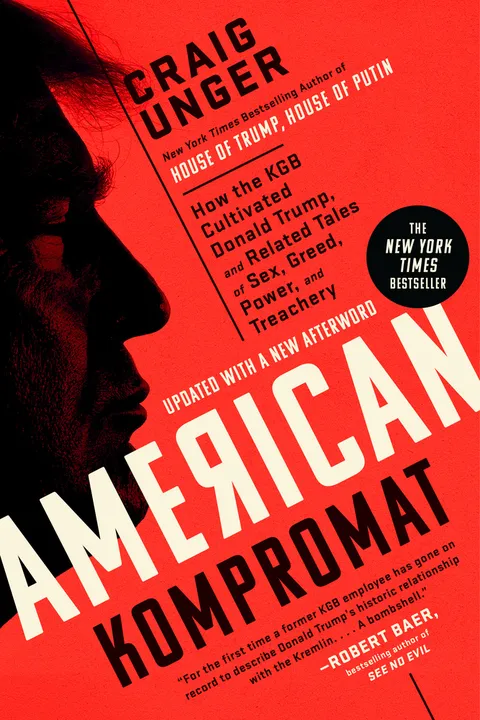
American Kompromat
How the KGB Cultivated Donald Trump, and Related Tales of Sex, Greed, Power, and Treachery
Report an issue
Tell us what's wrong and we'll take a look.
Thanks – we got it. We'll review and follow up if needed.
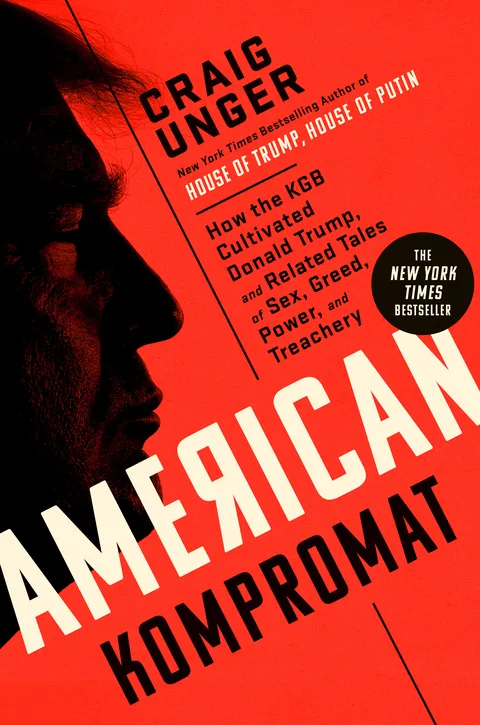
*Updated with a new afterword from the author*
Kompromat n.--Russian for "compromising information"
This is a story about the dirty secrets of the most powerful people in the world--including Donald Trump.
It is based on exclusive interviews with dozens of high-level sources--intelligence officers in the CIA, FBI, and the KGB; thousands of pages of FBI investigations, police investigations; and news articles in English, Russian, and Ukrainian. American Kompromat shows that from Trump to Jeffrey Epstein, kompromat was used in operations far more sinister than the public could ever imagine.
Among them, the book addresses what may be the single most important unanswered question of the entire Trump era: Is Donald Trump a Russian asset?
The answer, American Kompromat says, is yes, and it supports that conclusion with the first richly detailed narrative on how the KGB allegedly first "spotted" Trump as a potential asset, how they cultivated him as an asset, arranged his first trip to Moscow, and pumped him full of KGB talking points that were published in three of America's most prestigious newspapers.
Among its many revelations, American Kompromat reports for the first time that:
- According to Yuri Shvets, a former major in the KGB, Trump first did business over forty years ago with a Manhattan electronics store co-owned by a Soviet émigré who Shvets believes was working with the KGB. Trump's decision to do business there triggered protocols through which the Soviet spy agency began efforts to cultivate Trump as an asset, thus launching a decades-long "relationship" of mutual benefit to Russia and Trump, from real estate to real power.
- Trump's invitation to Moscow in 1987 was billed as a preliminary scouting trip for a hotel, but according to Shvets, was actually initiated by a high-level KGB official, General Ivan Gromakov. These sorts of trips were usually arranged for "deep development," recruitment, or for a meeting with the KGB handlers, even if the potential asset was unaware of it.
- Before Trump's first trip to Moscow, he met with Natalia Dubinina, who worked at the United Nations library in a vital position usually reserved as a cover for KGB operatives.
- In 1987, according to Shvets, the KGB circulated an internal cable hailing the successful execution of an active measure by a newly cultivated American asset who took out full page ads in The New York Times, The Washington Post, and The Boston Globe promoting policies promoted by the KGB. The ads had been taken out by Donald Trump, who, Shvets said, would become a "special unofficial contact" for the KGB, that is, an intelligence asset whose role has been compared to that of the late industrialist, Armand Hammer.
A number of America's highest national security officials have said they believe Trump is a Russian asset, but neither the Mueller Report nor the numerous congressional investigations throughout Trump's presidency pursued that vital question. American Kompromat does.
In addition to exploring Trump's ties to the KGB, American Kompromat also shows that from Donald Trump to Jeffrey Epstein, Russian kompromat operations documented the darkest secrets of the most powerful people in the world and transformed those secrets into potent weapons. It also reveals:
- How Jeffrey Epstein and Trump jostled for influence and financial supremacy for years. A college dropout let go from his prep school teaching job, Epstein became a millionaire in part with the help of Ghislaine Maxwell's father--media tycoon Robert Maxwell, who allegedly served as a Soviet and Israeli spy and likely gave Epstein a sum estimated between $10 and $20 million before his death in 1991.
- How the Jeffrey Epstein-Ghislaine Maxwell sex-trafficking operation provided a sourc
Craig Unger
Craig Unger is the New York Times bestselling author of five books on the Republican Party’s assault on democracy. The former editor in chief of Boston Magazine, he was also a contributing editor for Vanity Fair where he covered national security and foreign affairs. His work has appeared in many other publications including New York Magazine, The New Yorker, Esquire, The Guardian, The New York Times, Washington Post, and The New Republic. He lives in Brooklyn, New York.
More by Craig Unger








Why Readwise Books?
Readwise Books is an ebook & audiobook platform that automatically logs how much you and your friends read, making it fun and easy to read more. Learn more →