Report an issue
Tell us what's wrong and we'll take a look.
Thanks – we got it. We'll review and follow up if needed.
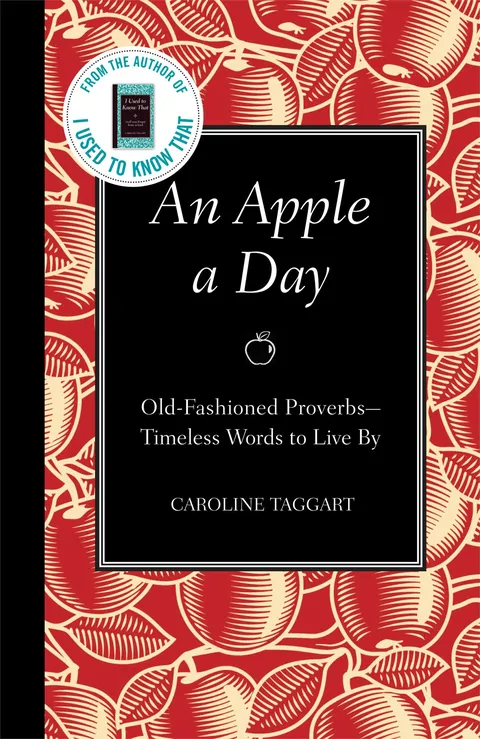
From Old Testament proverbs to modern phrases like "the best things in life are free," An Apple a Day takes a fun look at expressions that "have stood the test of time."
Read through from start to finish or search through the list of hundreds of the most common proverbs, arranged from A to Z for easy reference. You'll learn about each proverb's surprising origins, why some are valid and others are not, the derivation and meanings behind them, and their relevance in today's society.
Includes entries like:
Two heads are better than one: Like the less-familiar "Four eyes see better than two," this proverb extols the benefits of having someone else help you make up your mind-and it's a view that goes back to at least the fourteenth century. But while it is always useful to have a second opinion (A sounding board? Someone else to blame?) it might also be worth bearing in mind the disadvantages of design or decision-making by committee: something that really pleases no one. So whereas two heads may well be better than one, three could be a crowd. Laughter is the best medicine: This idea is an ancient one and is found in, appropriately, the book of Proverbs: "A merry heart doeth good like a medicine: but a broken spirit drieth the bones." It has prompted a surprising amount of research, with the result that some scientists claim that laughter has the same benefits as a mild workout-it stretches muscles, sends more oxygen to the tissues, and generally makes you feel healthier. One study even claims that laughing heartily for 10-15 minutes burns 50 calories. But let's pause for thought here. The world may laugh with you over a joke or a rerun of Seinfeld, but if you make a habit of laughing heartily for 10-15 minutes for no apparent reason, the world is going to think you are nuts and cross the street to avoid you. It may be worth striving for a happy medium. An apple a day keeps the doctor away: A common British folk saying,
Caroline Taggart
Caroline Taggart worked in publishing as an editor of popular non-fiction for 30 years before being asked by Michael O'Mara Books to write I USED TO KNOW THAT, which became a Sunday Times bestseller. Following that she co-wrote MY GRAMMAR AND I (OR SHOULD THAT BE 'ME'?) As a result of these books and HER LADYSHIP'S GUIDE TO THE QUEEN'S ENGLISH, published by Batsford, she has appeared frequently on BBC Breakfast and on national and regional radio, talking about language, grammar and Pythagoras's theorem. Her record is 16 radio interviews in one day on the subject of exclamation marks.
Her other books include THE BOOK OF ENGLISH PLACE NAMES, THE BOOK OF LONDON PLACE NAMES, HOW TO GREET THE QUEEN (AND OTHER QUESTIONS OF MODERN ETIQUETTE) and A SLICE OF BRITAIN: AROUND THE COUNTRY BY CAKE which The Sunday Times described as 'engaging, greedy and droll'. Since then she has reverted to words, with 500 WORDS YOU SHOULD KNOW, NEW WORDS FOR OLD and her current project, MISADVENTURES IN THE ENGLISH LANGUAGE, due in autumn 2016. The latest in her 'Her Ladyship' series for Batsford is HER LADYSHIP'S GUIDE TO THE ART OF CONVERSATION. Her website is carolinetaggart.co.uk and you can follow her on Twitter @citaggart.
More by Caroline Taggart



Why Readwise Books?
Readwise Books is an ebook & audiobook platform that automatically logs how much you and your friends read, making it fun and easy to read more. Learn more →