Report an issue
Tell us what's wrong and we'll take a look.
Thanks – we got it. We'll review and follow up if needed.
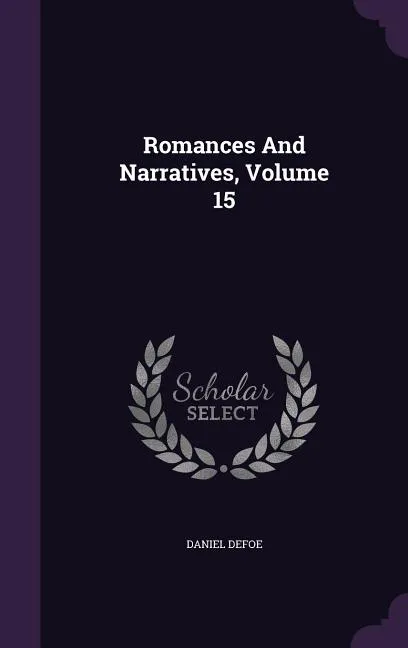
"Romances And Narratives: Colonel Jacque" presents a compelling narrative from the esteemed pen of Daniel Defoe. This edition offers readers a journey into the world of 18th-century fiction, exploring themes of identity, survival, and social mobility through the adventurous life of its protagonist, Colonel Jacque.
Defoe's meticulous prose and keen observations of human nature create a vivid and enduring portrait of a man navigating the complexities of his era. This book will appeal to enthusiasts of classic literature and historical fiction, inviting them to delve into a world rich in detail and moral inquiry.
This work has been selected by scholars as being culturally important, and is part of the knowledge base of civilization as we know it. This work was reproduced from the original artifact, and remains as true to the original work as possible. Therefore, you will see the original copyright references, library stamps (as most of these works have been housed in our most important libraries around the world), and other notations in the work.
This work is in the public domain in the United States of America, and possibly other nations. Within the United States, you may freely copy and distribute this work, as no entity (individual or corporate) has a copyright on the body of the work.
As a reproduction of a historical artifact, this work may contain missing or blurred pages, poor pictures, errant marks, etc. Scholars believe, and we concur, that this work is important enough to be preserved, reproduced, and made generally available to the public. We appreciate your support of the preservation process, and thank you for being an important part of keeping this knowledge alive and relevant.
Daniel Defoe
Daniel Defoe (1660-1731) is an English novelist, pamphleteer, and journalist, whose most famous work is Robinson Crusoe. Along with Samuel Richardson, Defoe is considered the founder of the English novel. Defoe studied at Charles Morton's Academy in London, then delved into politics and trade, for which he traveled extensively throughout Europe. In the early 1680s, Defoe was a commission merchant in Cornhill but went bankrupt in 1691. In 1684 he married Mary Tuffley, with whom he had two sons and five daughters. In 1702 Defoe wrote his famous pamphlet The Shortest Way With Dissenters, in which he mimicked the extreme attitudes of High Anglican Tories and pretended to argue for the extermination of all Dissenters. Defoe was arrested and pilloried for it. When the Tories fell from power Defoe continued to carry out intelligence work for the Whig government. In his own days, Defoe was regarded as an unscrupulous, diabolical journalist. Defoe was one of the first to write stories about believable characters in realistic situations using simple prose. He achieved literary immortality when in 1719 he published Robinson Crusoe, which was based partly on the memoirs of voyagers and castaways, such as Alexander Selkirk. During his remaining years, Defoe concentrated on books rather than pamphlets. Among his works are Moll Flanders, A Journal of the Plague Year, and Captain Jack. His last great work of fiction, Roxana, appeared in 1724. By the 1720s Defoe had ceased to be politically controversial in his writings, and he produced several historical works, a guide book, and The Great Law of Subordination Considered, an examination of the treatment of servants. Phenomenally industrious, Defoe produced in his last years works involving the supernatural: The Political History of the Devil and An Essay on the History and Reality of Apparitions. He died on April 26, 1731, at his lodgings in Ropemaker's Alley, Moorfields.
More by Daniel Defoe





Why Readwise Books?
Readwise Books is an ebook & audiobook platform that automatically logs how much you and your friends read, making it fun and easy to read more. Learn more →