Report an issue
Tell us what's wrong and we'll take a look.
Thanks – we got it. We'll review and follow up if needed.
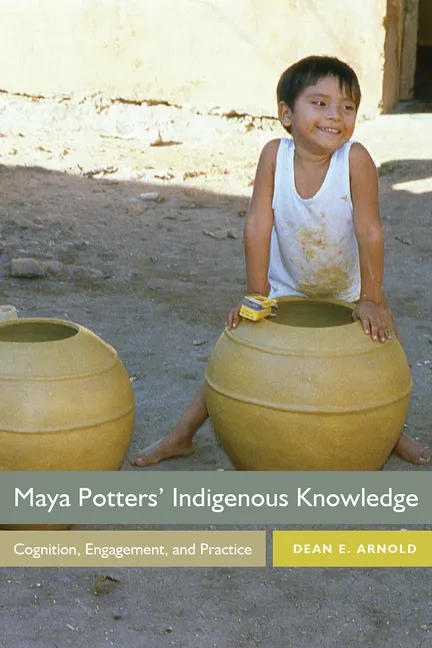
Based on fieldwork and reflection over a period of almost fifty years, Maya Potters' Indigenous Knowledge utilizes engagement theory to describe the indigenous knowledge of traditional Maya potters in Ticul, Yucatán, Mexico. In this heavily illustrated narrative account, Dean E. Arnold examines craftspeople's knowledge and skills, their engagement with their natural and social environments, the raw materials they use for their craft, and their process for making pottery.
Following Lambros Malafouris, Tim Ingold, and Colin Renfrew, Arnold argues that potters' indigenous knowledge is not just in their minds but extends to their engagement with the environment, raw materials, and the pottery-making process itself and is recursively affected by visual and tactile feedback. Pottery is not just an expression of a mental template but also involves the interaction of cognitive categories, embodied muscular patterns, and the engagement of those categories and skills with the production process. Indigenous knowledge is thus a product of the interaction of mind and material, of mental categories and action, and of cognition and sensory engagement--the interaction of both human and material agency.
Engagement theory has become an important theoretical approach and "indigenous knowledge" (as cultural heritage) is the focus of much current research in anthropology, archaeology, and cultural resource management. While Dean Arnold's previous work has been significant in ceramic ethnoarchaeology, Maya Potters' Indigenous Knowledge goes further, providing new evidence and opening up different concepts and approaches to understanding practical processes. It will be of interest to a wide variety of researchers in Maya studies, material culture, material sciences, ceramic ecology, and ethnoarchaeology.
Dean E Arnold
Dean E. Arnold is an adjunct curator in the Negaunee Integrated Research Center/Social Sciences at the Field Museum of Natural History in Chicago and professor emeritus of anthropology at Wheaton College in Illinois, where he taught for thirty-nine years. He has done fieldwork in Peru, Mexico, Bolivia, Guatemala, and the Southwest; authored six books, including the seminal Ceramic Theory and Cultural Process; coedited two books; and published more than sixty articles about potters, pottery, and pottery production and related subjects (such as Maya Blue). Arnold was a Fulbright Scholar in Mexico and Peru, a visiting fellow at Clare Hall at University of Cambridge in 1985, and a visiting scholar at the Department of Archaeology there in 1985, 1992, and 2000. He received the Society for American Archaeology's Award for Excellence in Ceramic Studies in 1996.
More by Dean E Arnold


Why Readwise Books?
Readwise Books is an ebook & audiobook platform that automatically logs how much you and your friends read, making it fun and easy to read more. Learn more →