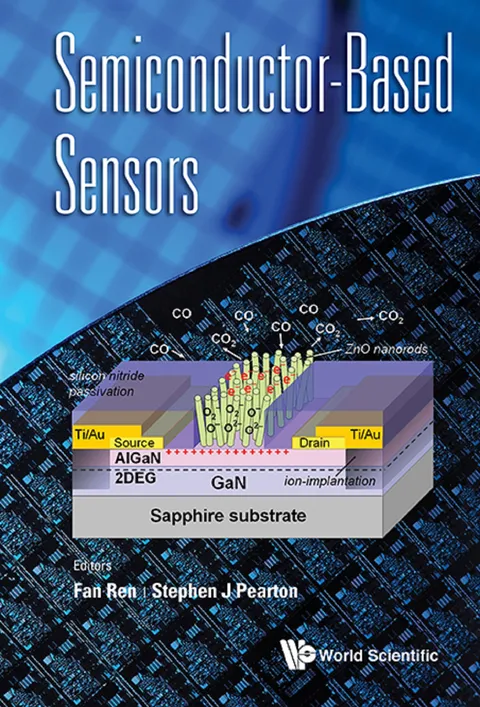
SEMICONDUCTOR-BASED SENSORS
Report an issue
Tell us what's wrong and we'll take a look.
Thanks – we got it. We'll review and follow up if needed.
This book provides a comprehensive summary of the status of emerging sensor technologies and provides a framework for future advances in the field. Chemical sensors have gained in importance in the past decade for applications that include homeland security, medical and environmental monitoring and also food safety. A desirable goal is the ability to simultaneously analyze a wide variety of environmental and biological gases and liquids in the field and to be able to selectively detect a target analyte with high specificity and sensitivity. The goal is to realize real-time, portable and inexpensive chemical and biological sensors and to use these as monitors for handheld gas, environmental pollutant, exhaled breath, saliva, urine, or blood, with wireless capability.In the medical area, frequent screening can catch the early development of diseases, reduce the suffering of patients due to late diagnoses, and lower the medical cost. For example, a 96% survival rate has been predicted in breast cancer patients if the frequency of screening is every three months. This frequency cannot be achieved with current methods of mammography due to high cost to the patient and invasiveness (radiation). In the area of detection of medical biomarkers, many different methods, including enzyme-linked immunsorbent assay (ELISA), particle-based flow cytometric assays, electrochemical measurements based on impedance and capacitance, electrical measurement of microcantilever resonant frequency change, and conductance measurement of semiconductor nanostructures, gas chromatography (GC), ion chromatography, high density peptide arrays, laser scanning quantitiative analysis, chemiluminescence, selected ion flow tube (SIFT), nanomechanical cantilevers, bead-based suspension microarrays, magnetic biosensors and mass spectrometry (MS) have been employed. Depending on the sample condition, these methods may show variable results in terms of sensitivity for some applications and may not meet the requirements for a handheld biosensor.
Fan Ren
Fan Ren was responsible for high-speed device development in the compound semiconductor area at Bell Labs prior to joining UF in 1998. He has over 22 years' experience in device fabrication of state-of-the-art electronic devices. He is a Fellow of IEEE, ECS, SPIE, MRS, APS and AVS. Prof. Ren will be responsible for electrical measurements, dielectric depositions, contact formation and some of the data interpretation. Prof. Ren also has an extensive background in radiation effects and in the development of wide bandgap materials and devices and demonstrated the first Ga2O3/Gd2O3 insulated gate n-channel enhancement-mode InGaAs MOSFET's.
Stephen J Pearton
Steve Pearton is a Professor of Materials Science and Engineering at the University of Florida. Prior to joining the university in 1994 he spent 10 years as a Member of Technical Staff at AT&T Bell Laboratories (now Lucent Technologies) in Murray Hill, NJ. He received his Ph.D. in physics from the University of Tasmania in Australia in 1983 and worked briefly at the Australian Atomic Energy Commission near Sydney prior to spending a year as a postdoctoral research associate at UC Berkeley and Lawrence Berkeley Laboratory. He is author or co-author of approximately 1300 journal articles, has given over 250 invited talks at international conferences, and has authored or edited 10 books.


Why Readwise Books?
Readwise Books is an ebook & audiobook platform that automatically logs how much you and your friends read, making it fun and easy to read more. Learn more →