Report an issue
Tell us what's wrong and we'll take a look.
Thanks – we got it. We'll review and follow up if needed.
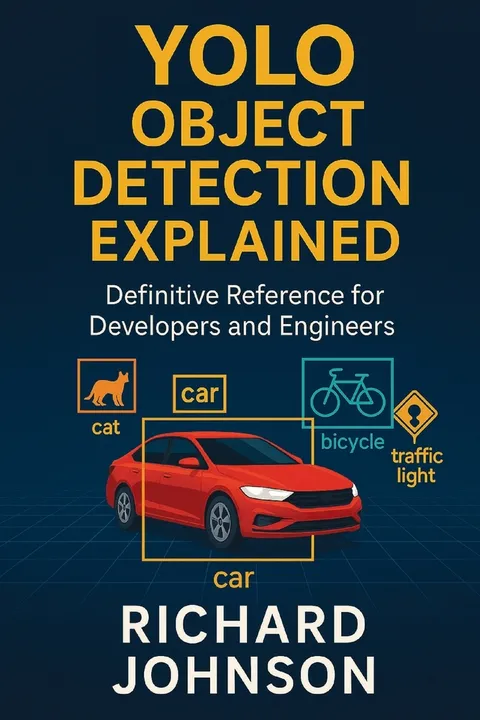
"YOLO Object Detection Explained" offers a comprehensive and accessible journey through the landscape of modern object detection, illuminating the path from its classical foundations to the cutting-edge innovations that define today's real-time vision systems. The book artfully traces the evolution of detection techniques, contrasting the architectural shifts from traditional handcrafted methods to sophisticated deep learning models like YOLO, SSD, and R-CNN, while contextualizing these advancements within real-world applications and benchmark-driven progress. Through this historical and technical narrative, readers gain not only a deep understanding of the field but also an appreciation for the performance breakthroughs that have made real-time object perception possible.
Central to the book is an in-depth exploration of the YOLO architecture itself-its unified, end-to-end philosophy, grid-based prediction mechanisms, and continuous refinement across successive versions. With clarity and rigor, the text guides practitioners through the entire YOLO lifecycle, from preparing augmented datasets and configuring models, to mastering advanced training strategies and overcoming deployment challenges across diverse hardware and edge environments. Specialized chapters tackle optimization, postprocessing, quantization, robustness, and production-scale serving, equipping the reader with practical insights for building and maintaining high-performance detection pipelines.
Beyond the core technology, "YOLO Object Detection Explained" addresses the nuanced realities of customizing YOLO for advanced and ethical applications. The book examines scenario-specific adaptations-ranging from healthcare and agriculture to autonomous vehicles and smart cities-while delving into the vital topics of adversarial security, bias mitigation, privacy, and explainability. It concludes with a forward-looking perspective on the future of object detection, surveying hybrid approaches, continual and federated learning, multimodal sensing, and the evolving benchmarks that will shape next-generation intelligent vision systems. This work stands as an essential resource for engineers, researchers, and decision-makers seeking both mastery of the present and a roadmap to the future of object detection.
Richard Johnson
Richard Johnson graduated with a degree in illustration from Loughborough University of Art and Design in 1999 andcurrently lives in Lincolnshire. Creating imagery for children of all ages is a particular passion of Richard's. His illustrations can be seen in many books, including Aesop's Fables, If Elephants Wore Trousers, Around the World in Eighty Tales, The Peter Pan Jigsaw Book, and My Grandpa's Amazing Inventions.
More by Richard Johnson





Why Readwise Books?
Readwise Books is an ebook & audiobook platform that automatically logs how much you and your friends read, making it fun and easy to read more. Learn more →