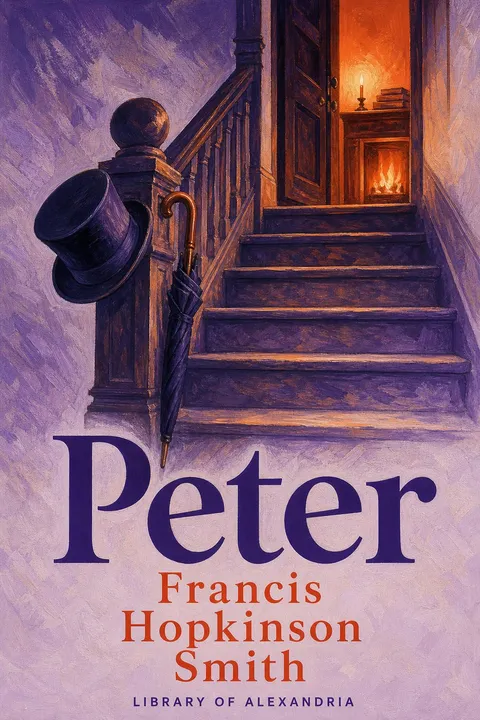
Peter
Gilded Age New York Fiction About Loyalty, Love, and the Courage to Do Right
Report an issue
Tell us what's wrong and we'll take a look.
Thanks – we got it. We'll review and follow up if needed.
In a city that measures success in money, one modest bank teller lives by a different standard.
Peter Grayson has spent nearly thirty years at the Exeter Bank. His salary is small, his apartment above a Fifteenth Street tailor's shop is shabby, and his influence reaches far beyond anything he owns. With humor, loyalty, and an instinct for treating people well, he moves through New York society as a welcome guest and a trusted friend. In Peter, Francis Hopkinson Smith makes this unassuming man the center of a story about what ambition can cost-and what kindness can preserve.
Against the bustle of Gilded Age New York, young engineer Jack Breen faces a world of Wall Street speculation, railroad contracts, and social expectations that put professional integrity under pressure. Around him and Peter gather the perceptive Miss Felicia Grayson, courageous Ruth MacFarlane, and loyal tailor Isaac Cohen. From Broadway evenings to crowded apartment gatherings, Smith brings the city's contrasts into focus: wealth and modest means, fashionable manners and genuine consideration, financial opportunity and moral responsibility. The novel's enduring appeal lies in its affectionate observation of people whose choices matter more than their standing.
What readers find inside:
- Old New York - Banking offices, parlor teas, and city streets form a vivid setting for lives shaped by rapid change.
- A Quiet Moral Center - Peter Grayson shows how attention, humor, and loyalty can sustain the people around him.
- Ambition Under Pressure - Jack Breen's engineering career brings questions of personal honor into the world of business.
- Memorable Relationships - Felicia, Ruth, and Isaac give the story its wit, emotional depth, and acts of generosity.
- Values Beyond Wealth - The novel asks what makes a gentleman when money and social position offer unreliable answers.
A rewarding choice for readers of classic American fiction, stories of Gilded Age society, and character-driven novels about love and integrity.
Step into Peter Grayson's New York and meet a man whose greatest distinction is how he treats others.
F Hopkinson Smith
Francis Hopkinson Smith was an American writer, artist, and engineer. He laid the groundwork for the Statue of Liberty, penned numerous novels, and garnered accolades for his paintings. F. Hopkinson Smith was the great uncle of G. E. Kidder Smith, an American architect, novelist, and photographer who lived from 1913 to 1997. Smith was born in Baltimore, Maryland on October 23, 1838, as a descendant of Francis Hopkinson, a signer of the Declaration of Independence. He graduated from the Boys' Latin School in Maryland. His first popular work was Col. Carter of Cartersville (1891). His novels Tom Grogan (1896) and Caleb West (1898) were the best-selling books in the United States in their respective years of release. On March 1, 1915, Smith notified the Carmel Arts and Crafts Club in Carmel-by-the-Sea, California, that his collection of fifteen original paintings had been shipped for an exhibition at the Club from June 8 to June 26, 1915. It was his first trip out West. On April 7, 1915, he died in his New York City residence.
More by F Hopkinson Smith



Why Readwise Books?
Readwise Books is an ebook & audiobook platform that automatically logs how much you and your friends read, making it fun and easy to read more. Learn more →