Report an issue
Tell us what's wrong and we'll take a look.
Thanks – we got it. We'll review and follow up if needed.
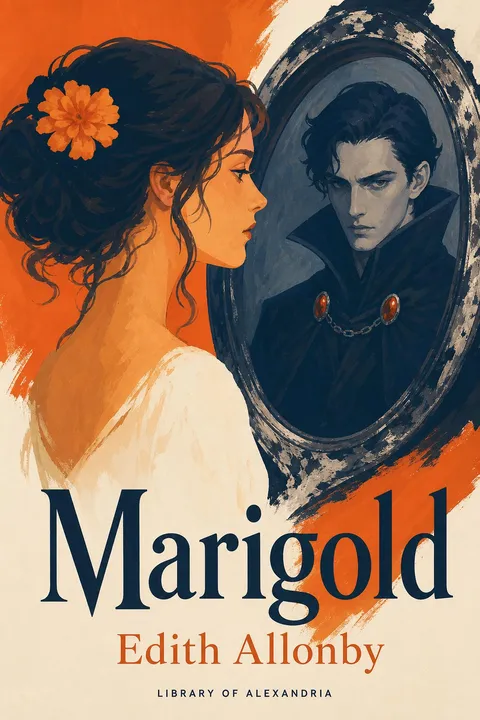
On a planet governed by temptation, a princess discovers the unpredictable power of compassion.
Edith Allonby's Marigold unfolds on Lucifram, a shadowy world presided over by Prince Plucritus and his imperious wife, Vestné. Into their web steps the Princess of Ellel: spirited, impulsive, and unwilling to remain within the boundaries of palace life. Disguised as a beggar girl, Marigold enters the lives of ordinary people and becomes the unwitting centre of a contest between Heaven and Hell.
Yet the novel's spiritual stakes are inseparable from its intimate human encounters. In her friendship with Timothy, a dying boy whom she nurses through long nights, Marigold discovers a courage that rank and power cannot supply. Around this tender relationship, Allonby builds an atmospheric fantasy of supernatural intrigue and pointed social observation. Questions of obedience, women's roles, clerical vanity, and scientific certainty give the story a satirical edge, while its heroine's unpredictable choices keep its moral questions alive.
What readers find inside:
- A world of temptation - Lucifram gives the struggle between good and evil a strange, tangible setting.
- A princess in disguise - Marigold's life as a beggar brings privilege into direct contact with vulnerability.
- Compassion under pressure - Her care for Timothy places ordinary kindness at the heart of a cosmic conflict.
- Supernatural intrigue - Prince Plucritus and Vestné embody a realm where power and spiritual peril are closely entwined.
- Searching satire - Social convention and religious authority come under the scrutiny of Allonby's wit.
For readers of Gothic fantasy, spiritual allegory, and classic fiction with an independent-minded heroine, this is a story in which grand ideas take shape through personal choices.
Enter Lucifram and follow a princess whose compassion challenges a world designed to ensnare her.
Edith Allonby
Edith Allonby was an English writer and teacher. (Her surname was occasionally spelled Allanby or Allenby.) She created two novels set on a fictional planet before committing suicide in an attempt to draw attention to her third work. Allonby was born in Cark as the daughter of Joshua Allonby and Jane Deborah Orr Allonby. Her mother died while she was a little child. She attended Whitelands College. Allonby worked as a teacher and schoolmistress at St. Anne's National School in Lancaster. She wrote three novels, Jewell Sowers (1903), Marigold (1905), and The Fulfillment (1905). Frustrated by editors' requests for modifications and the lack of attention her prior novels received, she committed herself by consuming carbolic acid in Lancaster in 1905, at the age of 29. She had obtained three bottles of the poison by sending an aide to buy each one, claiming that it was required for a school lesson. Her suicide note, which concluded with the phrase "I have died to give God's gift to the world with as few stumbling blocks as possible," was extensively circulated, notably in The London Standard and The New York Times. Within months of her death, The Fulfilment was published, with minor editing and annotations added.
More by Edith Allonby




Why Readwise Books?
Readwise Books is an ebook & audiobook platform that automatically logs how much you and your friends read, making it fun and easy to read more. Learn more →