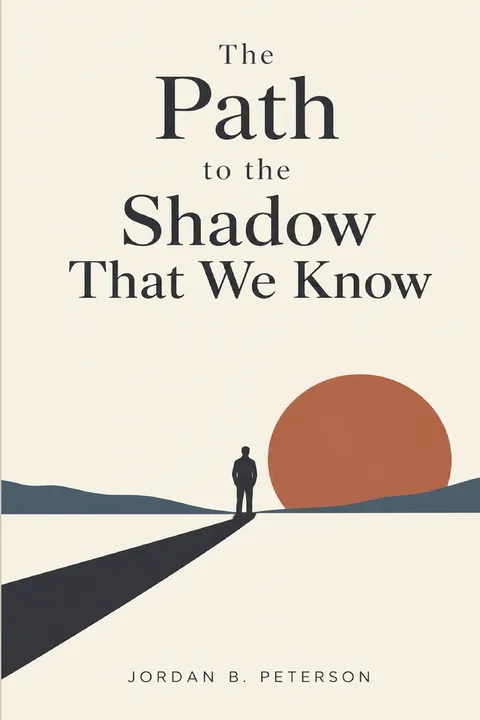
The Shadow that we know
Report an issue
Tell us what's wrong and we'll take a look.
Thanks – we got it. We'll review and follow up if needed.
How much of ourselves can we truly know-and how much remains beyond our understanding?
We encounter ourselves through our actions, our thoughts, our relationships, and the impressions we leave upon others. Yet no single experience can fully disclose the nature of a living being.
The Path to the Shadow That We Know investigates the relationship between the observable self and those aspects of existence that remain only partially understood.
Through an exploration of the material self, transcendental spiritual qualities, and the energy through which a living being acts upon the world, Jordan B. Peterson develops a philosophical account of the self as a unified existence whose meaning emerges through manifestation and recognition.
Central to the inquiry is the concept of reciprocal knowingness: the understanding that develops between a living being and the world through encounters, observations, and responses.
The book examines the shadow not simply as something dark or undesirable, but as a representation of the limits of what we know-about ourselves, about others, and about the qualities that have not yet been manifested.
How does a living being come to recognize itself? Can another observer know aspects of us that remain hidden from our own understanding? And what does it mean to exist as a whole being when no observer possesses a complete account of that existence?
The Path to the Shadow That We Know invites readers into a sustained philosophical examination of identity, recognition, spiritual existence, and the relationship between what is manifested and what remains unknown.
To understand the shadow is not necessarily to escape it, but to question what we believe we know about the being that casts it.
Jordan B Peterson
Jordan B. Peterson is Professor Emeritus of Psychology at the University of Toronto. Peterson received his B.A. in political science at the University of Alberta and Ph.D. in clinical psychology from McGill University. He remained at McGill as a post-doctoral fellow from 1991 to 1993 before moving to Harvard University, where he became Associate Professor of Psychology and was nominated for the Levinson Teaching Prize. In 1998, he moved back to Canada as a faculty member in the psychology department at the University of Toronto.
More by Jordan B Peterson






Why Readwise Books?
Readwise Books is an ebook & audiobook platform that automatically logs how much you and your friends read, making it fun and easy to read more. Learn more →