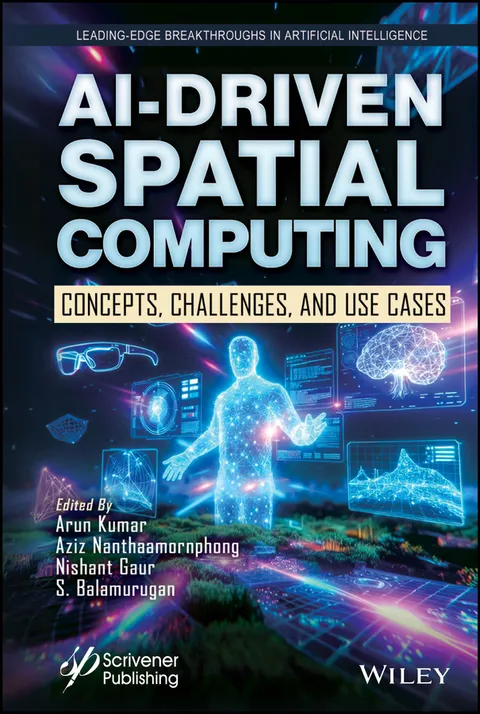
AI-Driven Spatial Computing
Concepts, Challenges, and Use Cases
Report an issue
Tell us what's wrong and we'll take a look.
Thanks – we got it. We'll review and follow up if needed.
Discover how the fusion of real-time adaptive AI and spatial computing is redefining Industry 5.0, giving you the exact technical frameworks and actionable strategies needed to lead the next era of human-machine innovation.
Industries are increasingly leveraging automation and cutting-edge innovations to streamline operations and meet evolving demands. Today, Industry 5.0 emphasizes collaboration between humans and machines, enabling greater creativity, customization, and innovation. This volume explores a significant advancement in artificial intelligence: adaptive, AI-driven systems capable of learning and evolving in real time. Unlike traditional AI, which relies on static data and predefined models, adaptive AI responds dynamically to changing conditions, making it especially valuable in complex, unpredictable environments. This book explores the transformative fusion of artificial intelligence with spatial computing technologies, providing a comprehensive understanding of how intelligent systems interpret, interact with, and simulate physical environments. It presents a cohesive framework that demonstrates how AI augments spatial awareness and decision-making in complex, dynamic settings, delving into critical technical and ethical issues that arise from integrating AI into spatial systems. These include concerns about data privacy and surveillance, algorithmic bias in location-based services, the computational complexity of real-time 3D perception, and the lack of standardized platforms for interoperability across spatial devices. The text also examines infrastructure constraints such as bandwidth limitations, latency in edge processing, and the security vulnerabilities of AI-driven spatial networks. Each case study illustrates the tangible benefits of spatial intelligence, providing readers with actionable insights into emerging opportunities and strategic implementations in this rapidly evolving field.
Readers will find the volume:
- Serves as a pioneering resource at the intersection of artificial intelligence and spatial technologies;
- Provides a timely synthesis of how AI techniques can enhance spatial awareness, decision-making, and interactivity in physical and virtual environments;
- Contributes to the maturation of spatial computing as an AI-augmented field, bringing together geoinformatics, robotics, and data science;
- Emphasizes technological integration and methodological and ethical frameworks needed for sustainable innovation.
Audience
Engineers, research scholars and students, IT professionals, network administrators, artificial intelligence and deep learning experts, and government research aagencies looking to the future AI applications.
Arun Kumar
Arun Kumar is an Assistant Professor of British Imperial, Colonial, and Post-Colonial History at the University of Nottingham. He is a historian of modern South Asian history (colonial India) with a deep interest in socio-economic history and the global history approach. He is also an Associate Editor for South Asian Studies, a journal of the British Association for South Asian Studies.


Why Readwise Books?
Readwise Books is an ebook & audiobook platform that automatically logs how much you and your friends read, making it fun and easy to read more. Learn more →