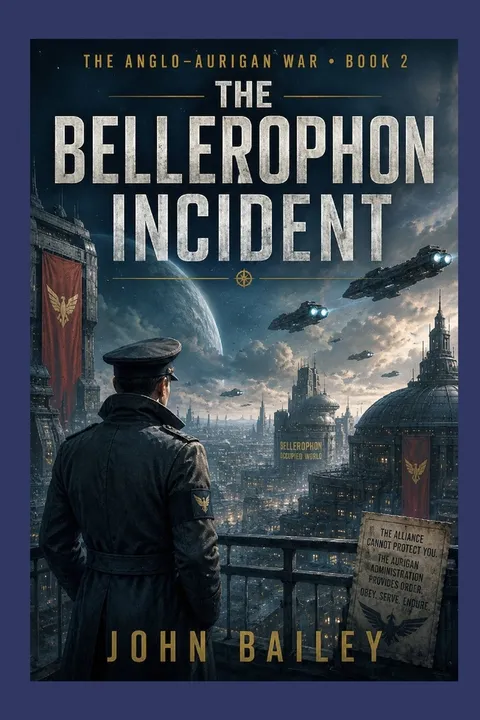
The Bellerephon Incident
Report an issue
Tell us what's wrong and we'll take a look.
Thanks – we got it. We'll review and follow up if needed.
It is Year 17 of the Anglo-Aurigan War. Convoy after convoy is vanishing from Allied supply routes-seven ships at a time, without warning, without wreckage. When intelligence analyst Dorothea Marsh overlays nine impossible loss events on a single star chart, every line points to one place: Bellerephon, a civilian world under Aurigan occupation.
A commando strike would announce exactly what the Admiralty knows. A conventional spy operation has failed six times already. What the mission requires is someone the Aurigans are not looking for-someone stepping into the identity of an enemy officer killed fourteen months ago in a transit accident, whose death was never recorded in Bellerephon's files.
That someone is Nathan Pritchard, a civilian astro-cartographer who has never carried a weapon in his life.
On an occupied world watched over by the meticulous Captain Viktor Stahl-a security officer with an uncanny talent for detecting deception-Nathan must master a dead man's identity, navigate a resistance movement fractured between urgency and caution, and locate an enemy installation capable of erasing entire convoys from space. Alongside him is Eliza Fairchild, a former schoolteacher whose quiet courage has kept the resistance alive through two years of occupation, and who understands that patience and precise timing are weapons as powerful as any fleet.
The window is closing. The convoys keep disappearing. And Stahl is beginning to notice that something about Lieutenant Gregor Weis does not quite add up.
The Bellerephon Incident is a taut, atmospheric thriller in the tradition of classic wartime espionage drama-reimagined among the stars. It is a story about impersonation under pressure, resistance under occupation, and the kind of courage that leaves no monuments behind.
John Bailey
John Bailey gained his PhD at Leicester University on Japanese Knotweed and its hybrids, co-supervised by Ann Conolly and Clive Stace, which established the cytological basis of the genus. He has since travelled extensively on knotweed research activities and speaking at conferences. With the aid of three PhD students, he took advantage of new DNA technologies to further elucidate population structure, evolution and phylogeny of the genus Reynoutria. He has contributed to more than 40 scientific papers on the subject and has a current h-index of 36.
More by John Bailey





Why Readwise Books?
Readwise Books is an ebook & audiobook platform that automatically logs how much you and your friends read, making it fun and easy to read more. Learn more →