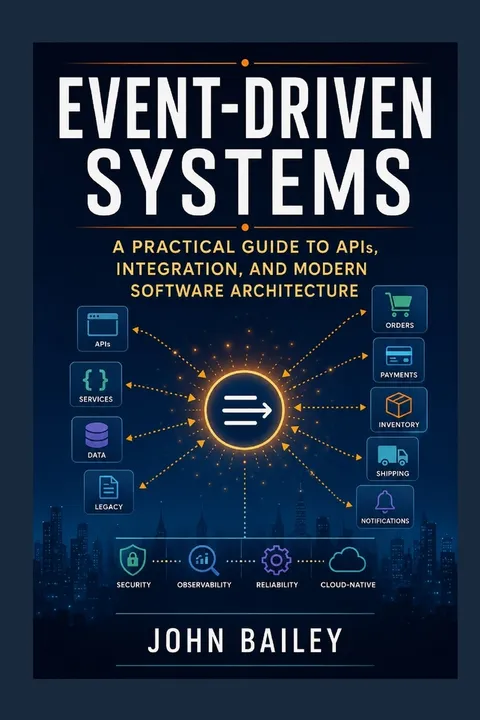
Event-Driven Systems
A Practical Guide to APIs, Integration, and Modern Software Architecture
Report an issue
Tell us what's wrong and we'll take a look.
Thanks – we got it. We'll review and follow up if needed.
Today's enterprise systems are composed of dozens-or even thousands-of services connected through APIs, event streams, message brokers, and cloud platforms. Understanding how these systems communicate is now an essential skill for software developers, infrastructure engineers, architects, Site Reliability Engineers (SREs), DevOps professionals, and IT leaders.
Event-Driven Systems provides a practical, architecture-first introduction to the technologies and design principles behind modern distributed applications. Rather than focusing on a specific programming language or cloud vendor, this book explains the enduring concepts that apply across today's software ecosystem.
Inside you'll learn how to:
- Understand Event-Driven Architecture (EDA) and when to use it
- Design clean, maintainable, and versioned APIs
- Build loosely coupled systems using events and messaging
- Choose between synchronous and asynchronous communication
- Apply proven Enterprise Integration Patterns
- Understand Kafka, RabbitMQ, cloud messaging, and event brokers conceptually
- Design resilient systems using retries, circuit breakers, timeouts, and bulkheads
- Implement observability with logs, metrics, tracing, SLOs, and error budgets
- Secure APIs and distributed services using modern authentication and authorization approaches
- Avoid common architectural anti-patterns that lead to distributed monoliths
- Connect architecture decisions to real business requirements
Written for experienced IT professionals entering modern software architecture, this book assumes familiarity with enterprise computing while requiring no prior experience with event-driven systems or microservices.
Whether you're a software engineer, platform engineer, systems administrator, infrastructure engineer, database professional, cloud architect, or technical manager, this guide will help you understand not just how modern systems work-but why they are designed the way they are.
Technology changes constantly.
Good architecture lasts.
John Bailey
John Bailey gained his PhD at Leicester University on Japanese Knotweed and its hybrids, co-supervised by Ann Conolly and Clive Stace, which established the cytological basis of the genus. He has since travelled extensively on knotweed research activities and speaking at conferences. With the aid of three PhD students, he took advantage of new DNA technologies to further elucidate population structure, evolution and phylogeny of the genus Reynoutria. He has contributed to more than 40 scientific papers on the subject and has a current h-index of 36.
More by John Bailey










Why Readwise Books?
Readwise Books is an ebook & audiobook platform that automatically logs how much you and your friends read, making it fun and easy to read more. Learn more →