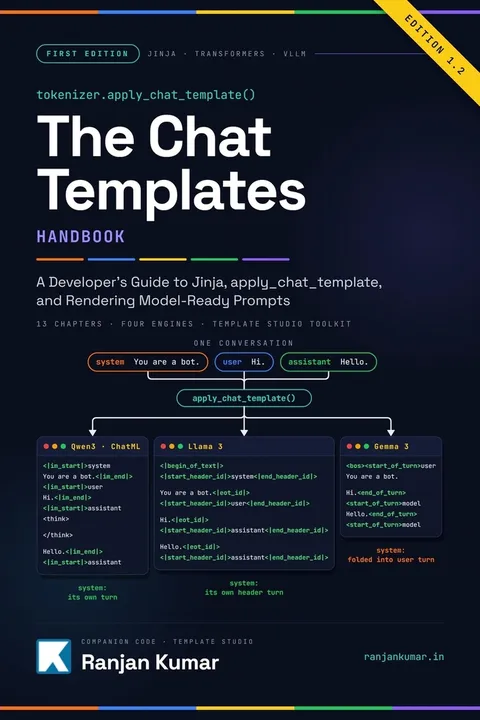
The Chat Templates Handbook
A Developer's Guide to Jinja, apply_chat_template, and Rendering Model-Ready Prompts
Report an issue
Tell us what's wrong and we'll take a look.
Thanks – we got it. We'll review and follow up if needed.
Your model passed every benchmark, then quietly got worse in production - and nothing in your logs says why.
The culprit is almost always the same invisible layer: the chat template, the code that turns your list of messages into the exact tokens the model was trained on. Get it wrong and the model still answers. It just answers worse, silently, with no error to chase. This book is about that layer, and how to make it correct, portable, tested, and safe.
WHY CHAT TEMPLATES MATTER MORE THAN EVER
Nearly every instruct model on Hugging Face ships a Jinja chat template. In Transformers, apply_chat_template() renders it; vLLM and SGLang render it on the server; llama.cpp runs its own copy embedded in the GGUF. As models gained tools, reasoning, and vision, that template grew from ten lines into a hundred-line program that breaks in new ways - and renders differently across engines. The role-tagged message list is the one stable contract underneath every modern LLM API. This book teaches you to render it correctly, everywhere.
NEW IN EDITION 1.2
Earlier printings tested the chat template as a rendered string. Edition 1.2 follows it down to the token IDs the model receives, on the engine you serve it from. A new chapter, The Template Behind the Endpoint, covers everything a server does between a request's JSON and those token IDs, with examples run against a live llama.cpp server. The chapters on authoring and training, tool calling, multimodal templates, and debugging have grown, and the errors in earlier printings are corrected.
WHAT YOU WILL LEARN
- Read and write Jinja chat templates, including the whitespace control that silently breaks tokenization
- Handle tool calling through a full agent loop: call IDs, parallel calls, MCP results, and the developer role
- Keep reasoning (thinking) history from quietly breaking the prefix cache
- Count what an image really costs in tokens after the processor expands its placeholder
- Train through your template with TRL, Axolotl, LLaMA-Factory, or Unsloth, and check it at the token level: round-trips, stop tokens, and the assistant mask
- Get the token IDs Transformers, llama.cpp, and vLLM actually send the model, and catch what the server changes, such as a doubled BOS token
- Debug broken templates and lock their behavior with golden-token tests that assert the serving engine's token IDs in CI
- Find and fix cross-engine differences between Transformers, vLLM, SGLang, and llama.cpp
- Defend against malicious templates - a real, documented inference-time attack surface
INSIDE THE BOOK
- Part I - Foundations: the gap between messages and tokens, the message model, just enough Jinja, and template anatomy across Llama, Qwen, and Gemma.
- Part II - The Hard Parts: tool-calling, reasoning, and multimodal templates, and authoring and training through your own.
- Part III - Production: cross-engine rendering, the template behind the endpoint, debugging, security, and a complete template toolkit you can drop into CI.
Thirteen chapters and six appendices, including a glossary of the book's sixteen named concepts, template reference cards, and an engine compatibility matrix.
WHO THIS BOOK IS FOR
- AI and backend engineers who ship LLM features and have used apply_chat_template()
- ML engineers fine-tuning open models who now own a chat template
- Platform and ML-infrastructure teams serving open models across multiple engines
Equal parts guide and reference, The Chat Templates Handbook turns the most overlooked layer in your LLM stack into one you can read, test, and trust. Every chapter leaves you with runnable code from Template Studio, the open-source toolkit built across the book.
Ranjan Kumar
Dr. Ranjan Kumar is a Professor in the Department of Physics at King Abdulaziz University, Jeddah, Kingdom of Saudi Arabia - on leave from Panjab University, Chandigarh, India. Dr. Kumar's field of specialization is theoretical condensed matter physics, and his research interests include: Fullerenes and carbon materials, Heusler alloys for spintronic applications, dilute magnetic semiconductors, electronic and thermoelectric properties of materials, and superconductors.
More by Ranjan Kumar



Why Readwise Books?
Readwise Books is an ebook & audiobook platform that automatically logs how much you and your friends read, making it fun and easy to read more. Learn more →