Report an issue
Tell us what's wrong and we'll take a look.
Thanks – we got it. We'll review and follow up if needed.
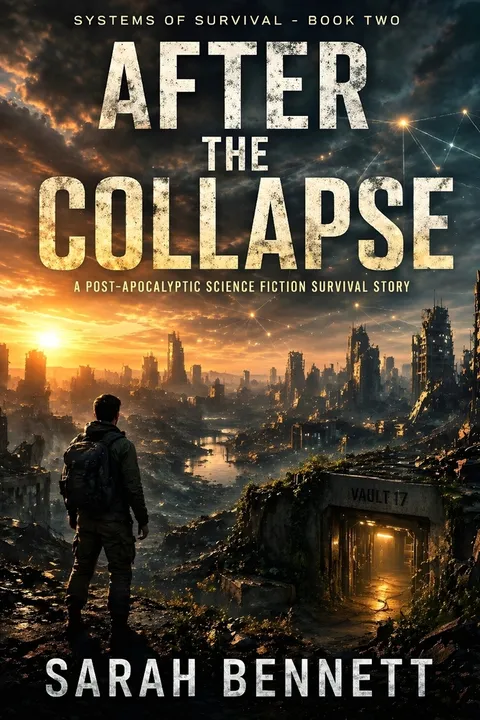
Years after cascading satellite failures, cyberwar retaliation, and global grid collapse destroyed the connected world, scattered settlements survive on salvaged turbines, rationed batteries, and the stubborn refusal to give up.
Marcus Hale was a systems engineer who helped maintain the orbital infrastructure before it failed. Now he fixes wind turbines in a settlement called Windfall, carrying guilt for the vulnerabilities he identified and never repaired. When a scavenging run into a dead city uncovers a sealed underground data vault, Marcus discovers intact schematics for a distributed communication network, a mesh system designed to reconnect settlements without the centralised control that caused the collapse.
The blueprints include his own pre-collapse design work. Someone completed his theoretical framework after the fall. Someone sealed it in the dark and walked away.
Rebuilding connectivity could restore medicine, agriculture forecasting, and coordinated climate response. It could save thousands of lives. But it could also attract the attention of the Iron Covenant, a militant movement that believes technological infrastructure caused the extinction cascades and must never be rebuilt. And the Opportunist traders who see the schematics as the most valuable commodity since the collapse.
Marcus faces an impossible choice: destroy the vault and preserve fragmentation, or activate a system that could unite a broken world, or ignite a war over who controls it.
With a fortified militia closing in, a fractured settlement behind him, and the blood of an ally on his hands, Marcus must decide whether the tools that failed humanity deserve a second chance, and whether the safeguards he builds into the system are enough to prevent history from repeating.
After the Collapse is a grounded, high-tension dystopian science fiction novel about rebuilding versus repeating, decentralised governance versus authoritarian control, and whether infrastructure empowers or dominates, depending not on architecture, but on who holds the keys.
Book 2 in The Systems of Survival series. Each book stands alone.
For readers who loved the political tension of Station Eleven, the survival engineering of The Martian, and the systemic worldbuilding of The Ministry for the Future.
Sarah Bennett
Sarah Bennett has written for the internet, television, a monthly sketch comedy show at the Upright Citizens Brigade Theater in New York, and the arts section of her high school paper. She's also written two New York Times bestselling books of advice with her father. Mostly, Sarah walks her dog, watches Red Sox games, and enjoys being too old to care that much about most things.
More by Sarah Bennett












Why Readwise Books?
Readwise Books is an ebook & audiobook platform that automatically logs how much you and your friends read, making it fun and easy to read more. Learn more →