Report an issue
Tell us what's wrong and we'll take a look.
Thanks – we got it. We'll review and follow up if needed.
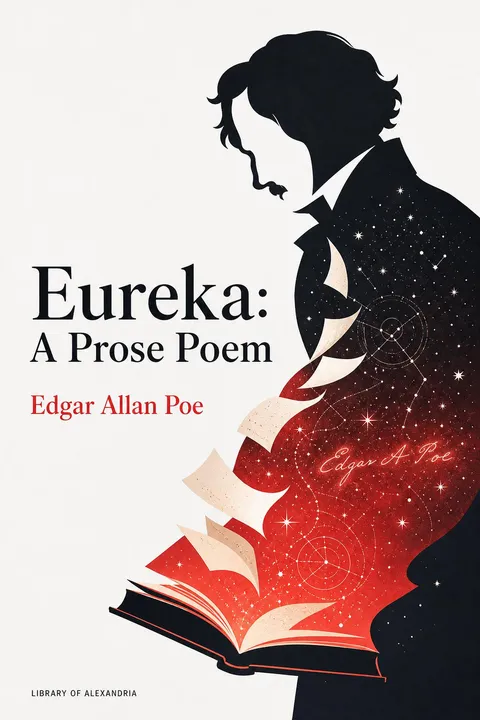
What if the universe's countless stars and atoms were expressions of a single unity? Edgar Allan Poe makes that question the starting point for a daring journey through matter, spirit, and existence.
Published in 1848, Eureka: A Prose Poem brings Poe's literary imagination to questions usually reserved for science and philosophy. Drawing on Newtonian physics, intuition, and theological speculation, he proposes a universe that emerges from a single divine source and eventually returns to oneness. Gravity, cosmic order, and the relationship between the individual and the whole become parts of one sweeping argument.
This is neither a conventional poem nor a textbook of established science. It is a nineteenth-century speculative essay written with poetic intensity: an attempt to understand the cosmos through both reasoning and imaginative insight. Its lasting fascination lies in the encounter between a distinctive literary mind and questions that remain compelling today-why anything exists, how matter is connected, and where human consciousness belongs in the universe.
What readers find inside:
- Cosmic origins - Poe imagines the diversity of matter arising from an original unity.
- Attraction and return - Gravity plays a central role in his account of the universe's eventual reunion.
- Science and intuition - Empirical ideas meet a sustained defense of imaginative insight.
- Matter and spirit - Physical existence and divine purpose are treated as intertwined questions.
- Poetic argument - Expansive prose gives abstract ideas an emotional and visionary force.
For readers exploring Poe beyond his fiction, lovers of philosophical literature, and anyone interested in the history of cosmological ideas, this work offers an absorbing encounter with a writer thinking on the largest possible scale.
Enter Poe's imagined cosmos and consider what it might mean for all existence to share one source.
Edgar Allan Poe
Edgar Allan Poe (1809–1849) was an American writer, poet, and critic. Best known for his macabre prose work, including the short story “The Tell-Tale Heart,” his writing has influenced literature in the United States and around the world.
More by Edgar Allan Poe


Why Readwise Books?
Readwise Books is an ebook & audiobook platform that automatically logs how much you and your friends read, making it fun and easy to read more. Learn more →