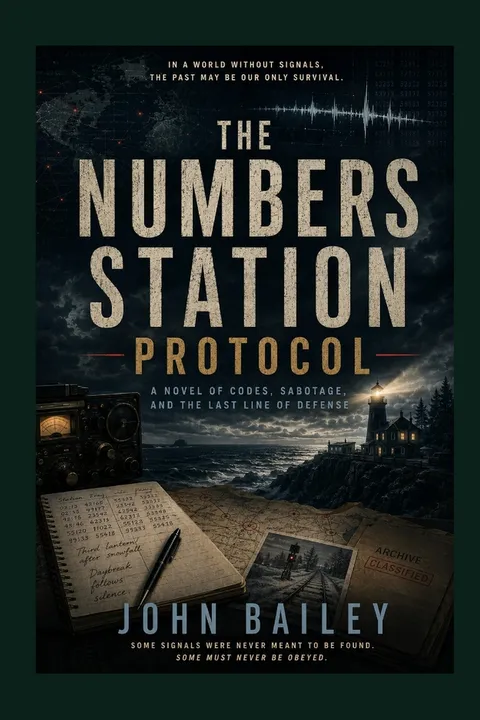
The Numbers Station Protocol
Report an issue
Tell us what's wrong and we'll take a look.
Thanks – we got it. We'll review and follow up if needed.
A retired shortwave hobbyist in rural Pennsylvania, Finch has been listening to the frequencies for forty years. What he catches one November night is not a hoax and not a ghost - it is a numbers station unlike any on record: no repetition, layered tones, and weather phrases that predict freight disasters twelve hours before they happen.
When Colonel Rebecca Vale - a marginalized Cold War signals expert running an underfunded archival unit out of a neglected government bunker - receives Finch's recordings, she recognizes something that should not exist: a Soviet naval meteorological cipher, last documented in 1987, running live and fully operational inside a network no modern surveillance system is designed to watch. Because modern surveillance abandoned shortwave decades ago.
Vale assembles an unconventional team: a retired merchant marine radio operator, a cryptographic historian, a rural direction-finding champion, a logistics analyst with a gift for cascade mathematics, and a former freight rail specialist who can read a junction failure the way a doctor reads a patient's chart. Together, in a bunker that smells like 1974, they begin to trace a network forty years in the building - a network that operates entirely in the analog margins of a digital world, moves through abandoned freight corridors, and speaks in one-time pads distributed before most of them were born.
What they find beneath the operational threat changes everything: a forgotten Cold War doctrine, authorized by both sides, designed as mutual deterrence - and the long silence that followed when one side remembered and the other forgot.
The Numbers Station Protocol is an espionage thriller in the tradition of le Carré and Clancy - procedural, atmospheric, morally serious, and grounded in the conviction that the most dangerous threats are the ones we stopped watching for.
John Bailey
John Bailey gained his PhD at Leicester University on Japanese Knotweed and its hybrids, co-supervised by Ann Conolly and Clive Stace, which established the cytological basis of the genus. He has since travelled extensively on knotweed research activities and speaking at conferences. With the aid of three PhD students, he took advantage of new DNA technologies to further elucidate population structure, evolution and phylogeny of the genus Reynoutria. He has contributed to more than 40 scientific papers on the subject and has a current h-index of 36.
More by John Bailey








Why Readwise Books?
Readwise Books is an ebook & audiobook platform that automatically logs how much you and your friends read, making it fun and easy to read more. Learn more →