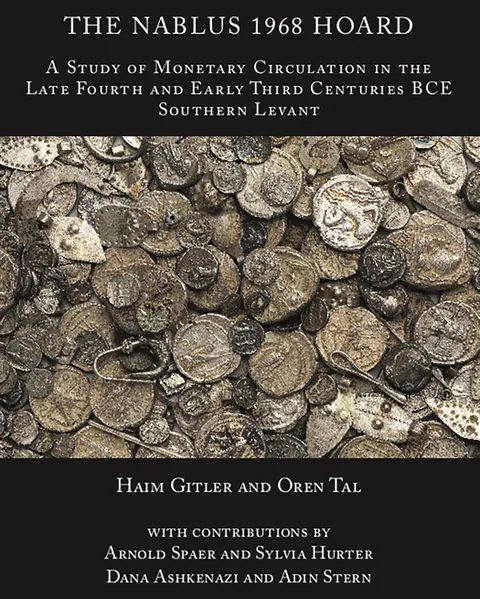
The Nablus 1968 Hoard
A Study of Monetary Circulation in the Late Fourth an Early Third Centuries Bce Southern Levant
Report an issue
Tell us what's wrong and we'll take a look.
Thanks – we got it. We'll review and follow up if needed.
The Nablus 1968 Hoard is the largest late Persian/early Hellenistic period coin and jewelry hoard recorded from the southern Levant and the largest known hoarded assemblage of Samarian coins. This study provides a detailed catalogue of all the coins and pieces of jewelry the authors managed to record. In addition, the authors discuss the hoard and its context, its burial date, a synopsis of the history and archaeology of the Persian period province of Samaria, a discussion on the hoard's Phoenician, Samarian, Athenian-styled, Philistian, and Yehud coins, Athenian tetradrachms and the few overseas Greek and Cypriot issues belonging to the hoard. The commentary chapter is followed by detailed archaeometallurgical studies on selected Samarian and Athenian-style coins and selected pieces of jewelry. There are also appendixes There are also two appendixes, one presenting a method for determining dies links and the second offering a glossary of relevant terms. The hoard's composition reflects the monetary circulation of the late fourth and early third centuries BCE southern Levant.
Oren Tal
Oren Tal is Professor of Classical Archaeology at Tel Aviv University, specializing in the archaeology of the classical and medieval Near East. He has been codirector of the German-Israeli Tell Iẓṭabba Excavation Project since 2019 and director of the Apollonia-Arsuf Excavation Project since 2007 and has excavated many other sites in Israel.
More by Oren Tal


Why Readwise Books?
Readwise Books is an ebook & audiobook platform that automatically logs how much you and your friends read, making it fun and easy to read more. Learn more →