The Merry Men
Report an issue
Tell us what's wrong and we'll take a look.
Thanks – we got it. We'll review and follow up if needed.
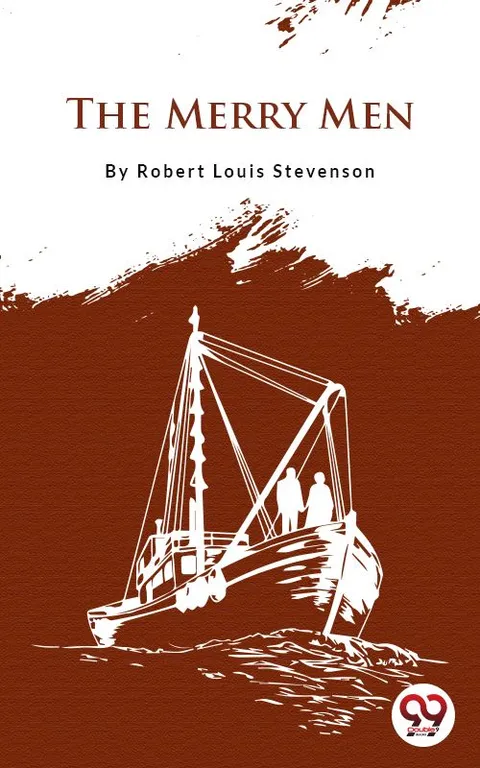

The narrator, Charles Darnaway, a recent graduate of the University of Edinburgh travels to the remote island of Aros off the north-west coast of Scotland. Aros is the home of his uncle, Gordon Darnaway, a hard-hearted and alcoholic Presbyterian. Charles has come in search of sunken treasure, as he believes a ship of the Spanish Armada sank in the bay under his uncle's home long before. Charles hopes to use the treasure to restore the Darnaways' fortunes and marry Gordon's daughter (and Charles' cousin) Mary Ellen. Charles is rowed out to the promontory by the only other inhabitant, Gordon's servant Rorie. Charles is surprised to find both Rorie and Gordon anxious and full of foreboding, though both furtively evade his questions. He is further surprised to find his uncle's austere home decorated with expensive lamps and rugs. He realizes at once they must have come from a shipwreck, and feels uneasy about this looting of the dead. His cousin Mary Ellen confirms that a ship was recently cast away nearby, having been driven by a storm into the dreadful breakers around the promontory, breakers that roar a hundred feet high around the rocks and are called "the Merry Men" due to the vast noise they make, like shrieking laughter. Charles goes down to the shore on his treasure-hunt. While there he sees the shattered hull of the wrecked ship, and also a fresh grave. He realizes the grave must be for the body of a mariner washed ashore. He takes this as a bad omen, but still sets out to the point where he thinks the Spanish ship must be. His first dive locates a weed-grown structure which appears to be the sunken ship, but a second dive shows it to be only a rock formation. He hauls himself along the weed-grown rocks, looking for signs of the wreck, until the signs of an approaching storm warn him to return to shore. As he makes for the surface his handhold breaks off in his grip; when he pulls himself on shore he looks at it and is horrified to recognize a human leg bone. He lays the bone on the sand, resolving to do no more hunting for the wreck.
Robert Louis Stevenson
Robert Louis Stevenson was born in Edinburgh in 1850, the only son of an engineer, Thomas Stevenson. Despite a lifetime of poor health, Stevenson was a keen traveller, and his first book An Inland Voyage (1878) recounted a canoe tour of France and Belgium. In 1880, he married an American divorcee, Fanny Osbourne, and there followed Stevenson's most productive period, in which he wrote, amongst other books, Treasure Island (1883), The Strange Case of Dr Jekyll and Mr Hyde, and Kidnapped (both 1886). In 1888, Stevenson left Britain in search of a more salubrious climate, settling in Samoa, where he died in 1894.
More by Robert Louis Stevenson


Why Readwise Books?
Readwise Books is an ebook & audiobook platform that automatically logs how much you and your friends read, making it fun and easy to read more. Learn more →