
J.S. Bach - Volume 1
Report an issue
Tell us what's wrong and we'll take a look.
Thanks – we got it. We'll review and follow up if needed.

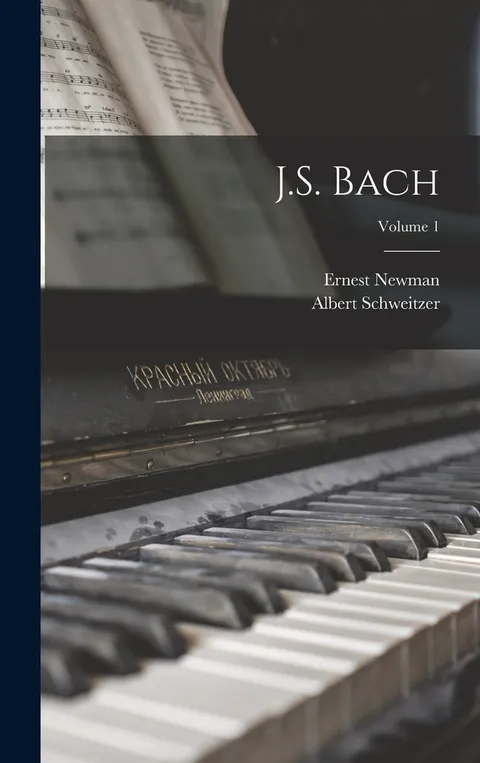
A fantastic little book about Bach and the musical climate before and during his life, with a look at his continuing influence in music. Many of the earliest books, particularly those dating back to the 1900s and before, are now extremely scarce and increasingly expensive. We are republishing these classic works in affordable, high quality, modern editions, using the original text and artwork.
Albert Schweitzer
Albert Schweitzer, OM (14 January 1875 – 4 September 1965) was a German—and later French—theologian, organist, philosopher, physician, and medical missionary in Africa, also known for his interpretive life of Jesus. He was born in the province of Alsace-Lorraine, at that time part of the German Empire. He considered himself French and wrote in French. Schweitzer, a Lutheran, challenged both the secular view of Jesus as depicted by historical-critical methodology current at his time in certain academic circles, as well as the traditional Christian view. He received the 1952 Nobel Peace Prize for his philosophy of “Reverence for Life”, expressed in many ways, but most famously in founding and sustaining the Albert Schweitzer Hospital in Lambaréné, now in Gabon, west central Africa (then French Equatorial Africa). As a music scholar and organist, he studied the music of German composer Johann Sebastian Bach and influenced the Organ reform movement (Orgelbewegung).
More by Albert Schweitzer














Why Readwise Books?
Readwise Books is an ebook & audiobook platform that automatically logs how much you and your friends read, making it fun and easy to read more. Learn more →