Report an issue
Tell us what's wrong and we'll take a look.
Thanks – we got it. We'll review and follow up if needed.
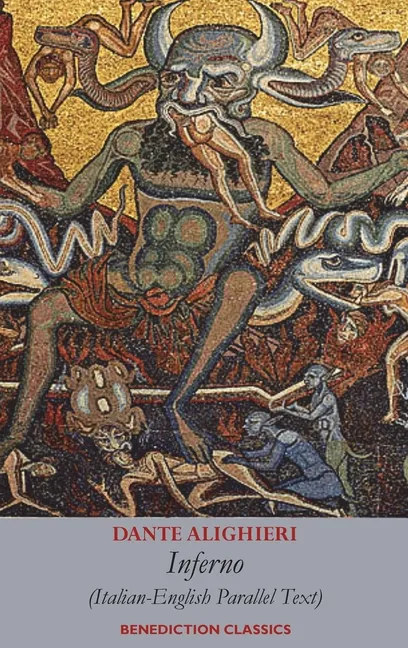
A unique parallel edition of Dante's Inferno with Dante's Italian and Longfellow's celebrated poetic translation on facing pages.
"Dante and Shakespeare divide the modern world between them. There is no third." - T. S. Eliot
"Dante's poem is, for many, the greatest single work of Western literature." - Ian Thompson.
"I love my Dante as much as the Bible. He is my spiritual food, the rest is ballast." - James Joyce.
In the middle of our life's journey, I found myself in a dark wood/Bewildered, and I knew I had lost the way: so opens Dante's Divine Comedy, "the best book literature has achieved" as Jorge Luis Borges writes.
Dante's Inferno, one of the greatest works of European literature, and "the most original and audacious treatment of the afterlife in Western literature" dazzles with its vivid and inventive storytelling and imagery. However, it contains much more than poetry and theology; it displays Dante's wide and comprehensive learning, and his deep understanding of contemporary politics and society. "All life is contained in the poem, for Dante's was an all-encompassing imagination, that interwove classical philosophy with Catholic doctrine and contemporary politics," (Ian Thompson).
The thirty-three cantos of Inferno follow Dante, as, guided by the epic poet, Virgil, he travels through the nine descending circles of a freezing Hell, until he meets Satan trapped at the bottom. The Inferno is the most gripping and engaging book of The Divine Comedy, as Dante meets those damned for forbidden love, and all manner of human vices. (The damned, amusingly, include many of Dante's enemies!) Inferno is the logical conclusion of all that is worst in human life. It is bearable only because Dante eventually emerges.
The Divine Comedy was written over a period of twenty years towards the end of Dante's life. It was appreciated as a masterpiece soon after its completion, and it has captivated both readers and the Western imagination ever since.
Dante's Inferno is the most widely translated book after the Bible. This edition is translated by the celebrated poet, Henry Wadsworth Longfellow. This dual-language Italian-English edition will be enjoyable for those who'd like to read Dante's Inferno in either English or Italian, while dipping into the other language to deepen pleasure or comprehension. Ideal for lovers of Dante.
Dante Alighieri, (1265-1321) was an Italian poet, prose writer, literary critic, philosopher, and political thinker and adviser. He is regarded as the greatest Italian writer. As one of the earliest forerunners of the Renaissance, predating Chaucer, he set the stage for the explosion of creativity that was to follow. Dante is best known for The Divine Comedy, which remains the greatest work of Italian literature.
Dante
Dante was born in Florence, Italy, in 1265. Heir of a poor but noble family, he was one of the seven elected officials in charge of the government of Florence. Civil war was common in Florence at the time and the issues were further complicated by the question of Papal influence. In 1300, Dante along with his fellow magistrates confirmed anti-papal measures. When in 1302, the French prince acting under orders from the Pope captured power in Florence, Dante was sentenced on charges of corruption and opposition to the Church and exiled from Florence on pain of execution by burning if he ever returned. He spent the rest of his life in exile, pining for his native city. He withdrew from active politics to a large extent and concentrated on his literary creations.
We do not know exactly when Dante began work on The Divine Comedy. He had been moving about from court to court after his exile and 1n 1317 had settled at Ravenna, where he completed his great work. Extant correspondence shows that the first and second parts of The Divine Comedy, the "Inferno" and the "Purgatario" were generally known around 1319. The last part, the "Paradiso" was completed only in 1321. Dante died at Ravenna on 14 September 1321 and the last thirteen Cantos of the "Paradiso" were published posthumously.
More by Dante
Henry Wadsworth Longfellow
Translated by
Henry Wadsworth Longfellow (1807-1882) was the most popular and admired American poet of the nineteenth century. Known for his narrative historical and mythic poems, his most famous works include Evangeline, The Song of Hiawatha, The Courtship of Miles Standish, and Tales of Wayside Inn. Versatile as well as prolific, Longfellow also won fame as a writer of short ballads and lyrics, and experimented in the essay, the short story, the novel, and the verse drama.


Why Readwise Books?
Readwise Books is an ebook & audiobook platform that automatically logs how much you and your friends read, making it fun and easy to read more. Learn more →